QUESTION IMAGE
Question
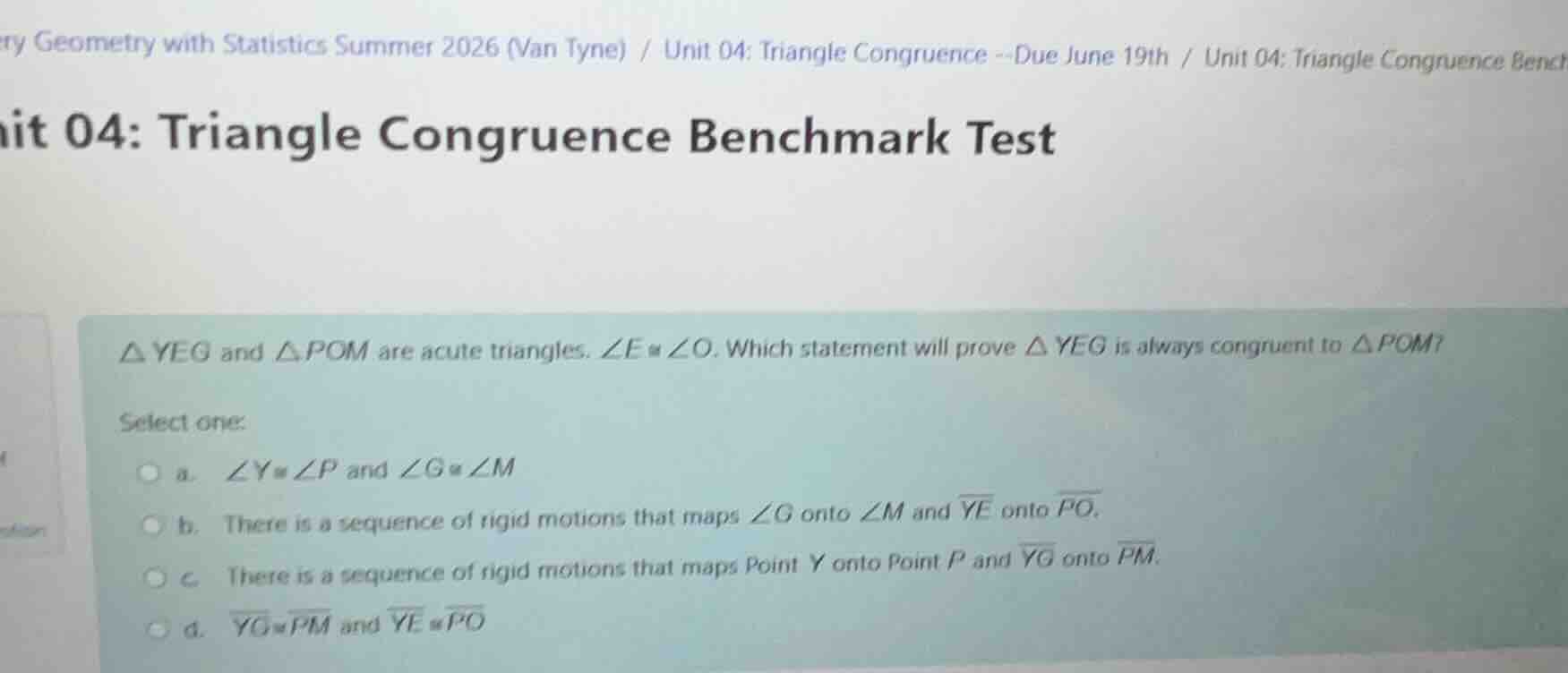
\\(\delta yeg\\) and \\(\delta pom\\) are acute triangles. \\(\angle e \cong \angle o\\). which statement will prove \\(\delta yeg\\) is always congruent to \\(\delta pom\\)?
select one:
a. \\(\angle y \cong \angle p\\) and \\(\angle g \cong \angle m\\)
b. there is a sequence of rigid motions that maps \\(\angle g\\) onto \\(\angle m\\) and \\(\overline{ye}\\) onto \\(\overline{po}\\).
c. there is a sequence of rigid motions that maps point \\(y\\) onto point \\(p\\) and \\(\overline{yg}\\) onto \\(\overline{pm}\\).
d. \\(\overline{yg} \cong \overline{pm}\\) and \\(\overline{ye} \cong \overline{po}\\)
⚡ Using what you learned: congruence criteria for triangles (sss, sas, asa, aas, hl)
Step 1: Analyze the given information
We are given two acute triangles, \(\Delta YEG\) and \(\Delta POM\), with one pair of congruent corresponding angles:
We need to find which statement guarantees that \(\Delta YEG \cong \Delta POM\).
Step 2: Evaluate the options
- Option a: \(\angle Y \cong \angle P\) and \(\angle G \cong \angle M\)
This gives us three pairs of congruent angles (AAA). AAA shows similarity, not necessarily congruence.
- Option b: There is a sequence of rigid motions that maps \(\angle G\) onto \(\angle M\) and \(\overline{YE}\) onto \(\overline{PO}\).
Rigid motions preserve angle measures and segment lengths. This implies:
Combined with the given \(\angle E \cong \angle O\), we have:
- Angle: \(\angle G \cong \angle M\)
- Angle: \(\angle E \cong \angle O\)
- Non-included Side: \(\overline{YE} \cong \overline{PO}\)
This satisfies the Angle-Angle-Side (AAS) congruence criterion, which proves \(\Delta YEG \cong \Delta POM\).
- Option c: There is a sequence of rigid motions that maps Point \(Y\) onto Point \(P\) and \(\overline{YG}\) onto \(\overline{PM}\).
This only establishes \(\overline{YG} \cong \overline{PM}\). Combined with \(\angle E \cong \angle O\), we have Side-Angle (SSA), which is not a valid congruence criterion.
- Option d: \(\overline{YG} \cong \overline{PM}\) and \(\overline{YE} \cong \overline{PO}\)
Combined with \(\angle E \cong \angle O\), this gives Side-Side-Angle (SSA) using the non-included angle \(\angle E\) and \(\angle O\). SSA does not guarantee congruence.

Snap & solve any problem in the app
Get step-by-step solutions on Sovi AI
Photo-based solutions with guided steps
Explore more problems and detailed explanations
b. There is a sequence of rigid motions that maps \(\angle G\) onto \(\angle M\) and \(\overline{YE}\) onto \(\overline{PO}\).