QUESTION IMAGE
Question
activity - comparing non-linear functions
activity
value: 1
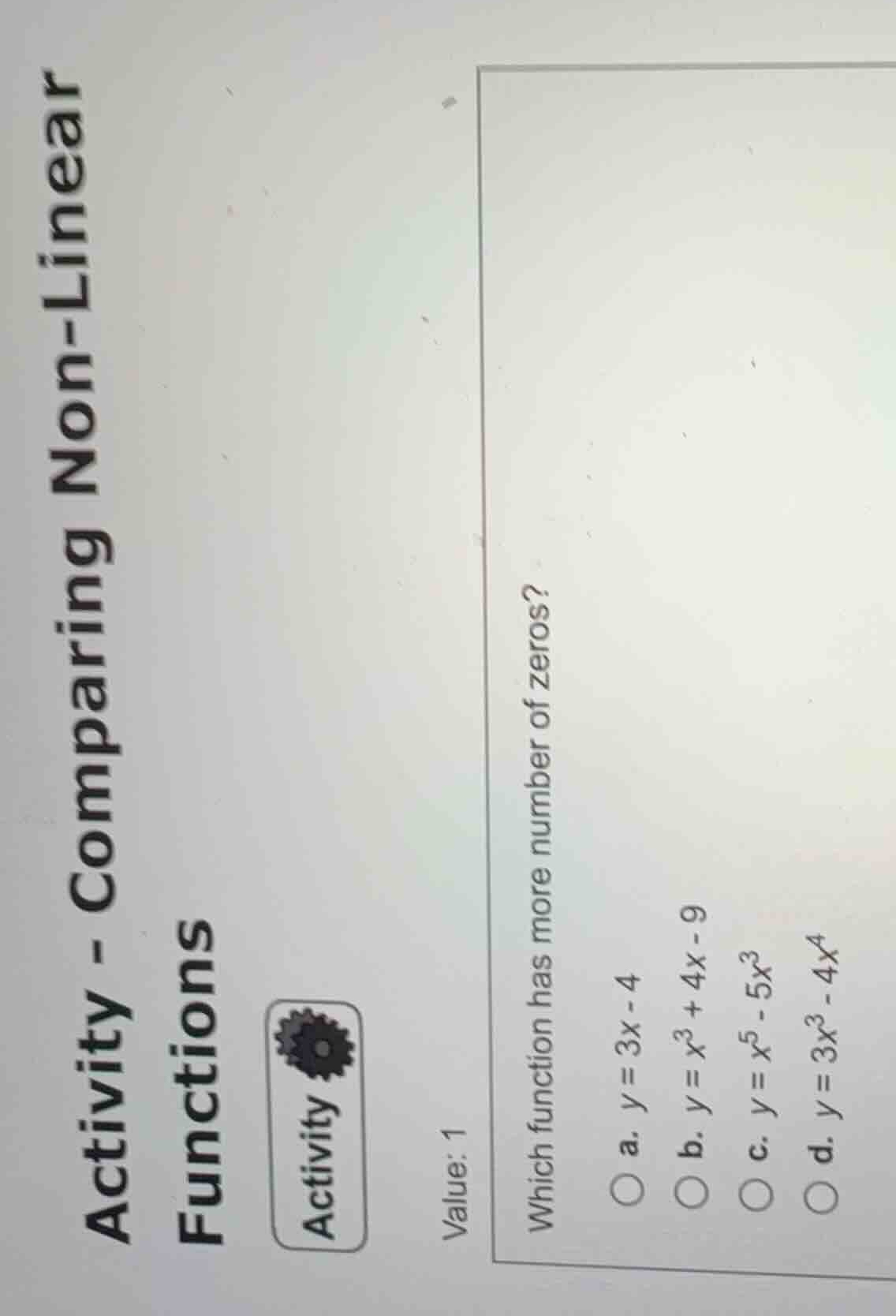
which function has more number of zeros?
a. \\(y = 3x - 4\\)
b. \\(y = x^3 + 4x - 9\\)
c. \\(y = x^5 - 5x^3\\)
d. \\(y = 3x^3 - 4x^4\\)
Analyze the degree of each polynomial function
The maximum number of real zeros a polynomial function can have is equal to its degree.
- Option a: \(y = 3x - 4\) (Degree 1, maximum 1 zero)
- Option b: \(y = x^3 + 4x - 9\) (Degree 3, maximum 3 zeros)
- Option c: \(y = x^5 - 5x^3\) (Degree 5, maximum 5 zeros)
- Option d: \(y = 3x^3 - 4x^4\) (Degree 4, maximum 4 zeros)
Determine the actual number of real zeros for each function
- Option a: \(3x - 4 = 0 \implies x = \frac{4}{3}\) (Exactly 1 real zero)
- Option b: \(y = x^3 + 4x - 9\). Since \(y' = 3x^2 + 4 > 0\), the function is strictly increasing. It has exactly 1 real zero.
- Option c: \(x^5 - 5x^3 = 0 \implies x^3(x^2 - 5) = 0 \implies x = 0, \pm\sqrt{5}\) (Exactly 3 distinct real zeros)
- Option d: \(3x^3 - 4x^4 = 0 \implies x^3(3 - 4x) = 0 \implies x = 0, \frac{3}{4}\) (Exactly 2 distinct real zeros)
Compare the number of zeros
Comparing the number of distinct real zeros:
- Option a: 1 zero
- Option b: 1 zero
- Option c: 3 zeros
- Option d: 2 zeros
Thus, the function with the most zeros is \(y = x^5 - 5x^3\).

Snap & solve any problem in the app
Get step-by-step solutions on Sovi AI
Photo-based solutions with guided steps
Explore more problems and detailed explanations
- a. \(y = 3x - 4\)
- b. \(y = x^3 + 4x - 9\)
- c. \(y = x^5 - 5x^3\) (Correct answer)
- d. \(y = 3x^3 - 4x^4\)