QUESTION IMAGE
Question
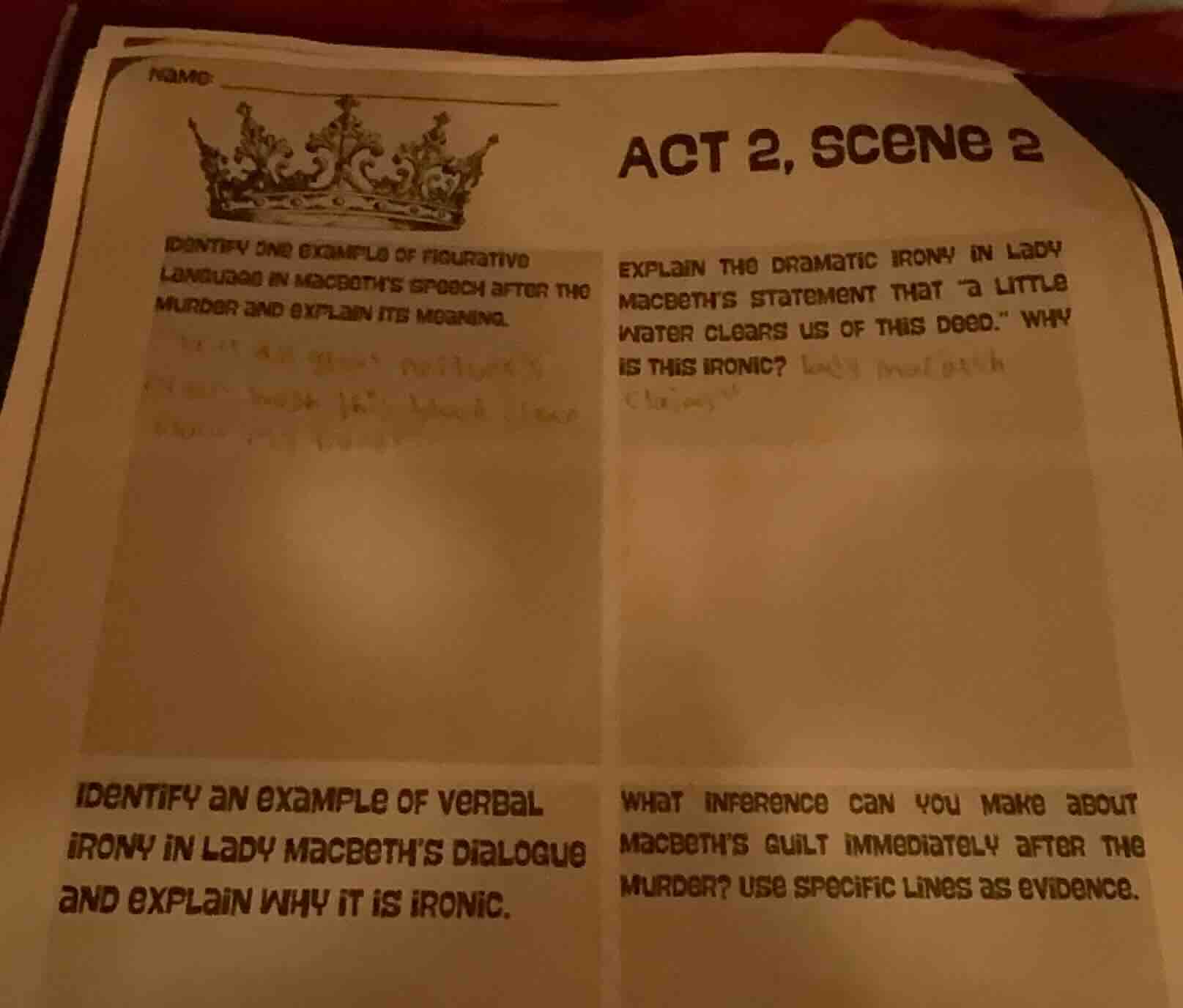
act 2, scene 2
identify one example of figurative language in macbeths speech after the murder and explain its meaning.
explain the dramatic irony in lady macbeths statement that \a little water clears us of this deed.\ why is this ironic?
identify an example of verbal irony in lady macbeths dialogue and explain why it is ironic.
what inference can you make about macbeths guilt immediately after the murder? use specific lines as evidence.
Figurative Language in Macbeth's Speech
- Example: "Will all great Neptune's ocean wash this blood clean from my hand? No, this my hand will rather the multitudinous seas incarnadine, making the green one red."
- Meaning: Macbeth uses hyperbole and metaphor to express that his guilt is so immense that instead of water cleansing his hands, his bloody hands will stain the entire ocean red.
Dramatic Irony in Lady Macbeth's Statement
- Statement: "A little water clears us of this deed."
- Irony: It is dramatically ironic because the audience knows that water cannot wash away their psychological guilt. Later in the play (Act 5), Lady Macbeth is driven mad by guilt, sleepwalking and desperately trying to wash imaginary bloodstains from her hands ("Out, damned spot!").
Verbal Irony in Lady Macbeth's Dialogue
- Example: "My hands are of your colour; but I shame to wear a heart so white."
- Irony: She mockingly equates her physical involvement with Macbeth's but calls him a coward ("white heart"). It is verbally ironic because she plays down the horror of the murder as a simple physical act, yet her subsequent descent into madness reveals she is deeply affected.
Inference About Macbeth's Guilt
- Inference: Macbeth is instantly consumed by overwhelming, paralyzing guilt and regret.
- Evidence: "Methought I heard a voice cry 'Sleep no more! Macbeth does murder sleep'" and "To know my deed, 'twere best not know myself."

Snap & solve any problem in the app
Get step-by-step solutions on Sovi AI
Photo-based solutions with guided steps
Explore more problems and detailed explanations
Question 1
- Figurative Language: "Will all great Neptune's ocean wash this blood clean from my hand? No, this my hand will rather the multitudinous seas incarnadine, making the green one red."
- Meaning: Macbeth uses hyperbole to show that his guilt is so vast it would stain the entire ocean red rather than be washed away.
Question 2
- Dramatic Irony: Lady Macbeth claims "a little water" easily washes away the crime. This is ironic because the audience later sees her driven mad by guilt, unable to wash the imaginary blood from her hands in Act 5.
Question 3
- Verbal Irony: Lady Macbeth says, "My hands are of your colour; but I shame to wear a heart so white." She minimizes the horror of the murder by calling Macbeth a coward, despite the fact that the deed will ultimately destroy her own mental stability.
Question 4
- Inference: Macbeth feels immediate, profound guilt and psychological torment.
- Evidence: "Methought I heard a voice cry 'Sleep no more!'" and "To know my deed, 'twere best not know myself."