QUESTION IMAGE
Question
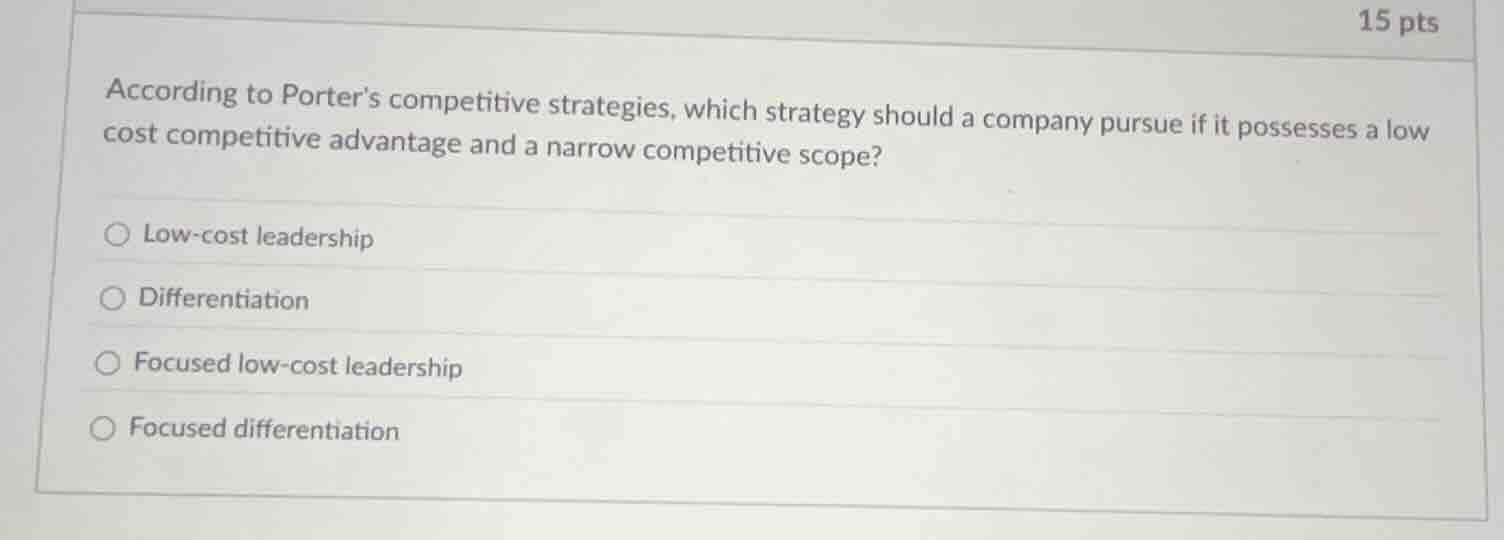
according to porters competitive strategies, which strategy should a company pursue if it possesses a low cost competitive advantage and a narrow competitive scope?
low-cost leadership
differentiation
focused low-cost leadership
focused differentiation
🆕 New Concept Discovered: Porter's Generic Strategies
How businesses choose to compete based on scope and source of advantage.
Step 1: Understand the dimensions of Porter's Generic Strategies
Michael Porter's framework classifies competitive strategies based on two main dimensions:
- Competitive Advantage (Source): Whether a firm tries to achieve an advantage by having the lowest costs (Low Cost) or by offering unique products/services (Differentiation).
- Competitive Scope (Target Market): Whether the firm targets a broad market (Broad Scope) or a narrow, niche market segment (Narrow Scope).
Step 2: Match the given criteria to the framework
The problem specifies two characteristics:
- Competitive Advantage: Low cost
- Competitive Scope: Narrow scope
When a company targets a narrow segment of the market (focusing its efforts) and competes by offering the lowest prices within that specific niche, it is pursuing a Focused low-cost leadership strategy (sometimes referred to as Cost Focus).

Snap & solve any problem in the app
Get step-by-step solutions on Sovi AI
Photo-based solutions with guided steps
Explore more problems and detailed explanations
Focused low-cost leadership