QUESTION IMAGE
Question
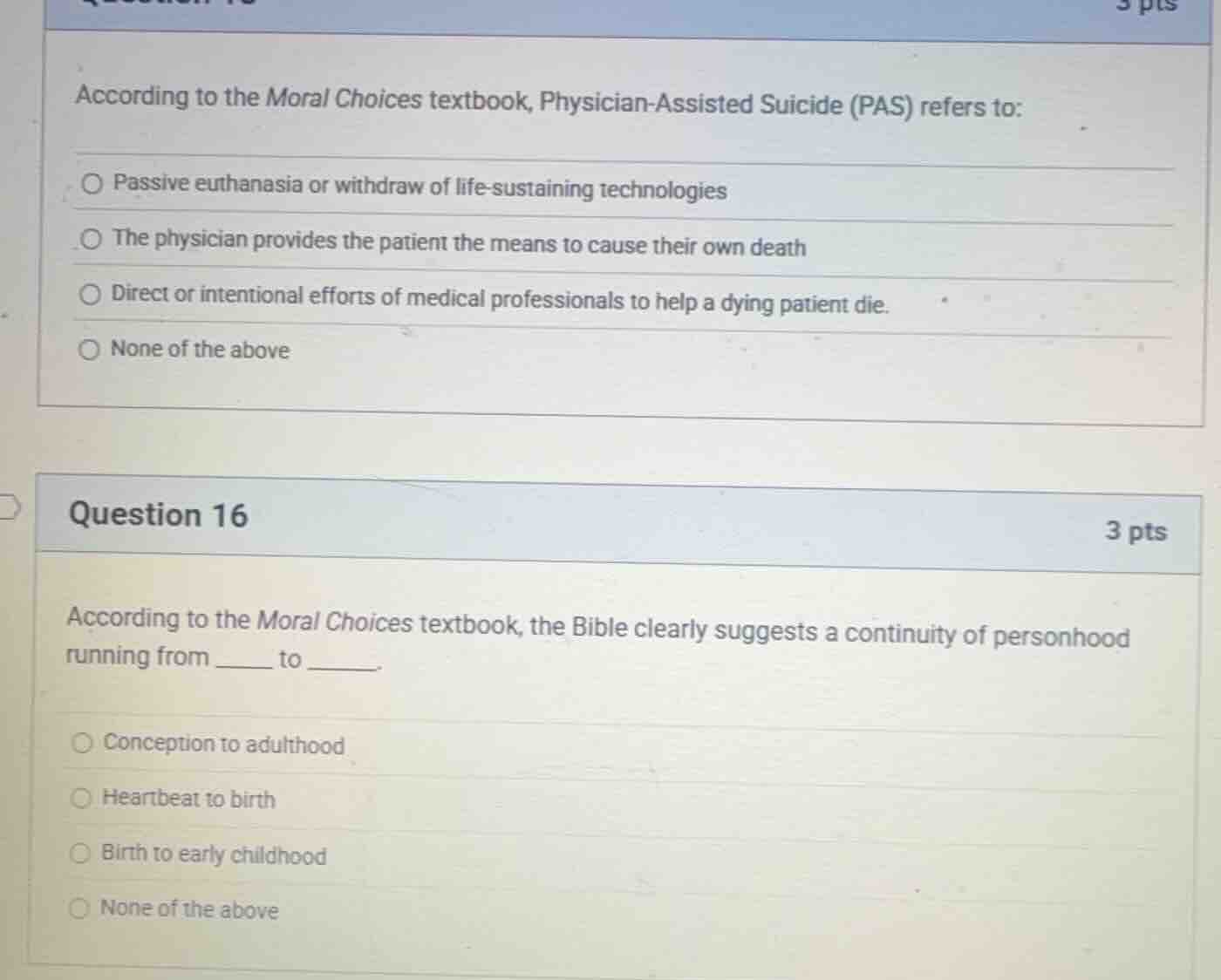
according to the moral choices textbook, physician-assisted suicide (pas) refers to:
passive euthanasia or withdraw of life-sustaining technologies
the physician provides the patient the means to cause their own death
direct or intentional efforts of medical professionals to help a dying patient die.
none of the above
question 16
according to the moral choices textbook, the bible clearly suggests a continuity of personhood running from ____ to ____.
conception to adulthood
heartbeat to birth
birth to early childhood
none of the above
🆕 New Concept Discovered: Bioethical Definitions and Perspectives
Understanding distinctions in end-of-life care and beginning-of-life personhood.
Step 1: Define Physician-Assisted Suicide (PAS)
In bioethics and specifically within Scott Rae's Moral Choices textbook, Physician-Assisted Suicide (PAS) is distinguished from other end-of-life practices by who performs the final act.
- Physician-Assisted Suicide (PAS): The physician provides the necessary means (such as a lethal prescription of medication), but the patient performs the final act of administration to cause their own death.
- Active Euthanasia: The physician directly administers the lethal agent to cause the patient's death.
- Passive Euthanasia: Withholding or withdrawing life-sustaining treatment, allowing the underlying natural disease process to take its course.
Therefore, the correct option for the first question is: "The physician provides the patient the means to cause their own death".
Step 2: Analyze the Biblical View on Personhood
In the chapter discussing abortion and the beginning of life, Moral Choices argues for the full moral status of the unborn. The text highlights biblical passages (such as Psalm 139:13–16 and Jeremiah 1:5) to show that God relates to the unborn child in the womb as a person.
The textbook argues that the Bible suggests a continuous line of personal identity (continuity of personhood) that begins at the very moment of conception and continues through life into eternity.
Looking at the options provided:
- Conception to adulthood (This does not capture the full scope of eternal continuity, but among the choices, "conception" is the critical biblical starting point emphasized in the text).
- Heartbeat to birth (Incorrect, as the text argues personhood begins before a heartbeat is detectable).
- Birth to early childhood (Incorrect, as it excludes the prenatal period).
Because the textbook emphasizes that personhood begins at conception and continues throughout life, the option "Conception to adulthood" is the intended correct answer.

Snap & solve any problem in the app
Get step-by-step solutions on Sovi AI
Photo-based solutions with guided steps
Explore more problems and detailed explanations
Question 15 (Top):
The physician provides the patient the means to cause their own death
Question 16 (Bottom):
Conception to adulthood