Sovi.AI - AI Math Tutor

Scan to solve math questions

QUESTION IMAGE

according to our course materials, the silk road facilitated the spread…

Question

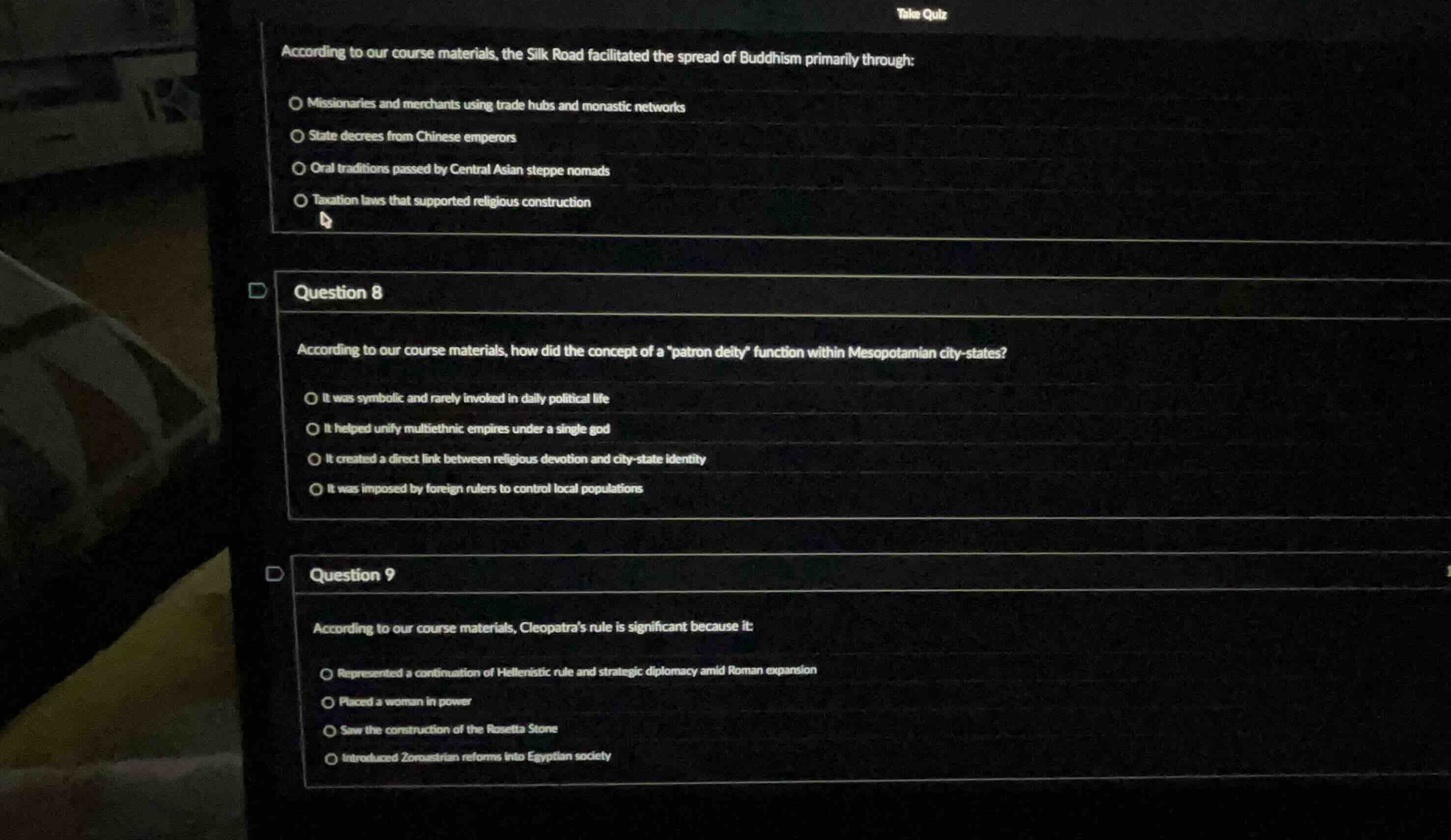
according to our course materials, the silk road facilitated the spread of buddhism primarily through:

  • missionaries and merchants using trade hubs and monastic networks
  • state decrees from chinese emperors
  • oral traditions passed by central asian steppe nomads
  • taxation laws that supported religious construction

question 8
according to our course materials, how did the concept of a \patron deity\ function within mesopotamian city-states?

  • it was symbolic and rarely invoked in daily political life
  • it helped unify multiethnic empires under a single god
  • it created a direct link between religious devotion and city-state identity
  • it was imposed by foreign rulers to control local populations

question 9
according to our course materials, cleopatras rule is significant because it:

  • represented a continuation of hellenistic rule and strategic diplomacy amid roman expansion
  • placed a woman in power
  • saw the construction of the rosetta stone
  • introduced zoroastrian reforms into egyptian society

Explanation:

Response

<pre_analysis>
{
"quality": "clear",
"question_count": 3,
"skills_matched": [
"direct_cot",
"multiple_choice_formatter",
"explain_then_answer",
"quick"
],
"needs_drawing": false,
"concepts_used": [
"Spread of Buddhism",
"Mesopotamian Religion",
"Ptolemaic Egypt"
],
"new_concepts": [],
"current_concepts": [
"Spread of Buddhism",
"Mesopotamian Religion",
"Ptolemaic Egypt"
]
}
</pre_analysis>

<reasoning>

Analyze the first question on the Silk Road and Buddhism

The question asks how the Silk Road facilitated the spread of Buddhism. Historically, Buddhism spread along trade routes primarily through the movement of merchants, missionaries, and the establishment of monastic communities at key trade hubs. Thus, the first option is correct.

Analyze Question 8 on Mesopotamian patron deities

The question asks how the concept of a "patron deity" functioned within Mesopotamian city-states. Each Mesopotamian city-state was considered the home of a specific patron god or goddess, which bound the local population together and linked religious devotion directly to the identity of that specific city-state. Thus, the third option is correct.

Analyze Question 9 on Cleopatra's rule

The question asks why Cleopatra's rule is significant. Cleopatra was the last active ruler of the Ptolemaic Kingdom of Egypt, representing the final phase of Hellenistic rule. Her reign is highly significant for her strategic diplomacy and alliances (with Julius Caesar and Mark Antony) to maintain Egyptian independence amid rapid Roman expansion. Thus, the first option is correct.
</reasoning>

<answer>

Question 1

<mcq-correct>Missionaries and merchants using trade hubs and monastic networks</mcq-correct>
<mcq-option>State decrees from Chinese emperors</mcq-option>
<mcq-option>Oral traditions passed by Central Asian steppe nomads</mcq-option>
<mcq-option>Taxation laws that supported religious construction</mcq-option>

Question 8

<mcq-option>It was symbolic and rarely invoked in daily political life</mcq-option>
<mcq-option>It helped unify multiethnic empires under a single god</mcq-option>
<mcq-correct>It created a direct link between religious devotion and city-state identity</mcq-correct>
<mcq-option>It was imposed by foreign rulers to control local populations</mcq-option>

Question 9

<mcq-correct>Represented a continuation of Hellenistic rule and strategic diplomacy amid Roman expansion</mcq-correct>
<mcq-option>Placed a woman in power</mcq-option>
<mcq-option>Saw the construction of the Rosetta Stone</mcq-option>
<mcq-option>Introduced Zoroastrian reforms into Egyptian society</mcq-option>
</answer>

<post_analysis>
{
"subject": "Social Science",
"question_type": "Multiple Choice",
"knowledge_point": [
"Social Science",
"History",
"Ancient World History"
]
}
</post_analysis>

Answer:

<pre_analysis>
{
"quality": "clear",
"question_count": 3,
"skills_matched": [
"direct_cot",
"multiple_choice_formatter",
"explain_then_answer",
"quick"
],
"needs_drawing": false,
"concepts_used": [
"Spread of Buddhism",
"Mesopotamian Religion",
"Ptolemaic Egypt"
],
"new_concepts": [],
"current_concepts": [
"Spread of Buddhism",
"Mesopotamian Religion",
"Ptolemaic Egypt"
]
}
</pre_analysis>

<reasoning>

Analyze the first question on the Silk Road and Buddhism

The question asks how the Silk Road facilitated the spread of Buddhism. Historically, Buddhism spread along trade routes primarily through the movement of merchants, missionaries, and the establishment of monastic communities at key trade hubs. Thus, the first option is correct.

Analyze Question 8 on Mesopotamian patron deities

The question asks how the concept of a "patron deity" functioned within Mesopotamian city-states. Each Mesopotamian city-state was considered the home of a specific patron god or goddess, which bound the local population together and linked religious devotion directly to the identity of that specific city-state. Thus, the third option is correct.

Analyze Question 9 on Cleopatra's rule

The question asks why Cleopatra's rule is significant. Cleopatra was the last active ruler of the Ptolemaic Kingdom of Egypt, representing the final phase of Hellenistic rule. Her reign is highly significant for her strategic diplomacy and alliances (with Julius Caesar and Mark Antony) to maintain Egyptian independence amid rapid Roman expansion. Thus, the first option is correct.
</reasoning>

<answer>

Question 1

<mcq-correct>Missionaries and merchants using trade hubs and monastic networks</mcq-correct>
<mcq-option>State decrees from Chinese emperors</mcq-option>
<mcq-option>Oral traditions passed by Central Asian steppe nomads</mcq-option>
<mcq-option>Taxation laws that supported religious construction</mcq-option>

Question 8

<mcq-option>It was symbolic and rarely invoked in daily political life</mcq-option>
<mcq-option>It helped unify multiethnic empires under a single god</mcq-option>
<mcq-correct>It created a direct link between religious devotion and city-state identity</mcq-correct>
<mcq-option>It was imposed by foreign rulers to control local populations</mcq-option>

Question 9

<mcq-correct>Represented a continuation of Hellenistic rule and strategic diplomacy amid Roman expansion</mcq-correct>
<mcq-option>Placed a woman in power</mcq-option>
<mcq-option>Saw the construction of the Rosetta Stone</mcq-option>
<mcq-option>Introduced Zoroastrian reforms into Egyptian society</mcq-option>
</answer>

<post_analysis>
{
"subject": "Social Science",
"question_type": "Multiple Choice",
"knowledge_point": [
"Social Science",
"History",
"Ancient World History"
]
}
</post_analysis>