Sovi.AI - AI Math Tutor

Scan to solve math questions

QUESTION IMAGE

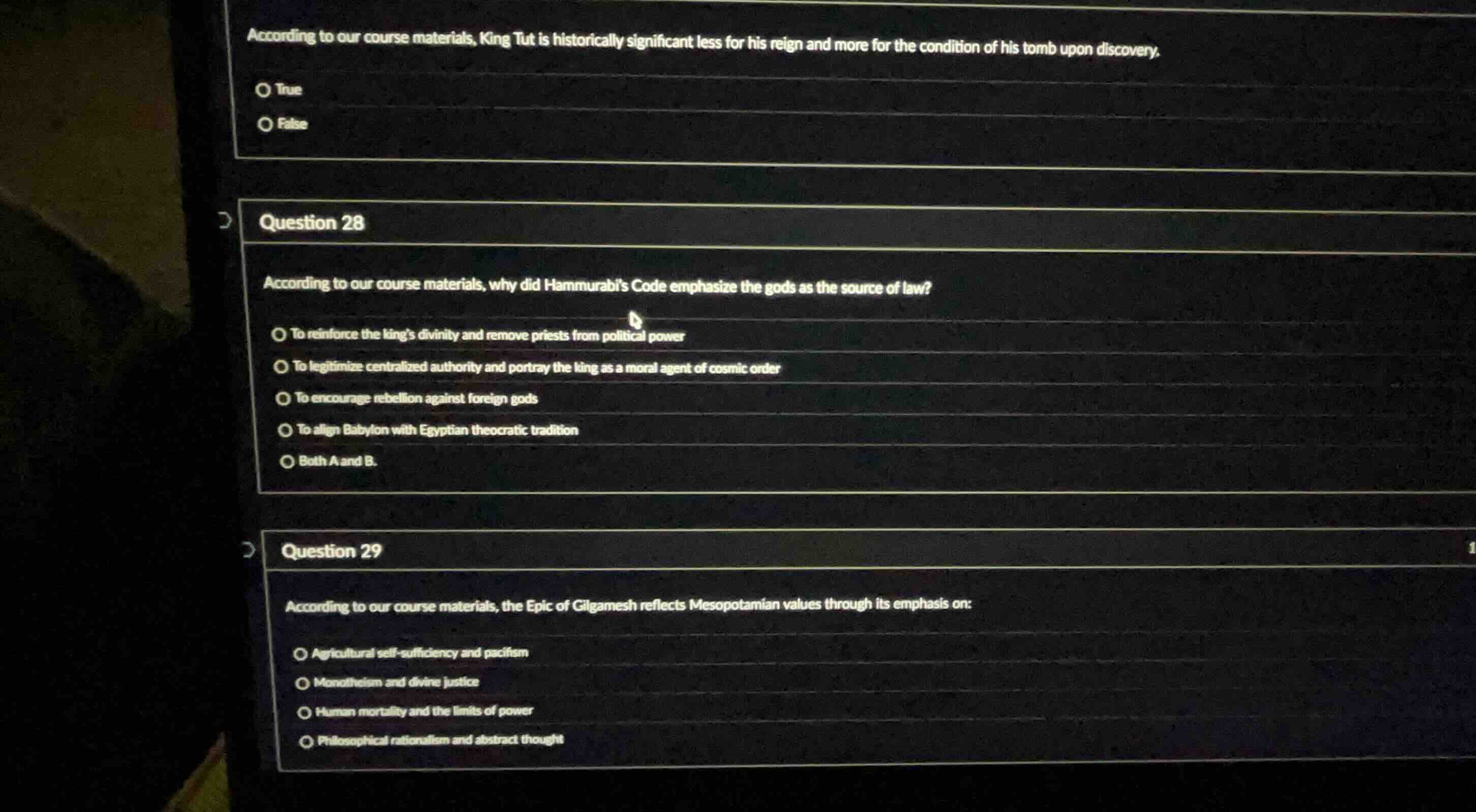
according to our course materials, king tut is historically significant…

Question

according to our course materials, king tut is historically significant less for his reign and more for the condition of his tomb upon discovery.
true
false

question 28
according to our course materials, why did hammurabis code emphasize the gods as the source of law?
to reinforce the kings divinity and remove priests from political power
to legitimize centralized authority and portray the king as a moral agent of cosmic order
to encourage rebellion against foreign gods
to align babylon with egyptian theocratic tradition
both a and b.

question 29
according to our course materials, the epic of gilgamesh reflects mesopotamian values through its emphasis on:
agricultural self-sufficiency and pacifism
monotheism and divine justice
human mortality and the limits of power
philosophical rationalism and abstract thought

Explanation:

Response

<pre_analysis>
{
"quality": "clear",
"question_count": 3,
"skills_matched": [
"direct_cot",
"explain_then_answer",
"quick"
],
"needs_drawing": false,
"concepts_used": [
"Hammurabi Code Ideology",
"Epic of Gilgamesh"
],
"new_concepts": [
"Tutankhamun Historical Significance"
],
"current_concepts": [
"Tutankhamun Historical Significance",
"Hammurabi Code Ideology",
"Epic of Gilgamesh"
]
}
</pre_analysis>

<reasoning>

Analyze the significance of King Tutankhamun

King Tutankhamun (King Tut) ruled briefly during the New Kingdom of Egypt and accomplished relatively little compared to major pharaohs. His immense historical significance today stems almost entirely from the discovery of his nearly intact tomb (KV62) by Howard Carter in 1922, which provided unprecedented archaeological evidence of royal burial practices. Thus, the statement is True.

Analyze the religious framing of Hammurabi's Code

Hammurabi's Code depicts the king receiving the laws directly from Shamash, the god of justice. This divine association serves to legitimize the king's centralized political authority and present him as a righteous ruler executing cosmic order on Earth, rather than claiming personal divinity or removing priests. Thus, the correct option is the second choice.

Analyze Mesopotamian values in the Epic of Gilgamesh

The Epic of Gilgamesh is a foundational Mesopotamian literary work that deeply explores the inevitability of human death, the search for immortality, and the ultimate limitations of even the most powerful kings. This reflects the characteristically pessimistic Mesopotamian worldview regarding mortality and the gods. Thus, the correct option is the third choice.
</reasoning>

<answer>

Question 1

<mcq-correct>True</mcq-correct>
<mcq-option>False</mcq-option>

Question 2

<mcq-option>To reinforce the king's divinity and remove priests from political power</mcq-option>
<mcq-correct>To legitimize centralized authority and portray the king as a moral agent of cosmic order</mcq-correct>
<mcq-option>To encourage rebellion against foreign gods</mcq-option>
<mcq-option>To align Babylon with Egyptian theocratic tradition</mcq-option>
<mcq-option>Both A and B.</mcq-option>

Question 3

<mcq-option>Agricultural self-sufficiency and pacifism</mcq-option>
<mcq-option>Monotheism and divine justice</mcq-correct>
<mcq-correct>Human mortality and the limits of power</mcq-correct>
<mcq-option>Philosophical rationalism and abstract thought</mcq-option>
</answer>

<post_analysis>
{
"subject": "Social Science",
"question_type": "Multi-part",
"knowledge_point": [
"Social Science",
"History",
"Ancient Near East and Egypt"
]
}
</post_analysis>

Answer:

<pre_analysis>
{
"quality": "clear",
"question_count": 3,
"skills_matched": [
"direct_cot",
"explain_then_answer",
"quick"
],
"needs_drawing": false,
"concepts_used": [
"Hammurabi Code Ideology",
"Epic of Gilgamesh"
],
"new_concepts": [
"Tutankhamun Historical Significance"
],
"current_concepts": [
"Tutankhamun Historical Significance",
"Hammurabi Code Ideology",
"Epic of Gilgamesh"
]
}
</pre_analysis>

<reasoning>

Analyze the significance of King Tutankhamun

King Tutankhamun (King Tut) ruled briefly during the New Kingdom of Egypt and accomplished relatively little compared to major pharaohs. His immense historical significance today stems almost entirely from the discovery of his nearly intact tomb (KV62) by Howard Carter in 1922, which provided unprecedented archaeological evidence of royal burial practices. Thus, the statement is True.

Analyze the religious framing of Hammurabi's Code

Hammurabi's Code depicts the king receiving the laws directly from Shamash, the god of justice. This divine association serves to legitimize the king's centralized political authority and present him as a righteous ruler executing cosmic order on Earth, rather than claiming personal divinity or removing priests. Thus, the correct option is the second choice.

Analyze Mesopotamian values in the Epic of Gilgamesh

The Epic of Gilgamesh is a foundational Mesopotamian literary work that deeply explores the inevitability of human death, the search for immortality, and the ultimate limitations of even the most powerful kings. This reflects the characteristically pessimistic Mesopotamian worldview regarding mortality and the gods. Thus, the correct option is the third choice.
</reasoning>

<answer>

Question 1

<mcq-correct>True</mcq-correct>
<mcq-option>False</mcq-option>

Question 2

<mcq-option>To reinforce the king's divinity and remove priests from political power</mcq-option>
<mcq-correct>To legitimize centralized authority and portray the king as a moral agent of cosmic order</mcq-correct>
<mcq-option>To encourage rebellion against foreign gods</mcq-option>
<mcq-option>To align Babylon with Egyptian theocratic tradition</mcq-option>
<mcq-option>Both A and B.</mcq-option>

Question 3

<mcq-option>Agricultural self-sufficiency and pacifism</mcq-option>
<mcq-option>Monotheism and divine justice</mcq-correct>
<mcq-correct>Human mortality and the limits of power</mcq-correct>
<mcq-option>Philosophical rationalism and abstract thought</mcq-option>
</answer>

<post_analysis>
{
"subject": "Social Science",
"question_type": "Multi-part",
"knowledge_point": [
"Social Science",
"History",
"Ancient Near East and Egypt"
]
}
</post_analysis>