QUESTION IMAGE
Question
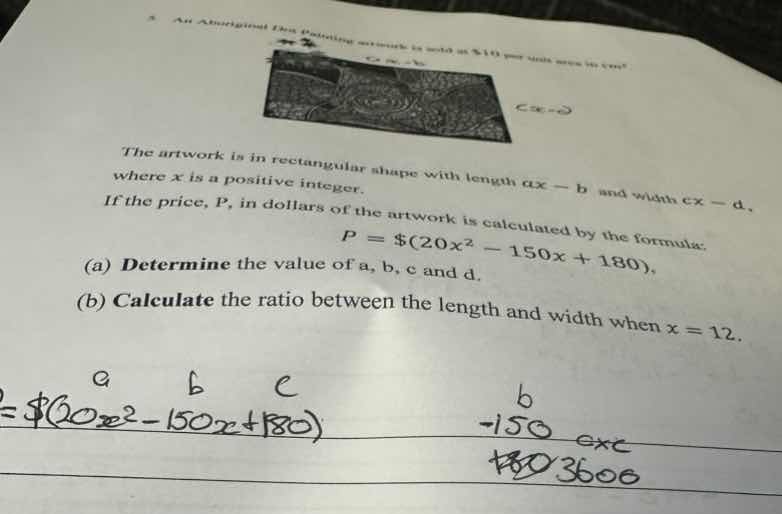
an aboriginal dot painting artwork is sold at $10 per unit area in \text{cm}^2.
the artwork is in rectangular shape with length ax - b and width cx - d, where x is a positive integer.
if the price, p, in dollars of the artwork is calculated by the formula:
\\p = \\$(20x^2 - 150x + 180),\\
(a) determine the value of a, b, c and d.
(b) calculate the ratio between the length and width when x = 12.
Relate price to area
The artwork is sold at $\$10$ per unit area in \(\text{cm}^2\).
The area \(A\) of the rectangular artwork is:
The price \(P\) is given by:
Expand the price formula
We expand the algebraic expression for the price \(P\):
Compare coefficients to find parameters
We compare this expanded form with the given price formula:
By equating the coefficients:
- \(10ac = 20 \implies ac = 2\)
- \(10bd = 180 \implies bd = 18\)
- \(10(ad + bc) = 150 \implies ad + bc = 15\)
Since \(a, b, c, d\) are integers from the linear dimensions \(ax-b\) and \(cx-d\):
From \(ac = 2\), the positive integer factors are either \((a=2, c=1)\) or \((a=1, c=2)\).
From the diagram, the length is labeled \(ax-b\) and the width is \(cx-d\). Usually, length \(\ge\) width, so we test \(a=2, c=1\).
If \(a=2\) and \(c=1\):
Since \(bd = 18\), we substitute \(b = \frac{18}{d}\):
Factoring this quadratic equation:
Since \(d\) must be an integer for standard school algebra problems of this type:
Then:
Thus, the parameters are:
This gives:
Length \(= 2x - 3\)
Width \(= x - 6\)
Calculate length and width at x = 12
We substitute \(x = 12\) into the expressions:
Determine the ratio
We find the ratio of length to width:

Snap & solve any problem in the app
Get step-by-step solutions on Sovi AI
Photo-based solutions with guided steps
Explore more problems and detailed explanations
Question (a)
The values are:
Question (b)
The ratio between the length and width when \(x = 12\) is: