QUESTION IMAGE
Question
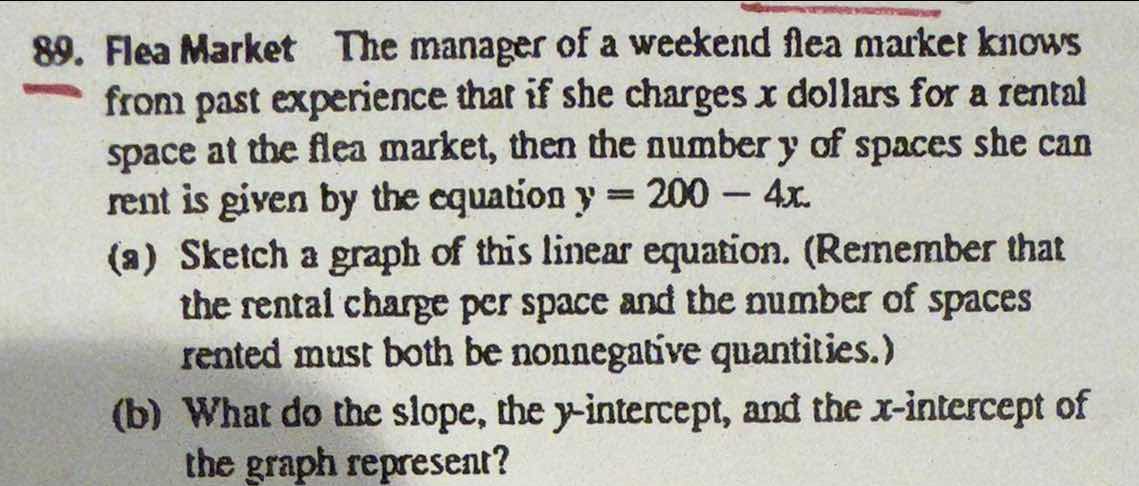
- flea market the manager of a weekend flea market knows from past experience that if she charges x dollars for a rental space at the flea market, then the number y of spaces she can rent is given by the equation $y = 200 - 4x$. (a) sketch a graph of this linear equation. (remember that the rental charge per space and the number of spaces rented must both be nonnegative quantities.) (b) what do the slope, the y-intercept, and the x-intercept of the graph represent?
Part (a)
Step 1: Determine the domain and range constraints
Since \( x \) (rental charge) and \( y \) (number of spaces rented) must be non - negative, we have:
- For \( y\geq0 \): \( 200 - 4x\geq0 \)
- Solve for \( x \): \( 4x\leq200 \), so \( x\leq50 \).
- Also, \( x\geq0 \) (because the rental charge can't be negative). So the domain of \( x \) is \( 0\leq x\leq50 \).
- When \( x = 0 \), \( y=200-4(0)=200 \).
- When \( y = 0 \), \( 0=200 - 4x\), then \( 4x = 200 \), and \( x = 50 \).
Step 2: Plot the points
We have two points: \((0,200)\) (the \( y \)-intercept) and \((50,0)\) (the \( x \)-intercept). To sketch the graph, we draw a straight line connecting these two points. Since \( x \) and \( y \) are non - negative, we only consider the line segment between \( x = 0 \) and \( x = 50 \) (or \( y=200 \) and \( y = 0 \)).
Part (b)
Step 1: Recall the slope - intercept form of a line
The equation of a line in slope - intercept form is \( y=mx + b \), where \( m \) is the slope and \( b \) is the \( y \)-intercept. Our equation is \( y=-4x + 200 \).
Step 2: Interpret the slope
The slope \( m=-4 \). In the context of the problem, \( y \) is the number of spaces rented and \( x \) is the rental charge per space. The slope represents the rate of change of the number of spaces rented with respect to the rental charge. A slope of - 4 means that for each increase of 1 dollar in the rental charge (\( x \) increases by 1), the number of spaces rented (\( y \)) decreases by 4.
Step 3: Interpret the \( y \)-intercept
The \( y \)-intercept \( b = 200 \) occurs when \( x = 0 \) (the rental charge is $0$). So the \( y \)-intercept represents the number of spaces that can be rented when the rental charge per space is $0$ dollars. In other words, if the manager charges $0$ dollars for a rental space, she can rent 200 spaces.
Step 4: Interpret the \( x \)-intercept
The \( x \)-intercept occurs when \( y = 0 \) (the number of spaces rented is 0). We found that when \( y = 0 \), \( x = 50 \). So the \( x \)-intercept represents the rental charge per space at which no spaces will be rented. If the manager charges $50$ dollars per space, then she will rent 0 spaces.
Part (a) Answer:
The graph is a line segment connecting the points \((0,200)\) and \((50,0)\) with \( x \) ranging from \( 0 \) to \( 50 \) and \( y \) ranging from \( 0 \) to \( 200 \).
Part (b) Answer:
- Slope: For each $1$ increase in rental charge, 4 fewer spaces are rented.
- \( y \)-intercept: 200 spaces can be rented when the rental charge is $0$.
- \( x \)-intercept: No spaces are rented when the rental charge is $50$.

Snap & solve any problem in the app
Get step-by-step solutions on Sovi AI
Photo-based solutions with guided steps
Explore more problems and detailed explanations
Step 1: Recall the slope - intercept form of a line
The equation of a line in slope - intercept form is \( y=mx + b \), where \( m \) is the slope and \( b \) is the \( y \)-intercept. Our equation is \( y=-4x + 200 \).
Step 2: Interpret the slope
The slope \( m=-4 \). In the context of the problem, \( y \) is the number of spaces rented and \( x \) is the rental charge per space. The slope represents the rate of change of the number of spaces rented with respect to the rental charge. A slope of - 4 means that for each increase of 1 dollar in the rental charge (\( x \) increases by 1), the number of spaces rented (\( y \)) decreases by 4.
Step 3: Interpret the \( y \)-intercept
The \( y \)-intercept \( b = 200 \) occurs when \( x = 0 \) (the rental charge is $0$). So the \( y \)-intercept represents the number of spaces that can be rented when the rental charge per space is $0$ dollars. In other words, if the manager charges $0$ dollars for a rental space, she can rent 200 spaces.
Step 4: Interpret the \( x \)-intercept
The \( x \)-intercept occurs when \( y = 0 \) (the number of spaces rented is 0). We found that when \( y = 0 \), \( x = 50 \). So the \( x \)-intercept represents the rental charge per space at which no spaces will be rented. If the manager charges $50$ dollars per space, then she will rent 0 spaces.
Part (a) Answer:
The graph is a line segment connecting the points \((0,200)\) and \((50,0)\) with \( x \) ranging from \( 0 \) to \( 50 \) and \( y \) ranging from \( 0 \) to \( 200 \).
Part (b) Answer:
- Slope: For each $1$ increase in rental charge, 4 fewer spaces are rented.
- \( y \)-intercept: 200 spaces can be rented when the rental charge is $0$.
- \( x \)-intercept: No spaces are rented when the rental charge is $50$.