QUESTION IMAGE
Question
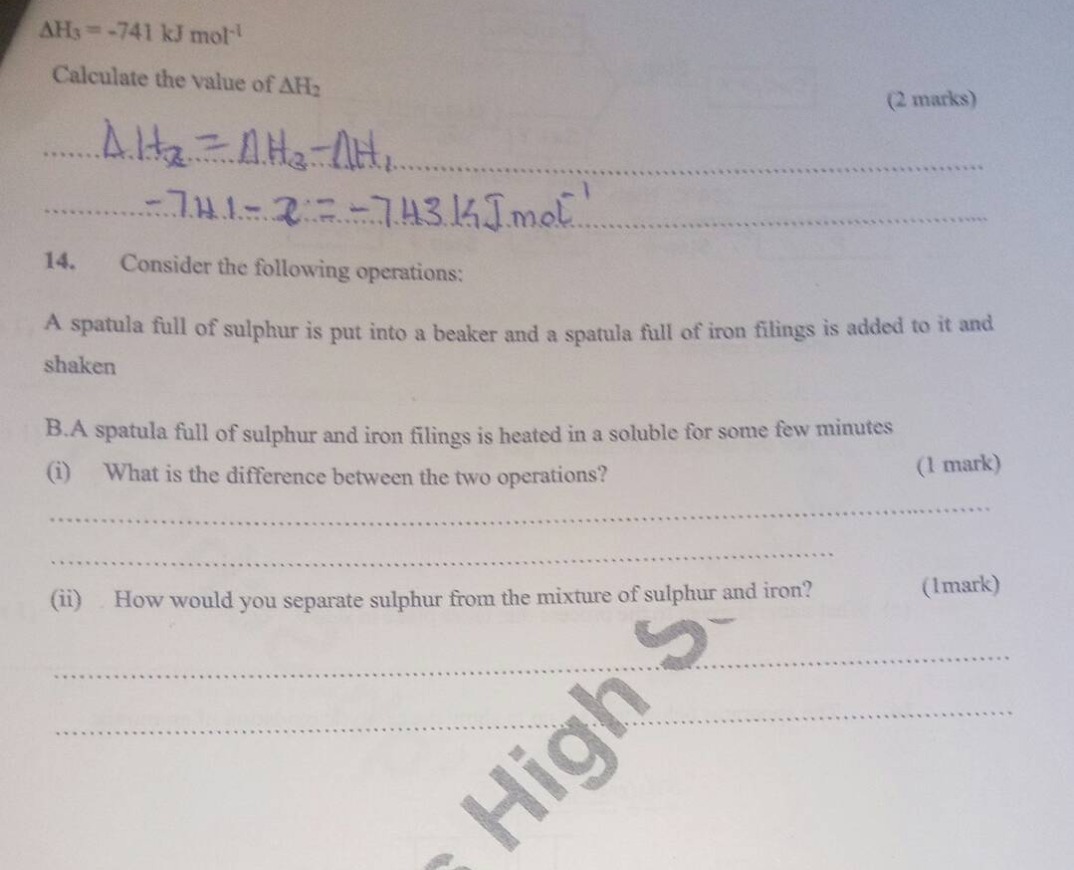
\delta h_3 = -741\text{ kj mol}^{-1}
calculate the value of \delta h_2
(2 marks)
- consider the following operations:
a spatula full of sulphur is put into a beaker and a spatula full of iron filings is added to it and shaken
b. a spatula full of sulphur and iron filings is heated in a soluble for some few minutes
(i) what is the difference between the two operations?
(1 mark)
(ii) how would you separate sulphur from the mixture of sulphur and iron?
(1 mark)
🆕 New Concept Discovered: Mixtures vs. Chemical Compounds
Distinguishing physical mixtures from chemical reactions.
Step 1: Analyze Operation A
In Operation A, sulfur powder and iron filings are mixed together in a beaker at room temperature without heating.
- What this means: No chemical reaction occurs. The substances are simply physically combined, meaning they retain their individual chemical properties (such as iron's magnetism and sulfur's solubility in specific organic solvents). This forms a physical mixture.
Step 2: Analyze Operation B
In Operation B, the mixture of sulfur and iron filings is heated.
- What this means: Heating supplies the activation energy required for a chemical reaction to take place between the two elements:
This reaction forms a completely new substance, iron(II) sulfide (\(\text{FeS}\)), which is a chemical compound with entirely different properties from the starting elements (for example, it is non-magnetic).
Step 3: Identify the difference between the two operations
Based on the analysis:
- Operation A is a physical change that results in a mixture.
- Operation B is a chemical change (reaction) that results in a compound (iron(II) sulfide).
Step 4: Determine how to separate sulfur from the physical mixture
Since the components in the physical mixture (Operation A) retain their original physical properties, we can use physical separation methods:
- Method 1 (Magnetic Separation): Use a magnet to attract and remove the magnetic iron filings, leaving the non-magnetic sulfur powder behind.
- Method 2 (Solvent Extraction): Add an organic solvent like carbon disulfide (\(\text{CS}_2\)) to the mixture. Sulfur dissolves in carbon disulfide while iron does not. Filter the mixture to remove the insoluble iron, and then evaporate the filtrate to recover the sulfur crystals.
Either of these physical methods is a valid way to separate the mixture.

Snap & solve any problem in the app
Get step-by-step solutions on Sovi AI
Photo-based solutions with guided steps
Explore more problems and detailed explanations
(i) What is the difference between the two operations?
Operation A is a physical process that produces a mixture (where iron and sulfur retain their individual properties), whereas Operation B is a chemical process (reaction) that produces a new compound (iron(II) sulfide, \(\text{FeS}\)).
---
(ii) How would you separate sulfur from the mixture of sulfur and iron?
You can separate them using either of the following physical methods:
- Using a magnet: Pass a magnet over the mixture to attract and remove the magnetic iron filings, leaving the sulfur behind.
- Using a solvent: Add carbon disulfide (\(\text{CS}_2\)) to dissolve the sulfur, filter out the insoluble iron filings, and then evaporate the liquid to obtain pure sulfur.