QUESTION IMAGE
Question
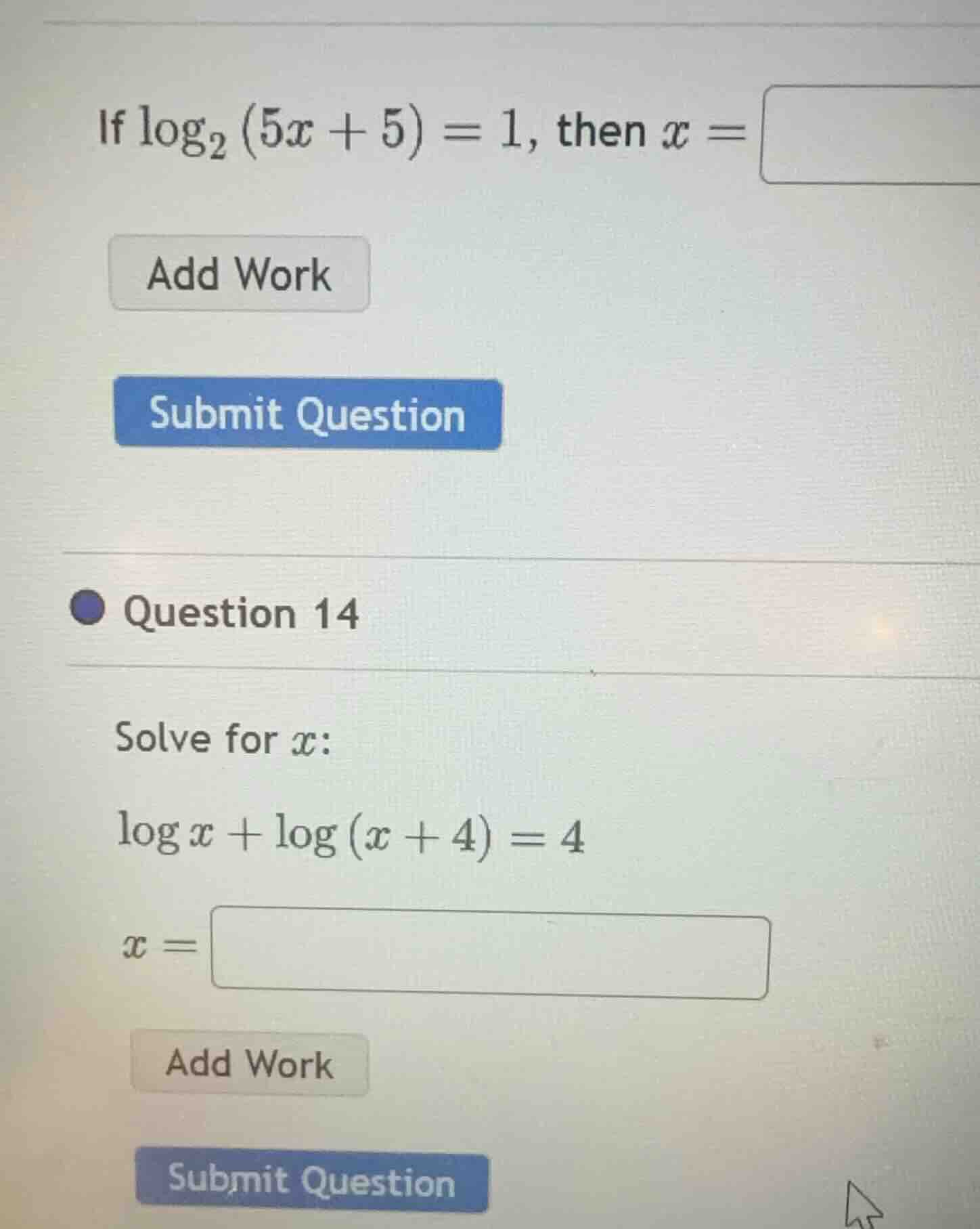
if \\(\log_{2} (5x + 5) = 1\\), then \\(x = \\)
question 14
solve for \\(x\\):
\\(\log x + \log (x + 4) = 4\\)
\\(x = \\)
⚡ Using what you learned: Solving Logarithmic Equations
Step 1: Convert to exponential form
For the first equation:
Convert the logarithmic equation to its exponential form:
Step 2: Solve for x
Subtract \( 5 \) from both sides:
Divide by \( 5 \):
---
Step 3: Apply product property
For the second equation (Question 14):
Note that \(\log\) without a base represents the common logarithm with base \( 10 \). Combine the logarithms using the product rule \(\log(a) + \log(b) = \log(ab)\):
Step 4: Convert to exponential form
Convert the equation to its exponential form with base \( 10 \):
Step 5: Solve the quadratic equation
Set the quadratic equation to zero:
Apply the quadratic formula \( x = \frac{-b \pm \sqrt{b^2 - 4ac}}{2a} \):
Simplify the radical:
Step 6: Check extraneous solutions
Since the domain of \(\log x\) requires \( x > 0 \), we must discard the negative solution:

Snap & solve any problem in the app
Get step-by-step solutions on Sovi AI
Photo-based solutions with guided steps
Explore more problems and detailed explanations
For the first equation:
\( x = -\frac{3}{5} \) (or \( -0.6 \))
For Question 14:
\( x = -2 + 2\sqrt{2501} \) (or approximately \( 98.02 \))