QUESTION IMAGE
Question
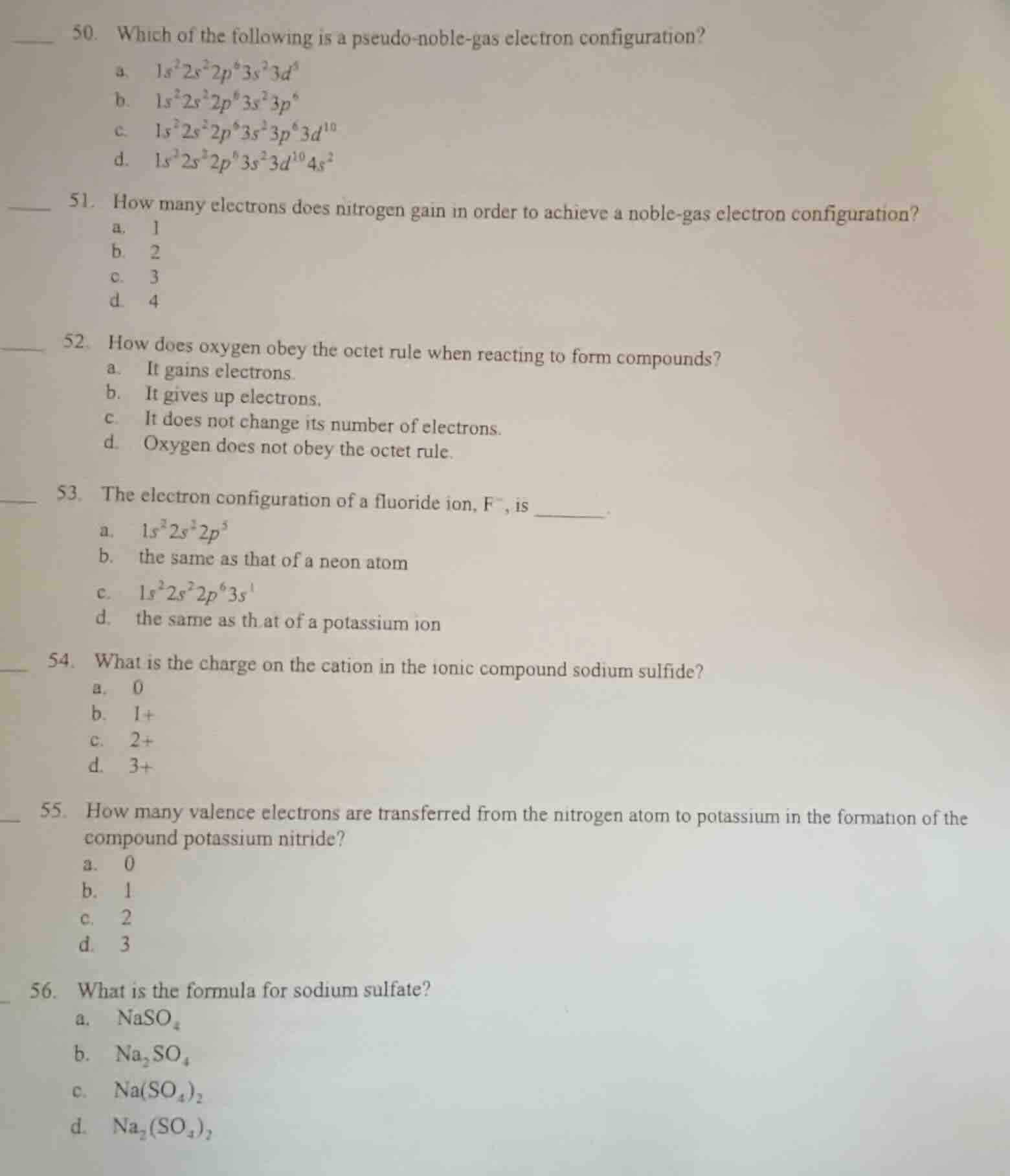
- which of the following is a pseudo-noble-gas electron configuration?
a. \\(1s^2 2s^2 2p^6 3s^2 3d^6\\)
b. \\(1s^2 2s^2 2p^6 3s^2 3p^6\\)
c. \\(1s^2 2s^2 2p^6 3s^2 3p^6 3d^{10}\\)
d. \\(1s^2 2s^2 2p^6 3s^2 3d^{10} 4s^2\\)
- how many electrons does nitrogen gain in order to achieve a noble-gas electron configuration?
a. 1
b. 2
c. 3
d. 4
- how does oxygen obey the octet rule when reacting to form compounds?
a. it gains electrons.
b. it gives up electrons.
c. it does not change its number of electrons.
d. oxygen does not obey the octet rule.
- the electron configuration of a fluoride ion, \\(\text{f}^-\\), is _______
a. \\(1s^2 2s^2 2p^5\\)
b. the same as that of a neon atom
c. \\(1s^2 2s^2 2p^6 3s^1\\)
d. the same as that of a potassium ion
- what is the charge on the cation in the ionic compound sodium sulfide?
a. 0
b. 1+
c. 2+
d. 3+
- how many valence electrons are transferred from the nitrogen atom to potassium in the formation of the compound potassium nitride?
a. 0
b. 1
c. 2
d. 3
- what is the formula for sodium sulfate?
a. \\(\text{naso}_4\\)
b. \\(\text{na}_2\text{so}_4\\)
c. \\(\text{na}(\text{so}_4)_2\\)
d. \\(\text{na}_2(\text{so}_4)_2\\)
Identify pseudo-noble-gas configuration
Using the Pseudo-Noble-Gas Configuration knowledge point
Determine nitrogen electron gain
Using the Valence Electron Shells knowledge point
Analyze oxygen octet rule behavior
Oxygen is in Group 16 and has 6 valence electrons (\(2s^2 2p^4\)). To satisfy the octet rule and achieve a stable noble-gas configuration (\(2s^2 2p^6\)), it must gain 2 electrons. Therefore, oxygen obeys the octet rule by gaining electrons.
Determine fluoride ion configuration
The fluorine atom has 9 electrons (\(1s^2 2s^2 2p^5\)). The fluoride ion (\(\text{F}^-\)) gains 1 electron, resulting in 10 electrons with the configuration \(1s^2 2s^2 2p^6\). This is identical to the electron configuration of a neutral neon atom (\(\text{Ne}\)).
Determine sodium sulfide cation charge
Using the Ionic Charge Limits knowledge point
Determine electron transfer in potassium nitride
Potassium (\(\text{K}\)) is a metal that loses electrons, while nitrogen (\(\text{N}\)) is a nonmetal that gains electrons. In the formation of potassium nitride (\(\text{K}_3\text{N}\)), valence electrons are transferred from potassium atoms to the nitrogen atom, not from nitrogen to potassium. Therefore, 0 valence electrons are transferred from nitrogen to potassium.
Determine formula for sodium sulfate
Sodium forms a \(\text{Na}^+\) cation. Sulfate is a polyatomic anion with the formula \(\text{SO}_4^{2-}\). To form a neutral ionic compound, two \(\text{Na}^+\) ions are required to balance one \(\text{SO}_4^{2-}\) ion, yielding the chemical formula \(\text{Na}_2\text{SO}_4\).

Snap & solve any problem in the app
Get step-by-step solutions on Sovi AI
Photo-based solutions with guided steps
Explore more problems and detailed explanations
Question 50
- a. \(1s^2 2s^2 2p^6 3s^2 3d^6\)
- b. \(1s^2 2s^2 2p^6 3s^2 3p^6\)
- c. \(1s^2 2s^2 2p^6 3s^2 3p^6 3d^{10}\) (Correct answer)
- d. \(1s^2 2s^2 2p^6 3s^2 3d^{10} 4s^2\)
Question 51
- a. 1
- b. 2
- c. 3 (Correct answer)
- d. 4
Question 52
- a. It gains electrons. (Correct answer)
- b. It gives up electrons.
- c. It does not change its number of electrons.
- d. Oxygen does not obey the octet rule.
Question 53
- a. \(1s^2 2s^2 2p^5\)
- b. the same as that of a neon atom (Correct answer)
- c. \(1s^2 2s^2 2p^6 3s^1\)
- d. the same as that of a potassium ion
Question 54
- a. 0
- b. 1+ (Correct answer)
- c. 2+
- d. 3+
Question 55
- a. 0 (Correct answer)
- b. 1
- c. 2
- d. 3
Question 56
- a. \(\text{NaSO}_4\)
- b. \(\text{Na}_2\text{SO}_4\) (Correct answer)
- c. \(\text{Na(SO}_4)_2\)
- d. \(\text{Na}_2\text{(SO}_4)_2\)