QUESTION IMAGE
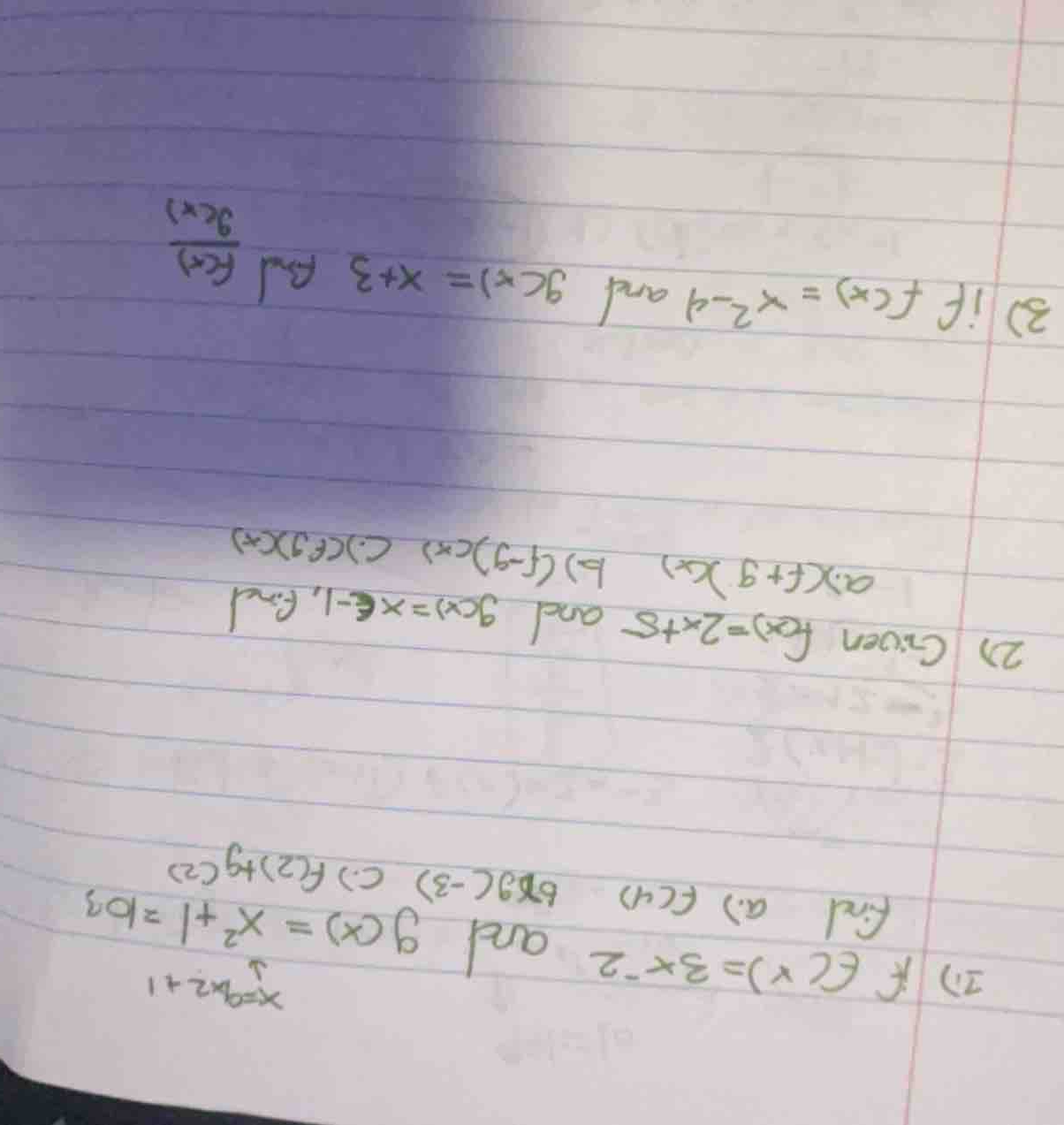
Question
- if \\(f(x) = 3x - 2\\) and \\(g(x) = x^2 + 1\\), find
a.) \\(f(4)\\)
b.) \\(g(-3)\\)
c.) \\(f(2) + g(2)\\)
- given \\(f(x) = 2x + 5\\) and \\(g(x) = x - 1\\), find
a.) \\((f + g)(x)\\)
b.) \\((f - g)(x)\\)
c.) \\((f \cdot g)(x)\\)
- if \\(f(x) = x^2 - 4\\) and \\(g(x) = x + 3\\), find \\(\frac{f(x)}{g(x)}\\)
The image is oriented upside down. Let's first transcribe the three questions accurately by rotating the text mentally:
Question 1:
If \(f(x) = 3x - 2\) and \(g(x) = x^2 + 1\), find:
a.) \(f(4)\)
b.) \(g(-3)\)
c.) \(f(2) + g(2)\)
Question 2:
Given \(f(x) = 2x + 5\) and \(g(x) = x - 1\), find:
a.) \((f + g)(x)\)
b.) \((f - g)(x)\)
c.) \((f \cdot g)(x)\)
Question 3:
If \(f(x) = x^2 - 4\) and \(g(x) = x + 3\), find \(\frac{f(x)}{g(x)}\).
Let's solve each question step-by-step.
Evaluate functions for Question 1
We are given \(f(x) = 3x - 2\) and \(g(x) = x^2 + 1\).
For part a.), substitute \(x = 4\) into \(f(x)\):
For part b.), substitute \(x = -3\) into \(g(x)\):
For part c.), first find \(f(2)\) and \(g(2)\):
Then add them together:
Perform operations for Question 2
We are given \(f(x) = 2x + 5\) and \(g(x) = x - 1\).
For part a.), find the sum function:
For part b.), find the difference function:
For part c.), find the product function:
Find the quotient for Question 3
We are given \(f(x) = x^2 - 4\) and \(g(x) = x + 3\).
Find the quotient function \(\frac{f(x)}{g(x)}\):
Since \(x^2 - 4 = (x - 2)(x + 2)\), there are no common factors with the denominator \(x + 3\) to simplify further. Thus, the expression is:

Snap & solve any problem in the app
Get step-by-step solutions on Sovi AI
Photo-based solutions with guided steps
Explore more problems and detailed explanations
Question 1
If \(f(x) = 3x - 2\) and \(g(x) = x^2 + 1\):
- a.) \(f(4) = 10\)
- b.) \(g(-3) = 10\)
- c.) \(f(2) + g(2) = 9\)
Question 2
Given \(f(x) = 2x + 5\) and \(g(x) = x - 1\):
- a.) \((f + g)(x) = 3x + 4\)
- b.) \((f - g)(x) = x + 6\)
- c.) \((f \cdot g)(x) = 2x^2 + 3x - 5\)
Question 3
If \(f(x) = x^2 - 4\) and \(g(x) = x + 3\):