Sovi.AI - AI Math Tutor

Scan to solve math questions

QUESTION IMAGE

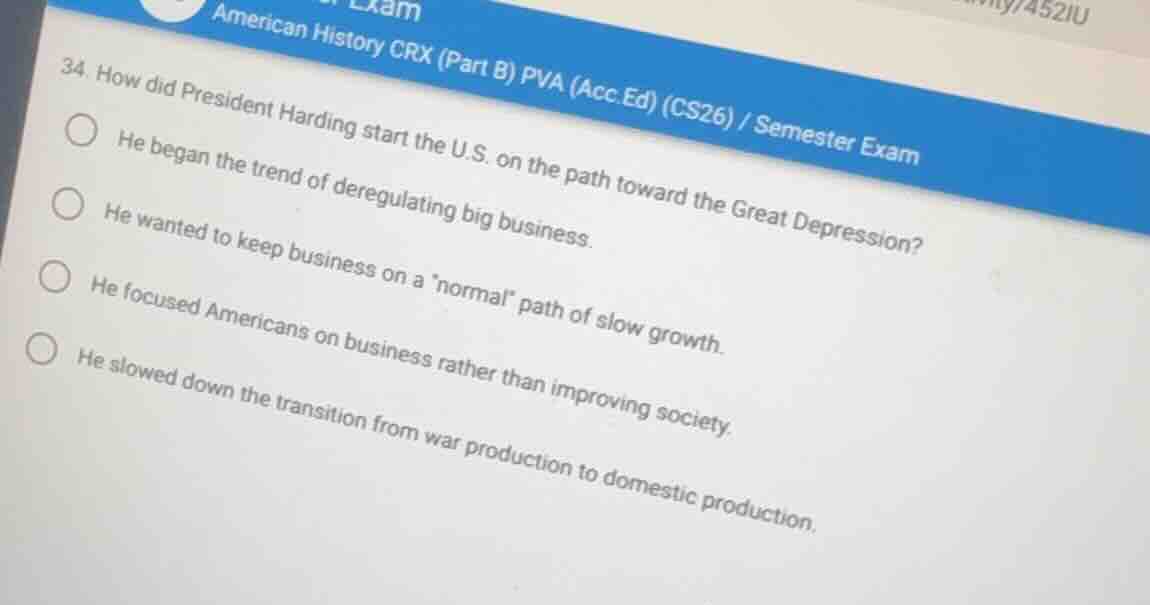
34. how did president harding start the u.s. on the path toward the gre…

Question

  1. how did president harding start the u.s. on the path toward the great depression?

he began the trend of deregulating big business.
he wanted to keep business on a
ormal\ path of slow growth.
he focused americans on business rather than improving society.
he slowed down the transition from war production to domestic production.

Explanation:

Response

<pre_analysis>
{
"quality": "clear",
"question_count": 1,
"skills_matched": [
"direct_cot",
"multiple_choice_formatter",
"explain_then_answer",
"tutor"
],
"needs_drawing": false,
"concepts_used": [],
"new_concepts": [
"Warren G. Harding",
"1920s Economic Policy",
"Origins of Great Depression"
],
"current_concepts": [
"Warren G. Harding",
"1920s Economic Policy",
"Origins of Great Depression"
]
}
</pre_analysis>

<reasoning>

Analyze Harding's economic policies

President Warren G. Harding took office in 1921 campaigning on a "Return to Normalcy." His administration favored pro-business, laissez-faire economic policies. This approach focused on reducing government intervention in the economy, cutting taxes, and rolling back progressive-era regulations on corporations.

Connect deregulation to the Great Depression

By reducing federal oversight and promoting deregulation, Harding's policies (continued by Coolidge and Hoover) allowed financial markets and large corporations to operate with minimal restrictions. This lack of regulation contributed to speculative bubbles, corporate consolidation, and economic imbalances that eventually culminated in the stock market crash of 1929 and the Great Depression.

Evaluate the given options

  • Option 1 ("He began the trend of deregulating big business"): This aligns directly with his laissez-faire policies that reduced government oversight, setting a precedent for the decade.
  • Option 2 ("He wanted to keep business on a 'normal' path of slow growth"): Incorrect, as the 1920s was a period of rapid, unregulated expansion rather than slow growth.
  • Option 3 ("He focused Americans on business rather than improving society"): While true in spirit regarding his pro-business stance, it does not directly explain the structural economic path toward the Great Depression as clearly as deregulation.
  • Option 4 ("He slowed down the transition from war production to domestic production"): Incorrect, as the transition was rapidly encouraged to restore peacetime commerce.

</reasoning>

<answer>
<mcq-correct>(A) He began the trend of deregulating big business.</mcq-correct>
<mcq-option>(B) He wanted to keep business on a "normal" path of slow growth.</mcq-option>
<mcq-option>(C) He focused Americans on business rather than improving society.</mcq-option>
<mcq-option>(D) He slowed down the transition from war production to domestic production.</mcq-option>
</answer>

<post_analysis>
{
"subject": "Social Science",
"question_type": "Multiple Choice",
"knowledge_point": [
"Social Science",
"U.S. History",
"1920s Economic Policy"
]
}
</post_analysis>

Answer:

<pre_analysis>
{
"quality": "clear",
"question_count": 1,
"skills_matched": [
"direct_cot",
"multiple_choice_formatter",
"explain_then_answer",
"tutor"
],
"needs_drawing": false,
"concepts_used": [],
"new_concepts": [
"Warren G. Harding",
"1920s Economic Policy",
"Origins of Great Depression"
],
"current_concepts": [
"Warren G. Harding",
"1920s Economic Policy",
"Origins of Great Depression"
]
}
</pre_analysis>

<reasoning>

Analyze Harding's economic policies

President Warren G. Harding took office in 1921 campaigning on a "Return to Normalcy." His administration favored pro-business, laissez-faire economic policies. This approach focused on reducing government intervention in the economy, cutting taxes, and rolling back progressive-era regulations on corporations.

Connect deregulation to the Great Depression

By reducing federal oversight and promoting deregulation, Harding's policies (continued by Coolidge and Hoover) allowed financial markets and large corporations to operate with minimal restrictions. This lack of regulation contributed to speculative bubbles, corporate consolidation, and economic imbalances that eventually culminated in the stock market crash of 1929 and the Great Depression.

Evaluate the given options

  • Option 1 ("He began the trend of deregulating big business"): This aligns directly with his laissez-faire policies that reduced government oversight, setting a precedent for the decade.
  • Option 2 ("He wanted to keep business on a 'normal' path of slow growth"): Incorrect, as the 1920s was a period of rapid, unregulated expansion rather than slow growth.
  • Option 3 ("He focused Americans on business rather than improving society"): While true in spirit regarding his pro-business stance, it does not directly explain the structural economic path toward the Great Depression as clearly as deregulation.
  • Option 4 ("He slowed down the transition from war production to domestic production"): Incorrect, as the transition was rapidly encouraged to restore peacetime commerce.

</reasoning>

<answer>
<mcq-correct>(A) He began the trend of deregulating big business.</mcq-correct>
<mcq-option>(B) He wanted to keep business on a "normal" path of slow growth.</mcq-option>
<mcq-option>(C) He focused Americans on business rather than improving society.</mcq-option>
<mcq-option>(D) He slowed down the transition from war production to domestic production.</mcq-option>
</answer>

<post_analysis>
{
"subject": "Social Science",
"question_type": "Multiple Choice",
"knowledge_point": [
"Social Science",
"U.S. History",
"1920s Economic Policy"
]
}
</post_analysis>