QUESTION IMAGE
Question
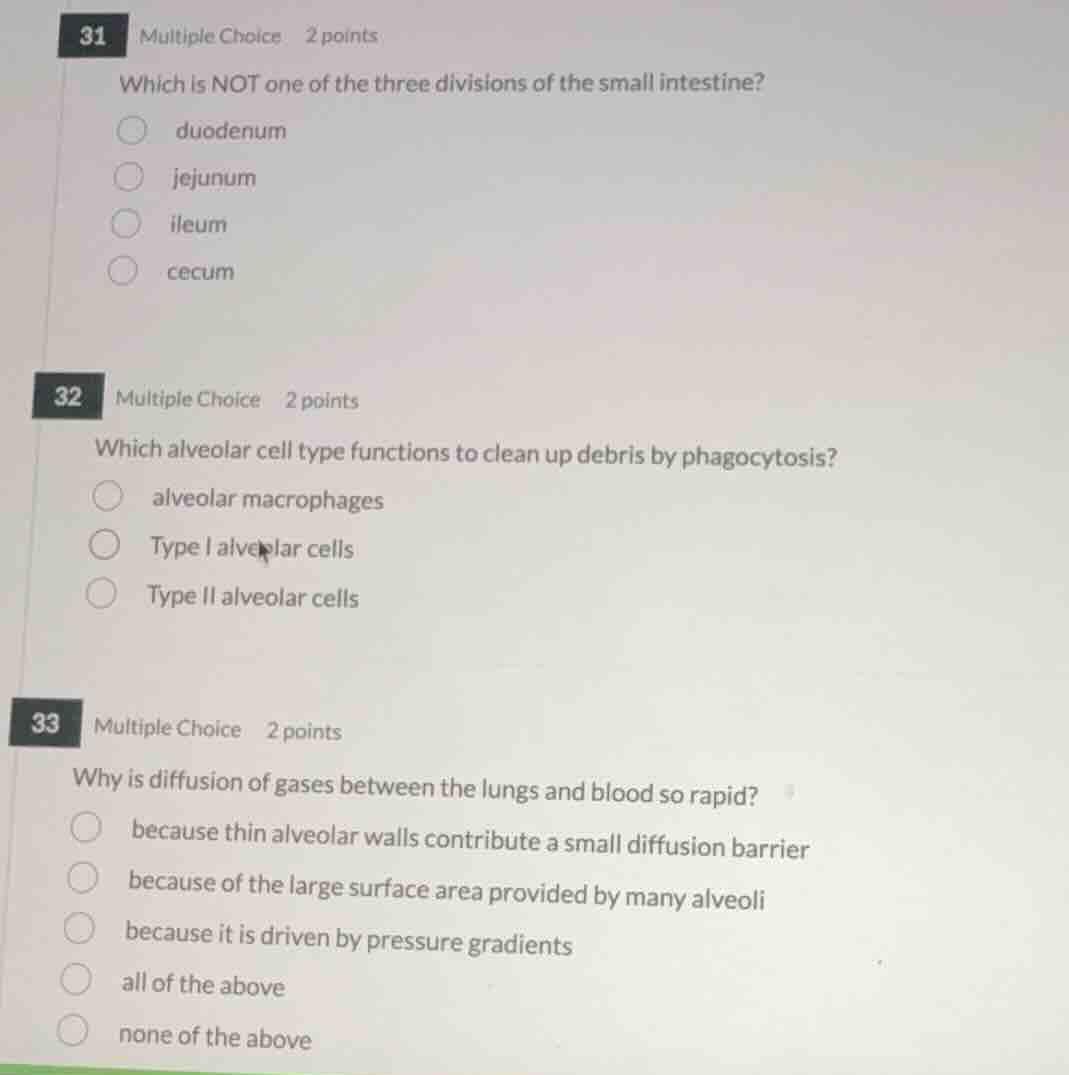
31 multiple choice 2 points
which is not one of the three divisions of the small intestine?
duodenum
jejunum
ileum
cecum
32 multiple choice 2 points
which alveolar cell type functions to clean up debris by phagocytosis?
alveolar macrophages
type i alveolar cells
type ii alveolar cells
33 multiple choice 2 points
why is diffusion of gases between the lungs and blood so rapid?
because thin alveolar walls contribute a small diffusion barrier
because of the large surface area provided by many alveoli
because it is driven by pressure gradients
all of the above
none of the above
Identify the divisions of the small intestine
The small intestine consists of three parts: the duodenum, jejunum, and ileum. The cecum is the beginning of the large intestine.
Identify the phagocytic alveolar cell type
Alveolar macrophages (dust cells) are phagocytes that clean up debris and pathogens in the alveoli. Type I cells form the structure for gas exchange, and Type II cells secrete surfactant.
Analyze factors contributing to rapid gas diffusion
According to Fick's Law of Diffusion, the rate of diffusion is maximized by a thin barrier (small diffusion distance), a large surface area, and a partial pressure gradient driving the movement of gases. All three listed factors contribute to the rapid rate of diffusion.

Snap & solve any problem in the app
Get step-by-step solutions on Sovi AI
Photo-based solutions with guided steps
Explore more problems and detailed explanations
Question 31
- duodenum
- jejunum
- ileum
- cecum (Correct answer)
Question 32
- alveolar macrophages (Correct answer)
- Type I alveolar cells
- Type II alveolar cells
Question 33
- because thin alveolar walls contribute a small diffusion barrier
- because of the large surface area provided by many alveoli
- because it is driven by pressure gradients
- all of the above (Correct answer)
- none of the above