QUESTION IMAGE
Question
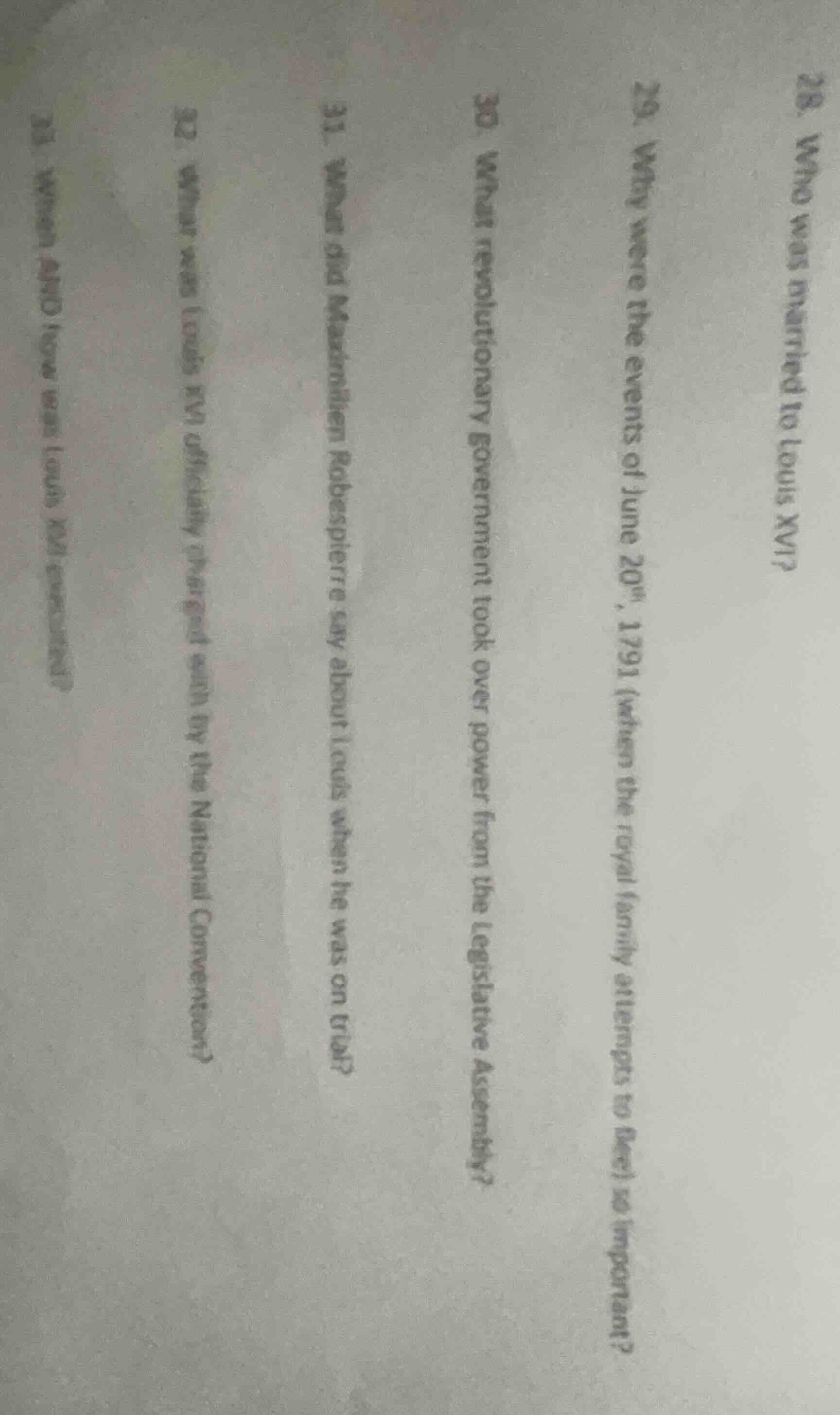
- who was married to louis xvi?
- why were the events of june 20th, 1791 (when the royal family attempts to flee) so important?
- what revolutionary government took over power from the legislative assembly?
- what did maximilien robespierre say about louis when he was on trial?
- what was louis xvi officially charged with by the national convention?
- when and how was louis xvi executed?
🆕 New Concept Discovered: Historical Cause and Effect
Analyzing how key events and figures shape historical outcomes.
Step 1: Identify Louis XVI's spouse (Question 28)
Louis XVI, the last King of France before the fall of the monarchy during the French Revolution, was married to Marie Antoinette of Austria.
Step 2: Analyze the significance of the Flight to Varennes (Question 29)
On June 20, 1791, the royal family attempted to escape Paris to rally royalist forces. This event, known as the Flight to Varennes, was crucial because:
- It shattered any remaining public trust in the King, proving to many French citizens that he was a traitor working with foreign enemies to overthrow the Revolution.
- It catalyzed the radicalization of the Revolution, shifting public sentiment away from a constitutional monarchy toward a republic.
Step 3: Identify the government succeeding the Legislative Assembly (Question 30)
The revolutionary government that took over power from the Legislative Assembly in September 1792 was the National Convention. It officially abolished the monarchy and declared France a republic.
Step 4: Analyze Robespierre's stance on Louis XVI's trial (Question 31)
During the trial of Louis XVI, Maximilien Robespierre argued that the King must be executed without a standard trial to secure the survival of the Republic. His famous stance was:
"Louis must die so that the nation may live."
He argued that if the King were tried and found innocent, the Revolution itself would be cast as a crime.
Step 5: Identify the official charges against Louis XVI (Question 32)
The National Convention officially charged Louis XVI (referred to during his trial as citizen "Louis Capet") with high treason and crimes against the French nation, specifically conspiring with foreign powers (such as Austria and Prussia) against the liberty and safety of the state.
Step 6: Determine the details of Louis XVI's execution (Question 33)
- When: January 21, 1793.
- How: He was executed by public decapitation using the guillotine at the Place de la Révolution in Paris.

Snap & solve any problem in the app
Get step-by-step solutions on Sovi AI
Photo-based solutions with guided steps
Explore more problems and detailed explanations
- 28. Marie Antoinette
- 29. It proved to the French public that the King was a traitor conspiring with foreign powers, destroying his remaining credibility and accelerating the push to abolish the monarchy and establish a republic.
- 30. The National Convention
- 31. He argued that Louis XVI did not need a trial and must be executed, famously stating, "Louis must die so that the nation may live," to legitimize the Revolution and protect the Republic.
- 32. High treason and conspiring against the liberty of the French nation and the safety of the state.
- 33. He was executed on January 21, 1793, by guillotine.