QUESTION IMAGE
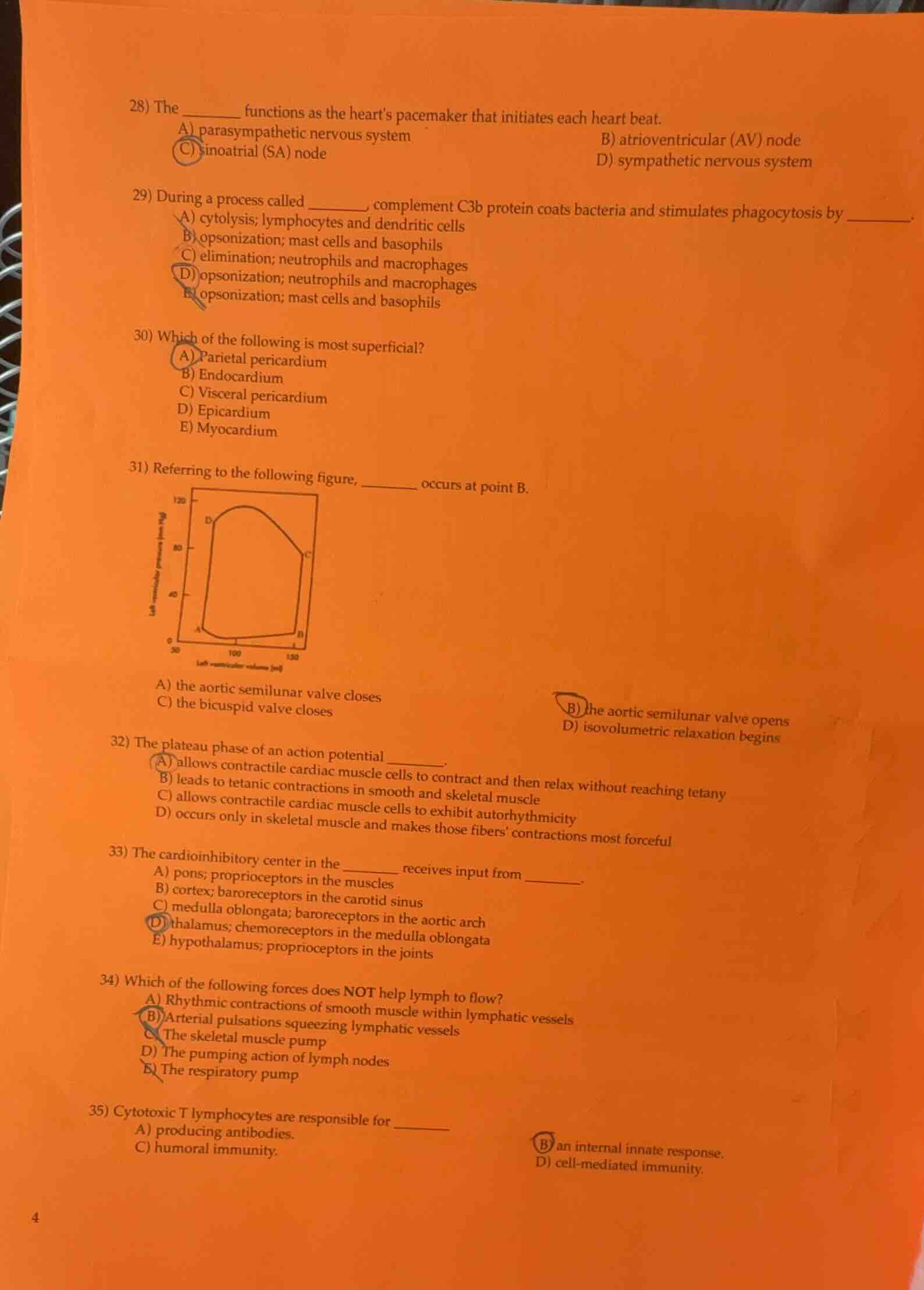
Question
- the functions as the hearts pacemaker that initiates each heart beat.
a) parasympathetic nervous system
b) atrioventricular (av) node
c) sinoatrial (sa) node
d) sympathetic nervous system
- during a process called ____, complement c3b protein coats bacteria and stimulates phagocytosis by ____.
a) cytolysis; lymphocytes and dendritic cells
b) opsonization; mast cells and basophils
c) elimination; neutrophils and macrophages
d) opsonization; neutrophils and macrophages
e) opsonization; mast cells and basophils
- which of the following is most superficial?
a) parietal pericardium
b) endocardium
c) visceral pericardium
d) epicardium
e) myocardium
- referring to the following figure, ______ occurs at point b.
a) the aortic semilunar valve closes
b) the aortic semilunar valve opens
c) the bicuspid valve closes
d) isovolumetric relaxation begins
- the plateau phase of an action potential ______.
a) allows contractile cardiac muscle cells to contract and then relax without reaching tetany
b) leads to tetanic contractions in smooth and skeletal muscle
c) allows contractile cardiac muscle cells to exhibit autorhythmicity
d) occurs only in skeletal muscle and makes those fibers contractions most forceful
- the cardioinhibitory center in the ____ receives input from ____.
a) pons; proprioceptors in the muscles
b) cortex; baroreceptors in the carotid sinus
c) medulla oblongata; baroreceptors in the aortic arch
d) thalamus; chemoreceptors in the medulla oblongata
e) hypothalamus; proprioceptors in the joints
- which of the following forces does not help lymph to flow?
a) rhythmic contractions of smooth muscle within lymphatic vessels
b) arterial pulsations squeezing lymphatic vessels
c) the skeletal muscle pump
d) the pumping action of lymph nodes
e) the respiratory pump
- cytotoxic t lymphocytes are responsible for ______.
a) producing antibodies.
b) an internal innate response.
c) humoral immunity.
d) cell-mediated immunity.
- The sinoatrial (SA) node is the primary pacemaker of the heart, located in the right atrium, responsible for initiating the electrical impulses that lead to heartbeats.
- Opsonization is the process where pathogens are coated with proteins (like C3b) to enhance phagocytosis by cells such as neutrophils and macrophages.
- The parietal pericardium is the outer layer of the serous pericardium, making it the most superficial of the listed heart layers.
- In a pressure-volume loop, point B represents the end of isovolumetric contraction, where left ventricular pressure exceeds aortic pressure, causing the aortic valve to open.
- The plateau phase in cardiac muscle action potentials (caused by calcium influx) extends the refractory period, preventing tetanic contractions and allowing the heart to fill.
- The cardioinhibitory center is located in the medulla oblongata and receives sensory input from baroreceptors (e.g., in the aortic arch) to regulate heart rate.
- Lymph flow is aided by skeletal muscle pumps, respiratory pumps, and vessel contractions; lymph nodes do not possess a "pumping action" to move fluid.
- Cytotoxic T lymphocytes directly attack infected or abnormal cells, which is the hallmark of cell-mediated immunity.

Snap & solve any problem in the app
Get step-by-step solutions on Sovi AI
Photo-based solutions with guided steps
Explore more problems and detailed explanations
- C) sinoatrial (SA) node
- D) opsonization; neutrophils and macrophages
- A) Parietal pericardium
- B) the aortic semilunar valve opens
- A) allows contractile cardiac muscle cells to contract and then relax without reaching tetany
- C) medulla oblongata; baroreceptors in the aortic arch
- D) The pumping action of lymph nodes
- D) cell-mediated immunity.