QUESTION IMAGE
Question
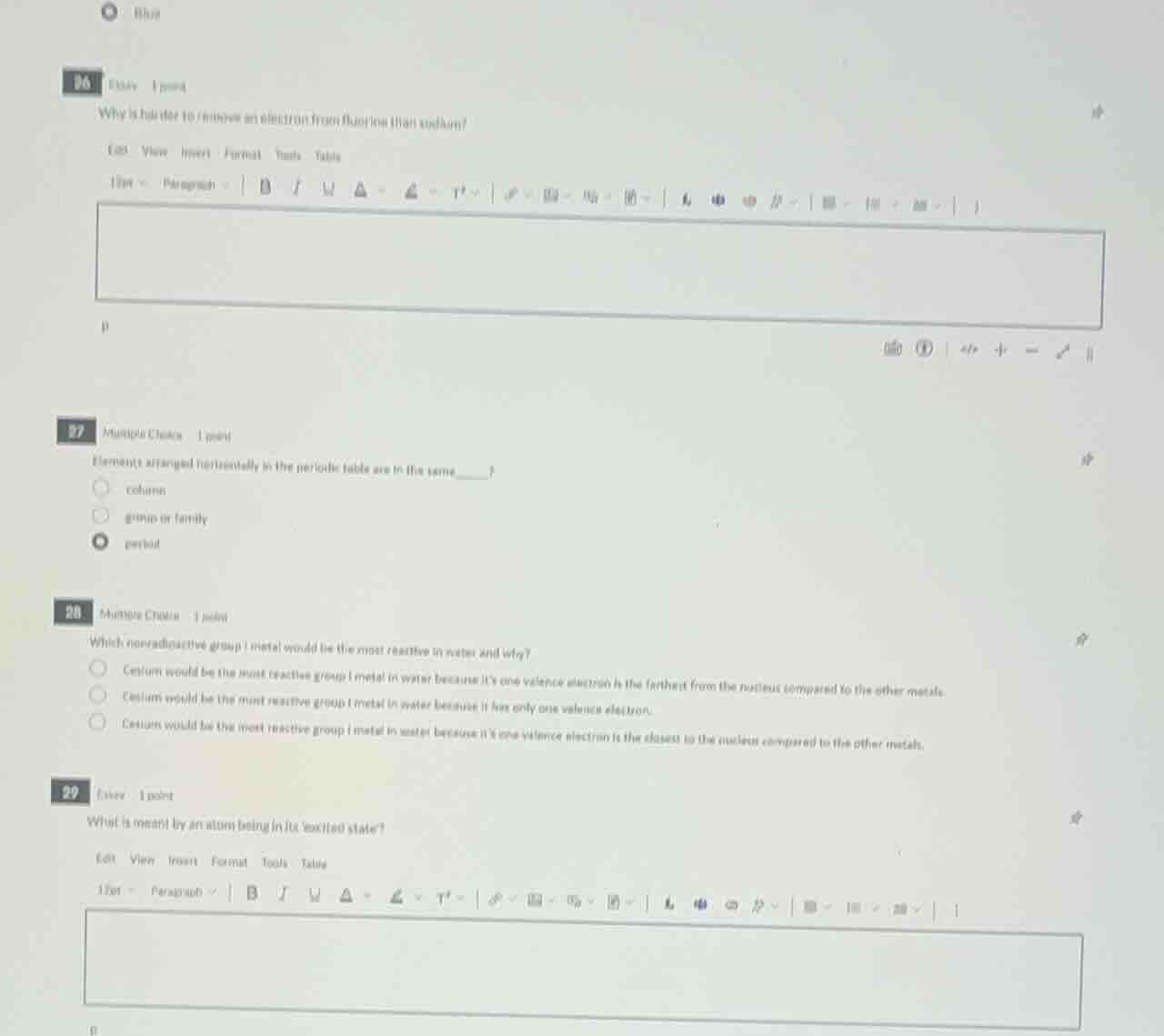
26 essay 1 point
why is harder to remove an electron from fluorine than sodium?
27 multiple choice 1 point
elements arranged horizontally in the periodic table are in the same ______?
column
group or family
period
28 multiple choice 1 point
which nonradioactive group i metal would be the most reactive in water and why?
cesium would be the most reactive group i metal in water because its one valence electron is the farthest from the nucleus compared to the other metals.
cesium would be the most reactive group i metal in water because it has only one valence electron.
cesium would be the most reactive group i metal in water because its one valence electron is the closest to the nucleus compared to the other metals.
29 essay 1 point
what is meant by an atom being in its excited state?
Compare nuclear attraction and shielding
Using the Periodic Trends knowledge point, we analyze why fluorine holds its valence electrons more tightly than sodium. Fluorine has a higher effective nuclear charge (\(Z_{\text{eff}}\)) and a smaller atomic radius than sodium. This stronger electrostatic attraction makes it much harder to remove an electron from fluorine.
Define horizontal arrangements
Using the Periodic Trends knowledge point, we identify the terminology for horizontal rows. Elements arranged horizontally across the periodic table are located in the same horizontal row, which is scientifically defined as a period.
Analyze Group 1 reactivity
Using the Group Similarities and Periodic Trends knowledge points, we evaluate the reactivity of alkali metals in water. Reactivity increases down the group because the single valence electron is further from the nucleus, experiencing weaker electrostatic attraction and thus being more easily lost. Among nonradioactive Group 1 metals, cesium is the furthest down, meaning its valence electron is the furthest from the nucleus.
Define the atomic excited state
We define the physical state of an atom when its electrons absorb energy. An atom is in an "excited state" when one or more of its electrons have absorbed energy and jumped to a higher energy level than their lowest possible energy levels (the ground state).

Snap & solve any problem in the app
Get step-by-step solutions on Sovi AI
Photo-based solutions with guided steps
Explore more problems and detailed explanations
Question 26
It is harder to remove an electron from fluorine than sodium because fluorine has a higher effective nuclear charge and a smaller atomic radius, resulting in a much stronger electrostatic attraction between the nucleus and its valence electrons compared to sodium.
Question 27
- column
- group or family
- period (Correct answer)
Question 28
- Cesium would be the most reactive group I metal in water because its one valence electron is the farthest from the nucleus compared to the other metals. (Correct answer)
- Cesium would be the most reactive group I metal in water because it has only one valence electron.
- Cesium would be the most reactive group I metal in water because its one valence electron is the closest to the nucleus compared to the other metals.
Question 29
An atom is in an "excited state" when one or more of its electrons have absorbed energy and transitioned to a higher energy level than their lowest possible energy configuration (the ground state).