Sovi.AI - AI Math Tutor

Scan to solve math questions

QUESTION IMAGE

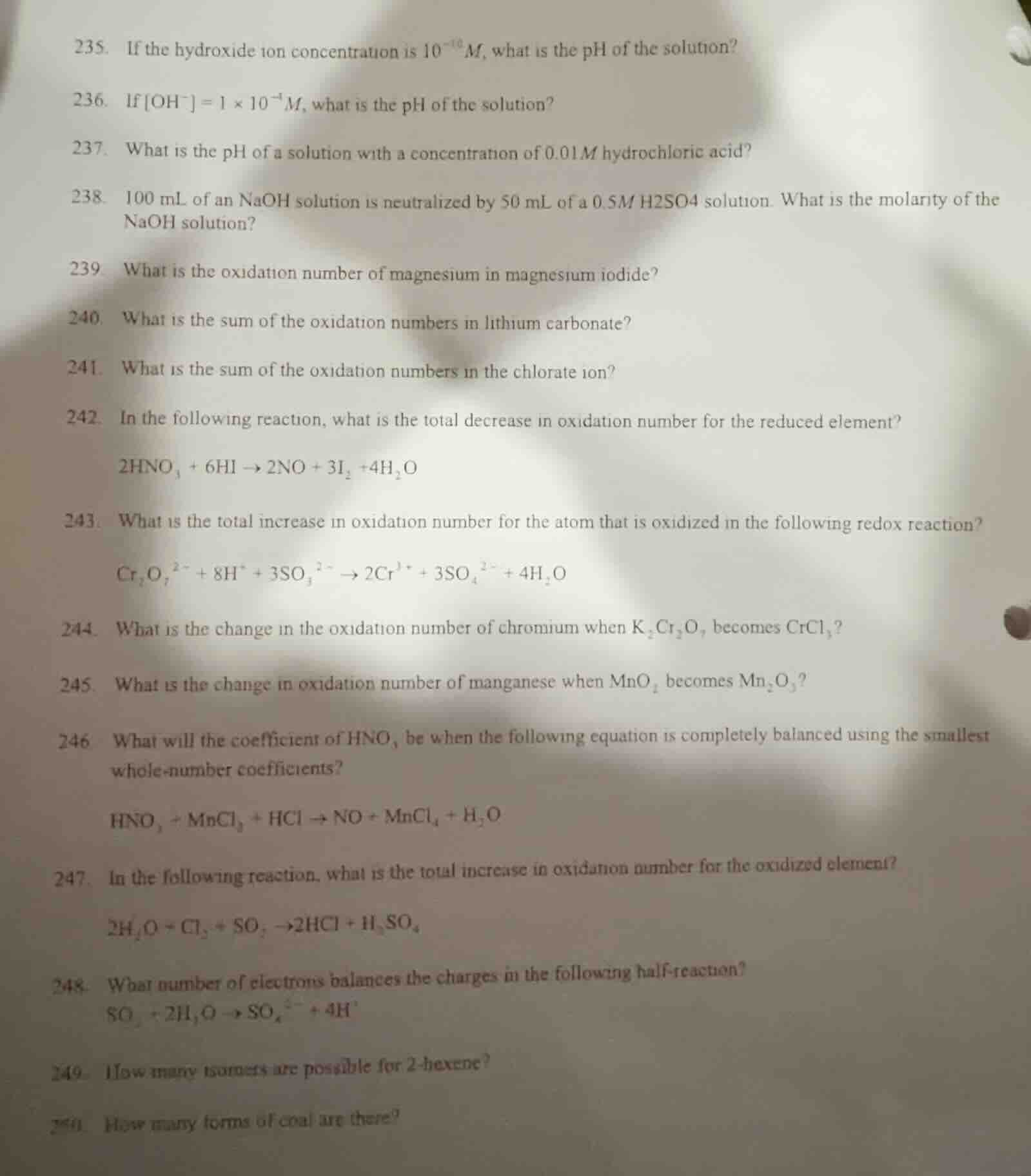
235. if the hydroxide ion concentration is \\(10^{-10}\\,m\\), what is …

Question

  1. if the hydroxide ion concentration is \\(10^{-10}\\,m\\), what is the ph of the solution?
  1. if \\(\text{oh}^- = 1 \times 10^{-4}\\,m\\), what is the ph of the solution?
  1. what is the ph of a solution with a concentration of \\(0.01\\,m\\) hydrochloric acid?
  1. \\(100\\,\text{ml}\\) of an \\(\text{naoh}\\) solution is neutralized by \\(50\\,\text{ml}\\) of a \\(0.5\\,m\\) \\(\text{h}_2\text{so}_4\\) solution. what is the molarity of the \\(\text{naoh}\\) solution?
  1. what is the oxidation number of magnesium in magnesium iodide?
  1. what is the sum of the oxidation numbers in lithium carbonate?
  1. what is the sum of the oxidation numbers in the chlorate ion?
  1. in the following reaction, what is the total decrease in oxidation number for the reduced element?

\\2\text{hno}_3 + 6\text{hi} \
ightarrow 2\text{no} + 3\text{i}_2 + 4\text{h}_2\text{o}\\

  1. what is the total increase in oxidation number for the atom that is oxidized in the following redox reaction?

\\\text{cr}_2\text{o}_7^{2-} + 8\text{h}^+ + 3\text{so}_3^{2-} \
ightarrow 2\text{cr}^{3+} + 3\text{so}_4^{2-} + 4\text{h}_2\text{o}\\

  1. what is the change in the oxidation number of chromium when \\(\text{k}_2\text{cr}_2\text{o}_7\\) becomes \\(\text{crcl}_3\\)?
  1. what is the change in oxidation number of manganese when \\(\text{mno}_2\\) becomes \\(\text{mn}_2\text{o}_3\\)?
  1. what will the coefficient of \\(\text{hno}_3\\) be when the following equation is completely balanced using the smallest whole-number coefficients?

\\\text{hno}_3 + \text{mncl}_2 + \text{hcl} \
ightarrow \text{no} + \text{mncl}_4 + \text{h}_2\text{o}\\

  1. in the following reaction, what is the total increase in oxidation number for the oxidized element?

\\2\text{h}_2\text{o} + \text{cl}_2 + \text{so}_2 \
ightarrow 2\text{hcl} + \text{h}_2\text{so}_4\\

  1. what number of electrons balances the charges in the following half-reaction?

\\\text{so}_2 + 2\text{h}_2\text{o} \
ightarrow \text{so}_4^{2-} + 4\text{h}^+\\

  1. how many isomers are possible for 2-hexene?
  1. how many forms of coal are there?

Explanation:

Response

<pre_analysis>
{
"quality": "clear",
"question_count": 16,
"skills_matched": [
"step_cot",
"table_formatter",
"explain_then_answer",
"tutor",
"mastery_adaptive_brevity"
],
"needs_drawing": false,
"concepts_used": [
"Self-Ionization of Water",
"Neutral Solution pH",
"Strong Acids and Bases",
"Acid-Base Neutralization",
"Oxidation Numbers",
"Redox Rules",
"Redox Balancing",
"Half-Reaction Method"
],
"new_concepts": [
"Isomerism of Alkenes",
"Coal Classification"
],
"current_concepts": [
"Self-Ionization of Water",
"Neutral Solution pH",
"Strong Acids and Bases",
"Acid-Base Neutralization",
"Oxidation Numbers",
"Redox Rules",
"Redox Balancing",
"Half-Reaction Method",
"Isomerism of Alkenes",
"Coal Classification"
]
}
</pre_analysis>

<reasoning>

Calculate pH from hydroxide concentration

Using the Self-Ionization of Water and Neutral Solution pH knowledge points
\[

$$\begin{aligned} &[\text{H}^+] = \frac{10^{-14}}{10^{-10}} = 10^{-4}\text{ M}\\ &\text{pH} = -\log(10^{-4}) = 4 \end{aligned}$$

\]

Calculate pH from hydroxide concentration

Using the Self-Ionization of Water and Neutral Solution pH knowledge points
\[

$$\begin{aligned} &[\text{H}^+] = \frac{10^{-14}}{1 \times 10^{-4}} = 10^{-10}\text{ M}\\ &\text{pH} = -\log(10^{-10}) = 10 \end{aligned}$$

\]

Calculate pH of hydrochloric acid

Using the Strong Acids and Bases knowledge point
\[

$$\begin{aligned} &[\text{H}^+] = 0.01\text{ M} = 10^{-2}\text{ M}\\ &\text{pH} = -\log(10^{-2}) = 2 \end{aligned}$$

\]

Calculate neutralization molarity

Using the Acid-Base Neutralization knowledge point
\[

$$\begin{aligned} &\text{H}_2\text{SO}_4 + 2\text{NaOH} ightarrow \text{Na}_2\text{SO}_4 + 2\text{H}_2\text{O}\\ &n(\text{H}^+) = 2 \times 0.5\text{ M} \times 0.050\text{ L} = 0.050\text{ mol}\\ &n(\text{OH}^-) = M_{\text{NaOH}} \times 0.100\text{ L} = 0.050\text{ mol}\\ &M_{\text{NaOH}} = 0.5\text{ M} \end{aligned}$$

\]

Determine oxidation numbers and changes

Using the Oxidation Numbers and Redox Rules knowledge points
\[

$$\begin{aligned} &\text{239: Mg in }\text{MgI}_2 ightarrow +2\\ &\text{240: Sum in }\text{Li}_2\text{CO}_3 ightarrow 0\\ &\text{241: Sum in }\text{ClO}_3^- ightarrow -1\\ &\text{242: }\text{HNO}_3 ightarrow \text{NO} \implies \text{N}(+5) ightarrow \text{N}(+2) \implies \text{Decrease} = 3 \times 2 = 6\\ &\text{243: }\text{SO}_3^{2-} ightarrow \text{SO}_4^{2-} \implies \text{S}(+4) ightarrow \text{S}(+6) \implies \text{Increase} = 2 \times 3 = 6\\ &\text{244: }\text{K}_2\text{Cr}_2\text{O}_7 ightarrow \text{CrCl}_3 \implies \text{Cr}(+6) ightarrow \text{Cr}(+3) \implies \text{Change} = -3\\ &\text{245: }\text{MnO}_2 ightarrow \text{Mn}_2\text{O}_3 \implies \text{Mn}(+4) ightarrow \text{Mn}(+3) \implies \text{Change} = -1\\ &\text{247: }\text{Cl}_2 ightarrow \text{HCl} \implies \text{Cl}(0) ightarrow \text{Cl}(-1) \implies \text{Total increase for oxidized S}(+4 ightarrow +6) = 2 \end{aligned}$$

\]

Balance redox equations and half-reactions

Using the Redox Balancing and Half-Reaction Method knowledge points
\[

$$\begin{aligned} &\text{246: } 2\text{HNO}_3 + 3\text{MnCl}_2 + 6\text{HCl} ightarrow 2\text{NO} + 3\text{MnCl}_4 + 4\text{H}_2\text{O} \implies \text{Coefficient of }\text{HNO}_3 = 2\\ &\text{248: }\text{SO}_2 + 2\text{H}_2\text{O} ightarrow \text{SO}_4^{2-} + 4\text{H}^+ + 2e^- \implies \text{Number of electrons} = 2 \end{aligned}$$

\]

Determine isomerism and coal forms

We analyze the remaining organic and general chemistry questi…

Answer:

<pre_analysis>
{
"quality": "clear",
"question_count": 16,
"skills_matched": [
"step_cot",
"table_formatter",
"explain_then_answer",
"tutor",
"mastery_adaptive_brevity"
],
"needs_drawing": false,
"concepts_used": [
"Self-Ionization of Water",
"Neutral Solution pH",
"Strong Acids and Bases",
"Acid-Base Neutralization",
"Oxidation Numbers",
"Redox Rules",
"Redox Balancing",
"Half-Reaction Method"
],
"new_concepts": [
"Isomerism of Alkenes",
"Coal Classification"
],
"current_concepts": [
"Self-Ionization of Water",
"Neutral Solution pH",
"Strong Acids and Bases",
"Acid-Base Neutralization",
"Oxidation Numbers",
"Redox Rules",
"Redox Balancing",
"Half-Reaction Method",
"Isomerism of Alkenes",
"Coal Classification"
]
}
</pre_analysis>

<reasoning>

Calculate pH from hydroxide concentration

Using the Self-Ionization of Water and Neutral Solution pH knowledge points
\[

$$\begin{aligned} &[\text{H}^+] = \frac{10^{-14}}{10^{-10}} = 10^{-4}\text{ M}\\ &\text{pH} = -\log(10^{-4}) = 4 \end{aligned}$$

\]

Calculate pH from hydroxide concentration

Using the Self-Ionization of Water and Neutral Solution pH knowledge points
\[

$$\begin{aligned} &[\text{H}^+] = \frac{10^{-14}}{1 \times 10^{-4}} = 10^{-10}\text{ M}\\ &\text{pH} = -\log(10^{-10}) = 10 \end{aligned}$$

\]

Calculate pH of hydrochloric acid

Using the Strong Acids and Bases knowledge point
\[

$$\begin{aligned} &[\text{H}^+] = 0.01\text{ M} = 10^{-2}\text{ M}\\ &\text{pH} = -\log(10^{-2}) = 2 \end{aligned}$$

\]

Calculate neutralization molarity

Using the Acid-Base Neutralization knowledge point
\[

$$\begin{aligned} &\text{H}_2\text{SO}_4 + 2\text{NaOH} ightarrow \text{Na}_2\text{SO}_4 + 2\text{H}_2\text{O}\\ &n(\text{H}^+) = 2 \times 0.5\text{ M} \times 0.050\text{ L} = 0.050\text{ mol}\\ &n(\text{OH}^-) = M_{\text{NaOH}} \times 0.100\text{ L} = 0.050\text{ mol}\\ &M_{\text{NaOH}} = 0.5\text{ M} \end{aligned}$$

\]

Determine oxidation numbers and changes

Using the Oxidation Numbers and Redox Rules knowledge points
\[

$$\begin{aligned} &\text{239: Mg in }\text{MgI}_2 ightarrow +2\\ &\text{240: Sum in }\text{Li}_2\text{CO}_3 ightarrow 0\\ &\text{241: Sum in }\text{ClO}_3^- ightarrow -1\\ &\text{242: }\text{HNO}_3 ightarrow \text{NO} \implies \text{N}(+5) ightarrow \text{N}(+2) \implies \text{Decrease} = 3 \times 2 = 6\\ &\text{243: }\text{SO}_3^{2-} ightarrow \text{SO}_4^{2-} \implies \text{S}(+4) ightarrow \text{S}(+6) \implies \text{Increase} = 2 \times 3 = 6\\ &\text{244: }\text{K}_2\text{Cr}_2\text{O}_7 ightarrow \text{CrCl}_3 \implies \text{Cr}(+6) ightarrow \text{Cr}(+3) \implies \text{Change} = -3\\ &\text{245: }\text{MnO}_2 ightarrow \text{Mn}_2\text{O}_3 \implies \text{Mn}(+4) ightarrow \text{Mn}(+3) \implies \text{Change} = -1\\ &\text{247: }\text{Cl}_2 ightarrow \text{HCl} \implies \text{Cl}(0) ightarrow \text{Cl}(-1) \implies \text{Total increase for oxidized S}(+4 ightarrow +6) = 2 \end{aligned}$$

\]

Balance redox equations and half-reactions

Using the Redox Balancing and Half-Reaction Method knowledge points
\[

$$\begin{aligned} &\text{246: } 2\text{HNO}_3 + 3\text{MnCl}_2 + 6\text{HCl} ightarrow 2\text{NO} + 3\text{MnCl}_4 + 4\text{H}_2\text{O} \implies \text{Coefficient of }\text{HNO}_3 = 2\\ &\text{248: }\text{SO}_2 + 2\text{H}_2\text{O} ightarrow \text{SO}_4^{2-} + 4\text{H}^+ + 2e^- \implies \text{Number of electrons} = 2 \end{aligned}$$

\]

Determine isomerism and coal forms

We analyze the remaining organic and general chemistry questions:

  • Question 249: 2-hexene (\(\text{CH}_3\text{-CH=CH-CH}_2\text{-CH}_2\text{-CH}_3\)) has 2 geometric isomers: cis-2-hexene and trans-2-hexene.
  • Question 250: There are 4 main forms (stages) of coal: peat, lignite, bituminous, and anthracite.

</reasoning>

<answer>

No.Answer
23610
2372
238\(0.5\text{ M}\)
239+2
2400
241-1
2426
2436
244Decreases by 3 (from +6 to +3)
245Decreases by 1 (from +4 to +3)
2462
2472
2482
2492 (cis and trans)
2504 (peat, lignite, bituminous, anthracite)

</answer>

<post_analysis>
{
"subject": "Natural Science",
"question_type": "Multi-part",
"knowledge_point": [
"Natural Science",
"Chemistry",
"Redox Reactions and Electrochemistry"
]
}
</post_analysis>