QUESTION IMAGE
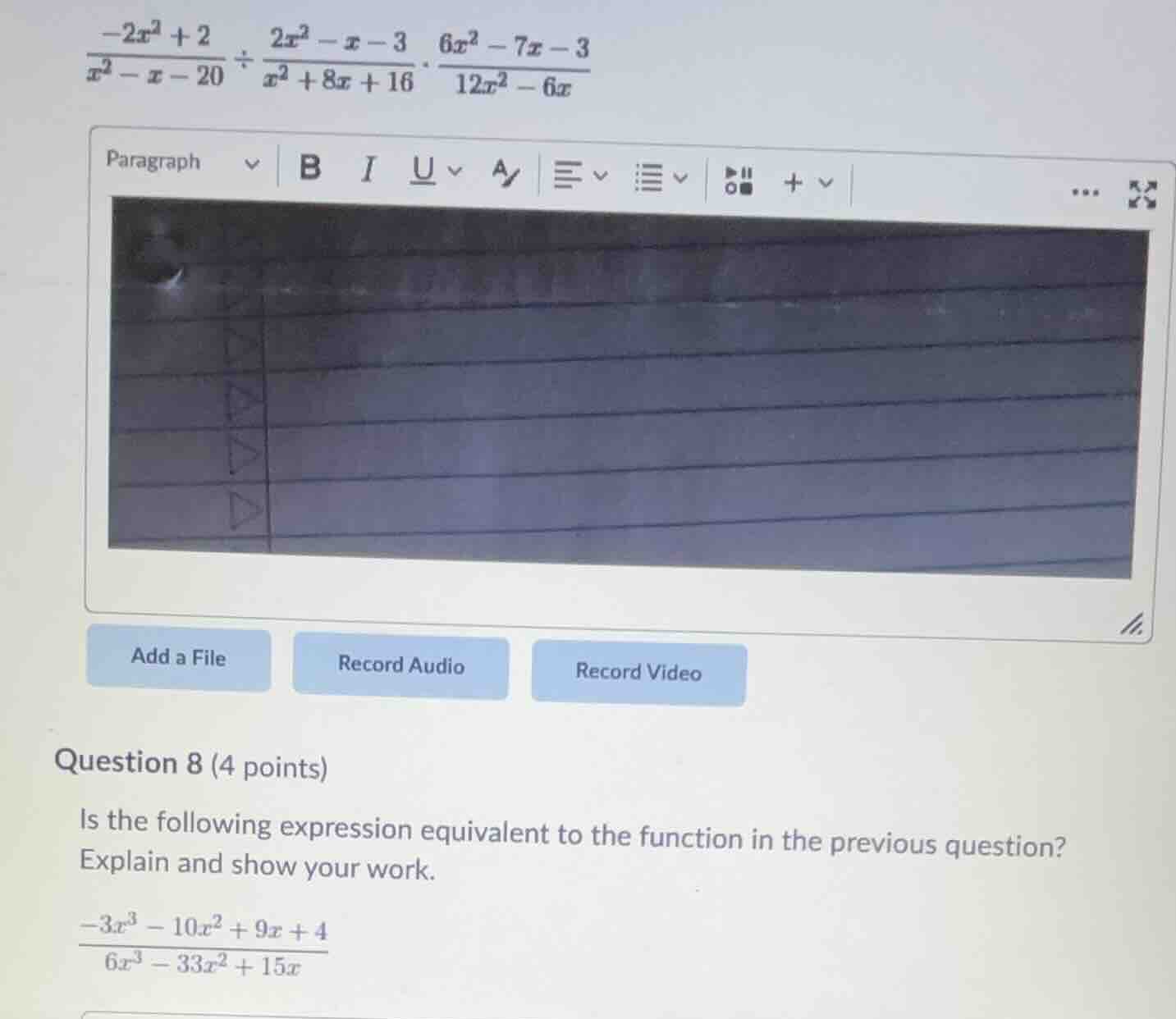
Question
\\\frac{-2x^2 + 2}{x^2 - x - 20} \div \frac{2x^2 - x - 3}{x^2 + 8x + 16} \cdot \frac{6x^2 - 7x - 3}{12x^2 - 6x}\\
question 8 (4 points)
is the following expression equivalent to the function in the previous question? explain and show your work.
\\\frac{-3x^3 - 10x^2 + 9x + 4}{6x^3 - 33x^2 + 15x}\\
Simplify the first rational expression and convert division to multiplication
$$
LATEXBLOCK0
$$
Cancel common factors to find the simplified form of the first expression
$$
LATEXBLOCK1
$$
Compare the simplified expression with the given expression
$$
LATEXBLOCK2
$$

Snap & solve any problem in the app
Get step-by-step solutions on Sovi AI
Photo-based solutions with guided steps
Explore more problems and detailed explanations
Yes, the expression is equivalent to the function in the previous question.
By factoring and simplifying the first expression:
$$
\frac{-2(x-1)(x+1)}{(x-5)(x+4)} \cdot \frac{(x+4)^2}{(2x-3)(x+1)} \cdot \frac{(2x-3)(3x+1)}{6x(2x-1)} = \frac{-(x-1)(x+4)(3x+1)}{3x(x-5)(2x-1)}
$$
Expanding the simplified numerator and denominator:
$$
\frac{-(3x^3 + 10x^2 - 9x - 4)}{3x(2x^2 - 11x + 5)} = \frac{-3x^3 - 10x^2 + 9x + 4}{6x^3 - 33x^2 + 15x}
$$
This matches the given expression exactly.