QUESTION IMAGE
Question
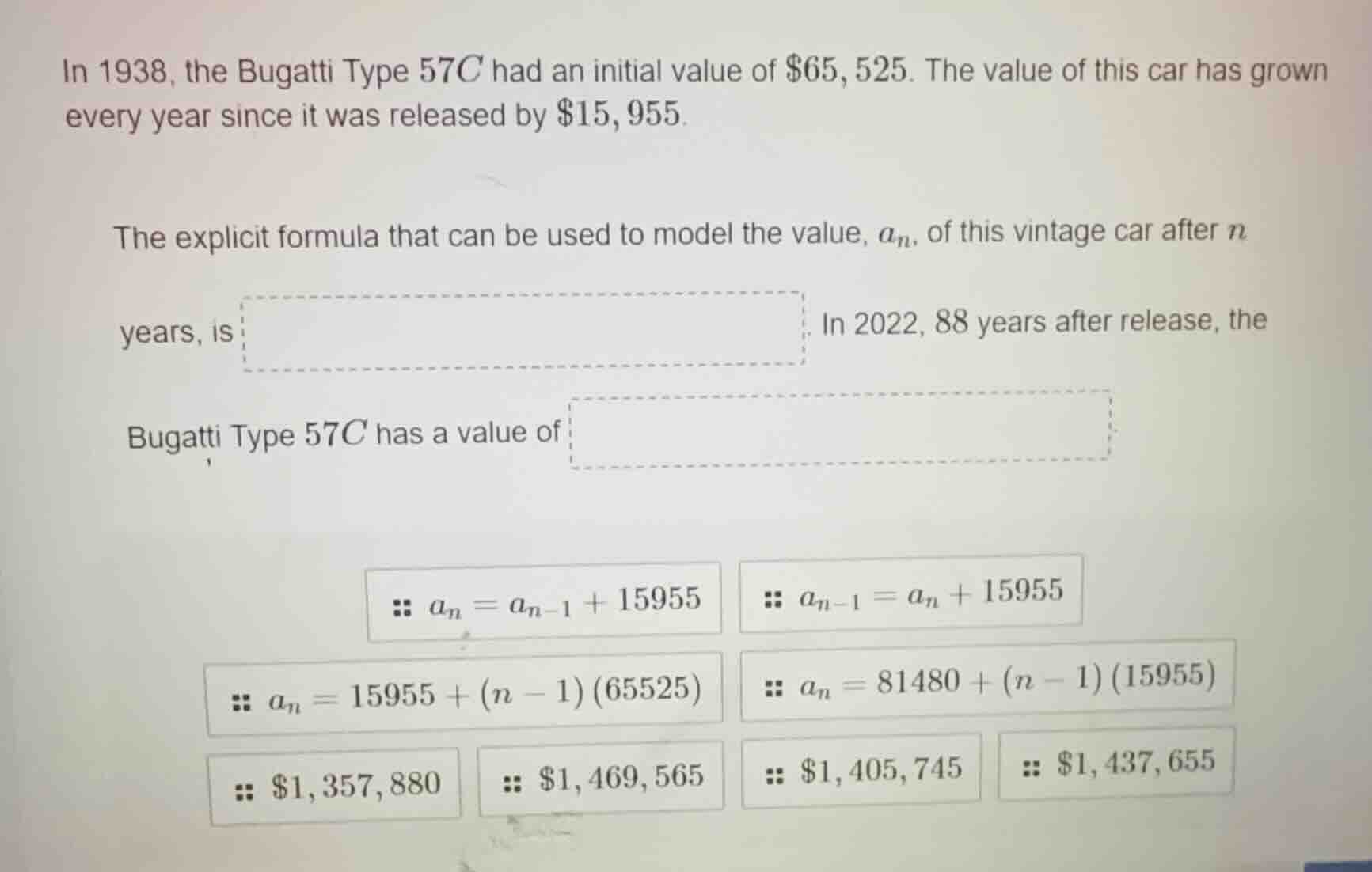
in 1938, the bugatti type 57c had an initial value of $65,525. the value of this car has grown every year since it was released by $15,955.
the explicit formula that can be used to model the value, $a_n$, of this vintage car after $n$ years, is \boxed{}. in 2022, 88 years after release, the bugatti type 57c has a value of \boxed{}.
\begin{tabular}{|c|c|}hline $a_n = a_{n-1} + 15955$ & $a_{n-1} = a_n + 15955$ \hline $a_n = 15955 + (n - 1)(65525)$ & $a_n = 81480 + (n - 1)(15955)$ \hline $$1,357,880$ & $$1,469,565$ \hline LXB11,437,655$ \hlineend{tabular}
Step1: Identify the sequence type
This is an arithmetic sequence problem where the initial value (first term \(a_1\)) is $65,525 and the common difference LXI1 is $15,955. The explicit formula for an arithmetic sequence is \(a_n = a_1+(n - 1)d\).
Substitute \(a_1 = 65525\) and \(d = 15955\) into the formula: \(a_n=65525+(n - 1)\times15955\). We can also simplify the formula: \(a_n=65525+15955n-15955=49570 + 15955n\) or \(a_n=65525+(n - 1)\times15955=15955n+(65525 - 15955)=15955n + 49570\). Another way to write it is \(a_n=65525+(n - 1)\times15955\), which can be expanded as \(a_n=15955(n - 1)+65525\). Wait, but let's check the given options. Wait, maybe I made a mistake. Wait, the first term \(a_1\) is when \(n = 1\) (after 1 year). Wait, initial value is at \(n = 0\)? Wait, no, the problem says "after \(n\) years". So when \(n = 0\), it's the initial value? Wait, no, let's re - read. "the value of this car has grown every year since it was released by $15,955". So in year 0 (1938), the value is $65,525. In year 1 (1939), the value is \(65525 + 15955\). So the explicit formula for an arithmetic sequence where \(a_n\) is the value after \(n\) years (with \(n = 0\) being the initial year) would be \(a_n=a_0+nd\), where \(a_0 = 65525\) and \(d = 15955\). But the options have formulas in terms of \((n - 1)\). Wait, maybe the problem considers \(n = 1\) as the first year after release. So when \(n = 1\), the value is \(65525\), and for \(n\) years after release, the formula is \(a_n=a_1+(n - 1)d\), where \(a_1 = 65525\) and \(d = 15955\). So \(a_n=65525+(n - 1)\times15955\). Let's simplify this: \(a_n=65525+15955n-15955=49570 + 15955n\). Now let's check the given formula options. One of the options is \(a_n=65525+(n - 1)\times15955\) (which is the same as \(a_n=15955(n - 1)+65525\)) and another is \(a_n=81480+(n - 1)\times15955\). Wait, that can't be. Wait, maybe I miscalculated. Wait, \(65525+15955 = 81480\). Oh! Wait a minute. If \(n = 1\) (after 1 year), the value is \(65525+15955=81480\). So maybe the formula is written with \(a_1 = 81480\) (the value after 1 year) and then the explicit formula is \(a_n=a_1+(n - 1)d\), where \(a_1 = 81480\) and \(d = 15955\). So \(a_n=81480+(n - 1)\times15955\). Yes, that makes sense. Because when \(n = 1\), \(a_1=81480+(1 - 1)\times15955=81480\), which is the value after 1 year (1939), and the initial value (1938) is \(81480 - 15955=65525\), which matches. So the correct explicit formula is \(a_n=81480+(n - 1)\times15955\).
Step2: Calculate the value after 88 years
Now, we need to find the value when \(n = 88\). Use the formula \(a_n=81480+(n - 1)\times15955\). Substitute \(n = 88\) into the formula:
First, calculate \((n - 1)=88 - 1 = 87\).
Then, calculate \((n - 1)\times15955=87\times15955\). Let's calculate \(87\times15955\):
\(80\times15955 = 1276400\)
\(7\times15955 = 111685\)
\(87\times15955=1276400 + 111685=1388085\)
Then, \(a_{88}=81480+1388085\)
\(a_{88}=1469565\)

Snap & solve any problem in the app
Get step-by-step solutions on Sovi AI
Photo-based solutions with guided steps
Explore more problems and detailed explanations
The explicit formula is \(a_{n}=81480+(n - 1)(15955)\) and the value after 88 years is \(\$1,469,565\)