QUESTION IMAGE
Question
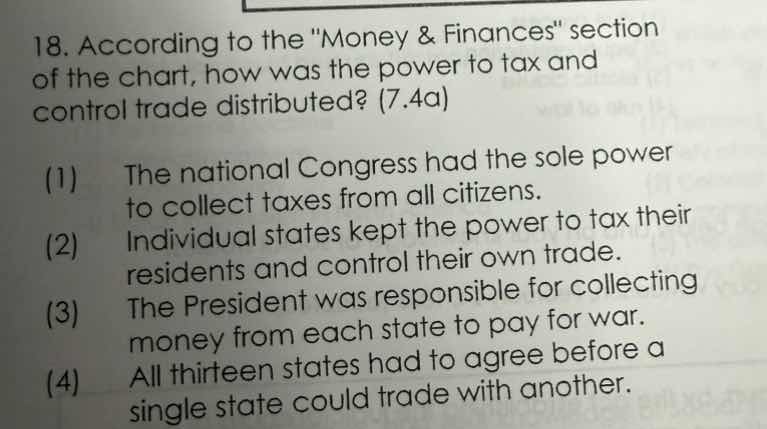
- according to the \money & finances\ section of the chart, how was the power to tax and control trade distributed? (7.4a)
(1) the national congress had the sole power to collect taxes from all citizens.
(2) individual states kept the power to tax their residents and control their own trade.
(3) the president was responsible for collecting money from each state to pay for war.
(4) all thirteen states had to agree before a single state could trade with another.
Analyze the historical context
The question references a chart comparing powers under the Articles of Confederation. Under this first constitution, the national government was intentionally kept weak.
Evaluate the distribution of power
Under the Articles of Confederation, the national Congress lacked the power to levy taxes directly or regulate interstate and foreign commerce.
Assess the options
- Option (1) is incorrect because Congress could not collect taxes directly from citizens.
- Option (2) is correct because individual states retained sovereignty, including the power to tax their residents and regulate their own trade.
- Option (3) is incorrect because there was no executive branch or President under the Articles.
- Option (4) is incorrect because states did not need unanimous consent to trade with one another.

Snap & solve any problem in the app
Get step-by-step solutions on Sovi AI
Photo-based solutions with guided steps
Explore more problems and detailed explanations
- (1) The national Congress had the sole power to collect taxes from all citizens.
- (2) Individual states kept the power to tax their residents and control their own trade. (Correct answer)
- (3) The President was responsible for collecting money from each state to pay for war.
- (4) All thirteen states had to agree before a single state could trade with another.