QUESTION IMAGE
Question
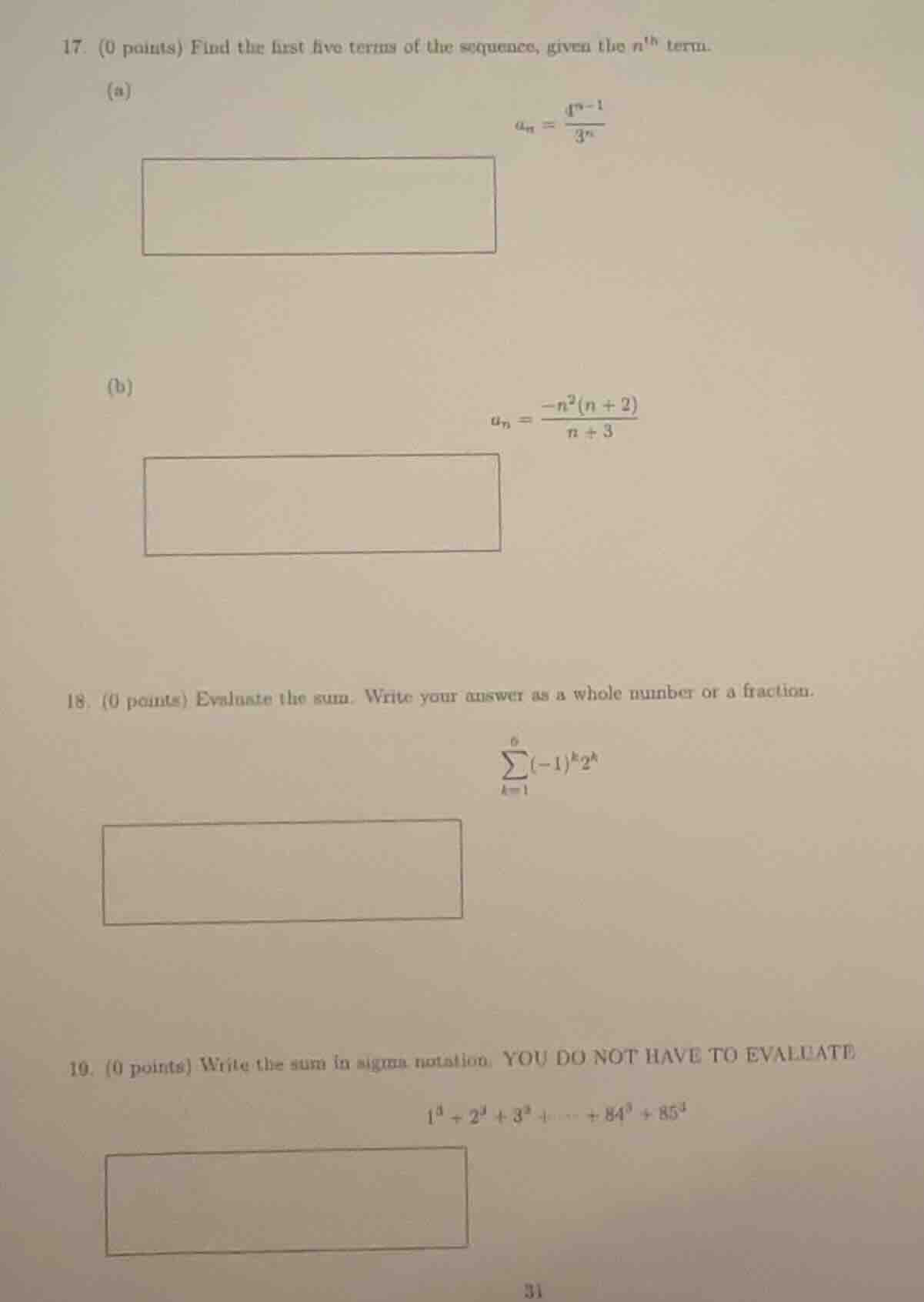
- (0 points) find the first five terms of the sequence, given the \\(n^{\text{th}}\\) term.
(a)
\\a_n = \frac{4^{n-1}}{3^n}\\
(b)
\\a_n = \frac{-n^2(n + 2)}{n + 3}\\
- (0 points) evaluate the sum. write your answer as a whole number or a fraction.
\\\sum_{k=1}^{6} (-1)^k 2^k\\
- (0 points) write the sum in sigma notation. you do not have to evaluate.
\\1^3 + 2^3 + 3^3 + \dots + 84^3 + 85^3\\
Step1: Find terms for 17(a)
$$a_n = \frac{4^{n-1}}{3^n} \implies a_1 = \frac{1}{3}, a_2 = \frac{4}{9}, a_3 = \frac{16}{27}, a_4 = \frac{64}{81}, a_5 = \frac{256}{243}$$
Step2: Find terms for 17(b)
$$u_n = \frac{-n^2(n+2)}{n+3} \implies u_1 = -\frac{3}{4}, u_2 = -\frac{8}{5}, u_3 = -\frac{15}{2}, u_4 = -\frac{96}{7}, u_5 = -\frac{175}{8}$$
Step3: Evaluate sum for 18
$$\sum_{k=1}^{6} (-1)^k 2^k = -2 + 4 - 8 + 16 - 32 + 64 = 42$$
Step4: Write sigma notation for 19
$$1^3 + 2^3 + 3^3 + \dots + 84^3 + 85^3 = \sum_{i=1}^{85} i^3$$

Snap & solve any problem in the app
Get step-by-step solutions on Sovi AI
Photo-based solutions with guided steps
Explore more problems and detailed explanations
- (a) \(\frac{1}{3}, \frac{4}{9}, \frac{16}{27}, \frac{64}{81}, \frac{256}{243}\)
(b) \(-\frac{3}{4}, -\frac{8}{5}, -\frac{15}{2}, -\frac{96}{7}, -\frac{175}{8}\)
- \(42\)
- \(\sum_{i=1}^{85} i^3\)