QUESTION IMAGE
Question
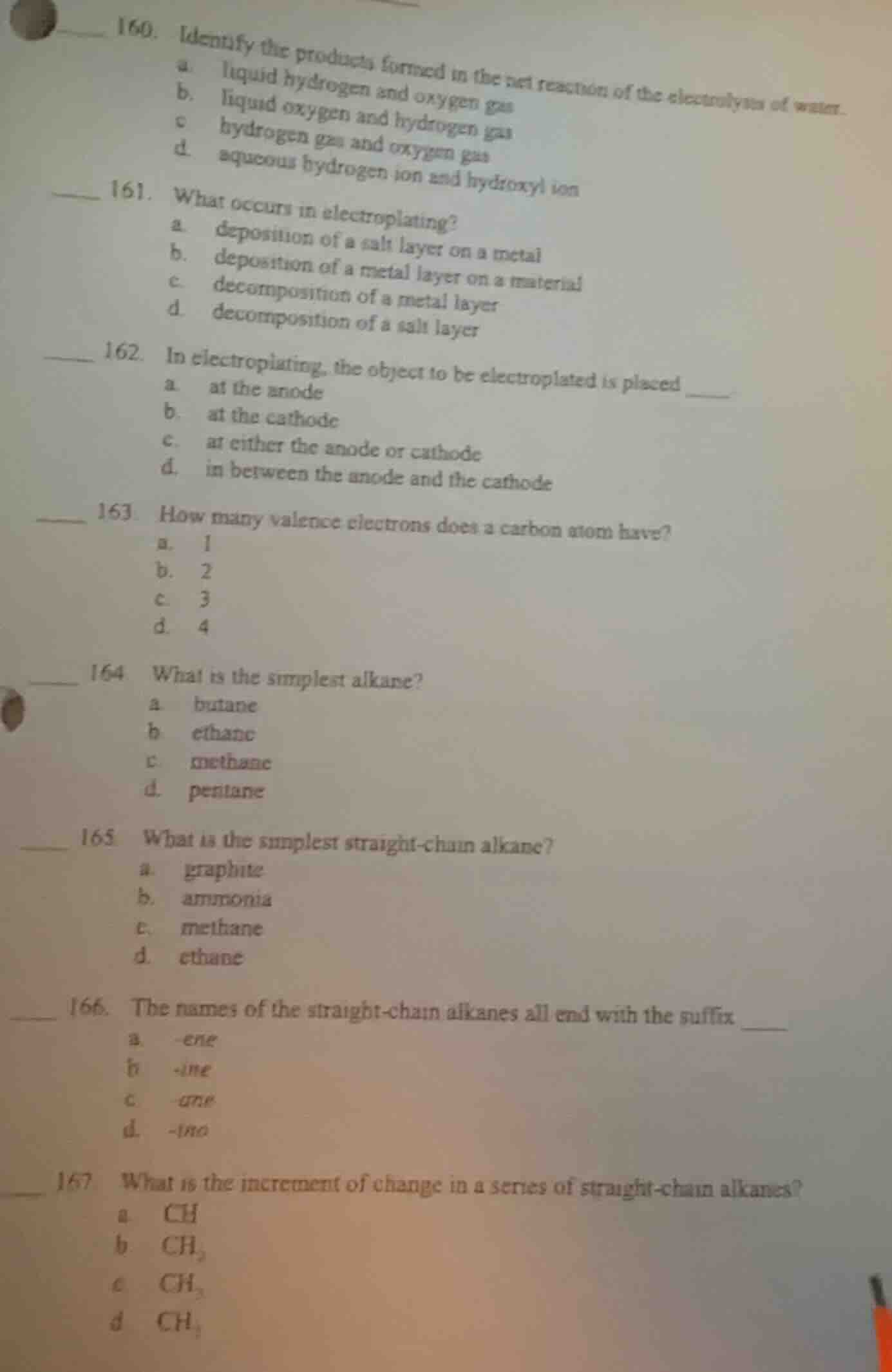
- identify the products formed in the net reaction of the electrolysis of water.
a. liquid hydrogen and oxygen gas
b. liquid oxygen and hydrogen gas
c. hydrogen gas and oxygen gas
d. aqueous hydrogen ion and hydroxyl ion
- what occurs in electroplating?
a. deposition of a salt layer on a metal
b. deposition of a metal layer on a material
c. decomposition of a metal layer
d. decomposition of a salt layer
- in electroplating, the object to be electroplated is placed ______.
a. at the anode
b. at the cathode
c. at either the anode or cathode
d. in between the anode and the cathode
- how many valence electrons does a carbon atom have?
a. 1
b. 2
c. 3
d. 4
- what is the simplest alkane?
a. butane
b. ethane
c. methane
d. pentane
- what is the simplest straight-chain alkane?
a. graphite
b. ammonia
c. methane
d. ethane
- the names of the straight-chain alkanes all end with the suffix ______.
a. -ene
b. -ine
c. -ane
d. -ino
- what is the increment of change in a series of straight-chain alkanes?
a. \\(\text{ch}\\)
b. \\(\text{ch}_2\\)
c. \\(\text{ch}_3\\)
d. \\(\text{ch}_4\\)
Analyze electrolysis of water
Using the Electrolysis knowledge point
The overall chemical equation for the electrolysis of water is:
The products formed are hydrogen gas and oxygen gas. Thus, option (c) is correct.
Analyze electroplating principles
Electroplating is an electrochemical process where metal ions in a solution are reduced to form a thin, coherent metal coating on an electrode. This results in the deposition of a metal layer on a material. The object to be plated is placed at the cathode (negative electrode) where reduction of metal cations (\(\text{M}^{n+} + n\text{e}^-
ightarrow \text{M}\)) occurs.
- For 161: Option (b) is correct.
- For 162: Option (b) is correct.
Determine carbon valence electrons
Using the Valence Electron Shells knowledge point
Carbon is in Group 14 (IVA) of the periodic table. Its ground-state electron configuration is \(1s^2 2s^2 2p^2\). The outermost shell (shell \(n=2\)) contains \(2 + 2 = 4\) valence electrons. Thus, option (d) is correct.
Identify simplest alkanes
Alkanes are saturated hydrocarbons with the general formula \(\text{C}_n\text{H}_{2n+2}\).
- The simplest alkane has \(n=1\), which is methane (\(\text{CH}_4\)). This is also the simplest straight-chain alkane.
- For 164: Option (c) is correct.
- For 165: Option (c) is correct.
Analyze alkane nomenclature and series
- Saturated hydrocarbons (alkanes) are named using the suffix "-ane". Thus, option (c) is correct for 166.
- In a homologous series of straight-chain alkanes, each successive member differs from the previous one by a constant increment of one carbon atom and two hydrogen atoms, which is a methylene group, \(\text{CH}_2\). Thus, option (b) is correct for 167.

Snap & solve any problem in the app
Get step-by-step solutions on Sovi AI
Photo-based solutions with guided steps
Explore more problems and detailed explanations
Question 160
- a. liquid hydrogen and oxygen gas
- b. liquid oxygen and hydrogen gas
- c. hydrogen gas and oxygen gas (Correct answer)
- d. aqueous hydrogen ion and hydroxyl ion
Question 161
- a. deposition of a salt layer on a metal
- b. deposition of a metal layer on a material (Correct answer)
- c. decomposition of a metal layer
- d. decomposition of a salt layer
Question 162
- a. at the anode
- b. at the cathode (Correct answer)
- c. at either the anode or cathode
- d. in between the anode and the cathode
Question 163
- a. 1
- b. 2
- c. 3
- d. 4 (Correct answer)
Question 164
- a. butane
- b. ethane
- c. methane (Correct answer)
- d. pentane
Question 165
- a. graphite
- b. ammonia
- c. methane (Correct answer)
- d. ethane
Question 166
- a. -ene
- b. -ine
- c. -ane (Correct answer)
- d. -yne
Question 167
- a. \(\text{CH}\)
- b. \(\text{CH}_2\) (Correct answer)
- c. \(\text{CH}_3\)
- d. \(\text{CH}_4\)