QUESTION IMAGE
Question
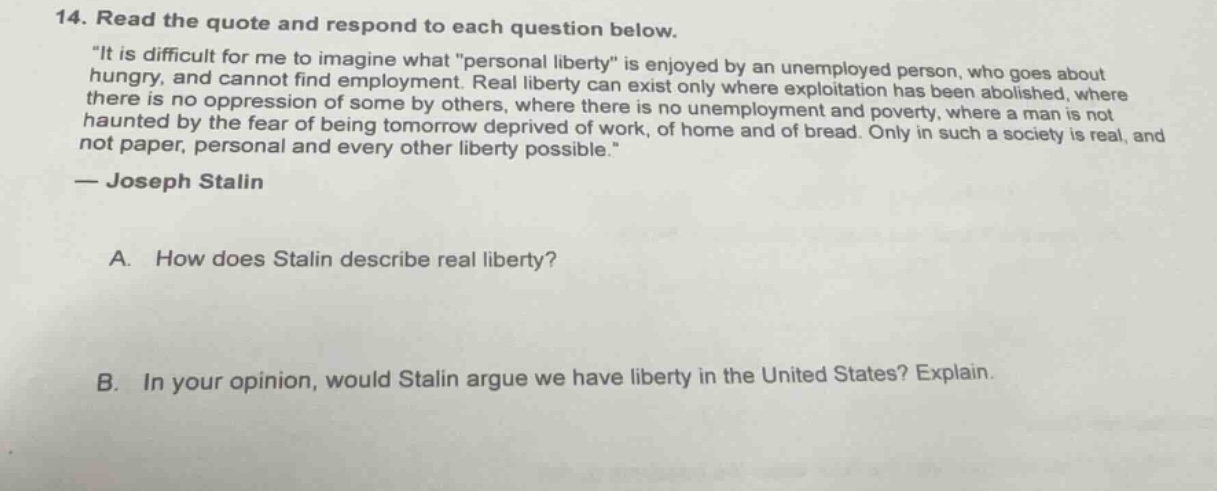
- read the quote and respond to each question below.
\it is difficult for me to imagine what \personal liberty\ is enjoyed by an unemployed person, who goes about hungry, and cannot find employment. real liberty can exist only where exploitation has been abolished, where there is no oppression of some by others, where there is no unemployment and poverty, where a man is not haunted by the fear of being tomorrow deprived of work, of home and of bread. only in such a society is real, and not paper, personal and every other liberty possible.\
— joseph stalin
a. how does stalin describe real liberty?
b. in your opinion, would stalin argue we have liberty in the united states? explain.
Analyze Stalin's definition of real liberty
Stalin argues that "personal liberty" is meaningless for an unemployed, hungry person. Using the Stalinist Era perspective, he asserts that "real liberty" can only exist where exploitation, oppression, unemployment, and poverty are abolished. To him, true freedom is economic security and freedom from basic material wants.
Evaluate the US context from Stalin's perspective
Stalin would argue that the United States does not have real liberty. Because the US is a capitalist society, it permits unemployment, poverty, and class exploitation. From his viewpoint, American political liberties are merely "paper" freedoms that fail to protect citizens from the fear of losing work, home, and bread.

Snap & solve any problem in the app
Get step-by-step solutions on Sovi AI
Photo-based solutions with guided steps
Explore more problems and detailed explanations
Question A
Stalin describes "real liberty" as a state that can only exist when exploitation and oppression have been completely abolished. In his view, true freedom requires the elimination of unemployment and poverty, ensuring that individuals are not haunted by the fear of losing their work, home, or food.
Question B
Stalin would argue that we do not have real liberty in the United States. From his socialist perspective, capitalist systems inherently involve class exploitation, unemployment, and poverty. He would view American political and personal freedoms as merely "paper" liberties because they do not guarantee economic security or free citizens from basic material deprivation.