QUESTION IMAGE
Question
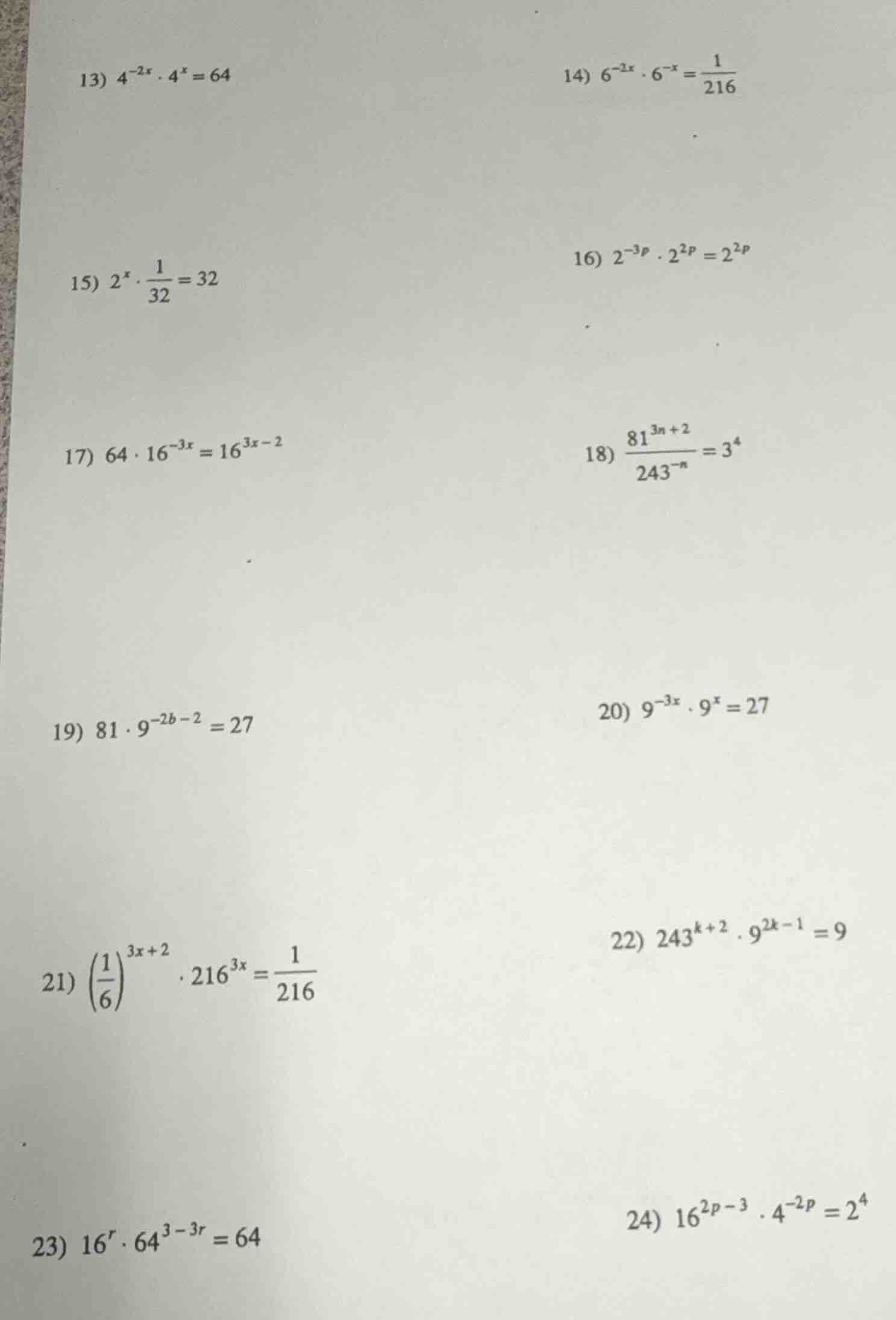
- $4^{-2x} \cdot 4^{x} = 64$
- $6^{-2x} \cdot 6^{-x} = \frac{1}{216}$
- $2^{x} \cdot \frac{1}{32} = 32$
- $2^{-3p} \cdot 2^{2p} = 2^{2p}$
- $64 \cdot 16^{-3x} = 16^{3x - 2}$
- $\frac{81^{3n + 2}}{243^{-n}} = 3^{4}$
- $81 \cdot 9^{-2b - 2} = 27$
- $9^{-3x} \cdot 9^{x} = 27$
- $\left(\frac{1}{6}\
ight)^{3x + 2} \cdot 216^{3x} = \frac{1}{216}$
- $243^{k + 2} \cdot 9^{2k - 1} = 9$
- $16^{r} \cdot 64^{3 - 3r} = 64$
- $16^{2p - 3} \cdot 4^{-2p} = 2^{4}$
Response
Let's solve problem 13: \( 4^{-2x} \cdot 4^{x} = 64 \)
Step 1: Use exponent rule \( a^m \cdot a^n = a^{m + n} \)
\( 4^{-2x + x} = 64 \)
Simplify the exponent: \( 4^{-x} = 64 \)
Step 2: Express 4 and 64 as powers of 2
We know that \( 4 = 2^2 \) and \( 64 = 2^6 \). So we can rewrite the equation:
\( (2^2)^{-x} = 2^6 \)
Step 3: Use exponent rule \( (a^m)^n = a^{m \cdot n} \)
\( 2^{-2x} = 2^6 \)
Step 4: Since the bases are equal, set the exponents equal
\( -2x = 6 \)
Step 5: Solve for \( x \)
Divide both sides by -2: \( x = \frac{6}{-2} = -3 \)

Snap & solve any problem in the app
Get step-by-step solutions on Sovi AI
Photo-based solutions with guided steps
Explore more problems and detailed explanations
\( x = -3 \)