QUESTION IMAGE
Question
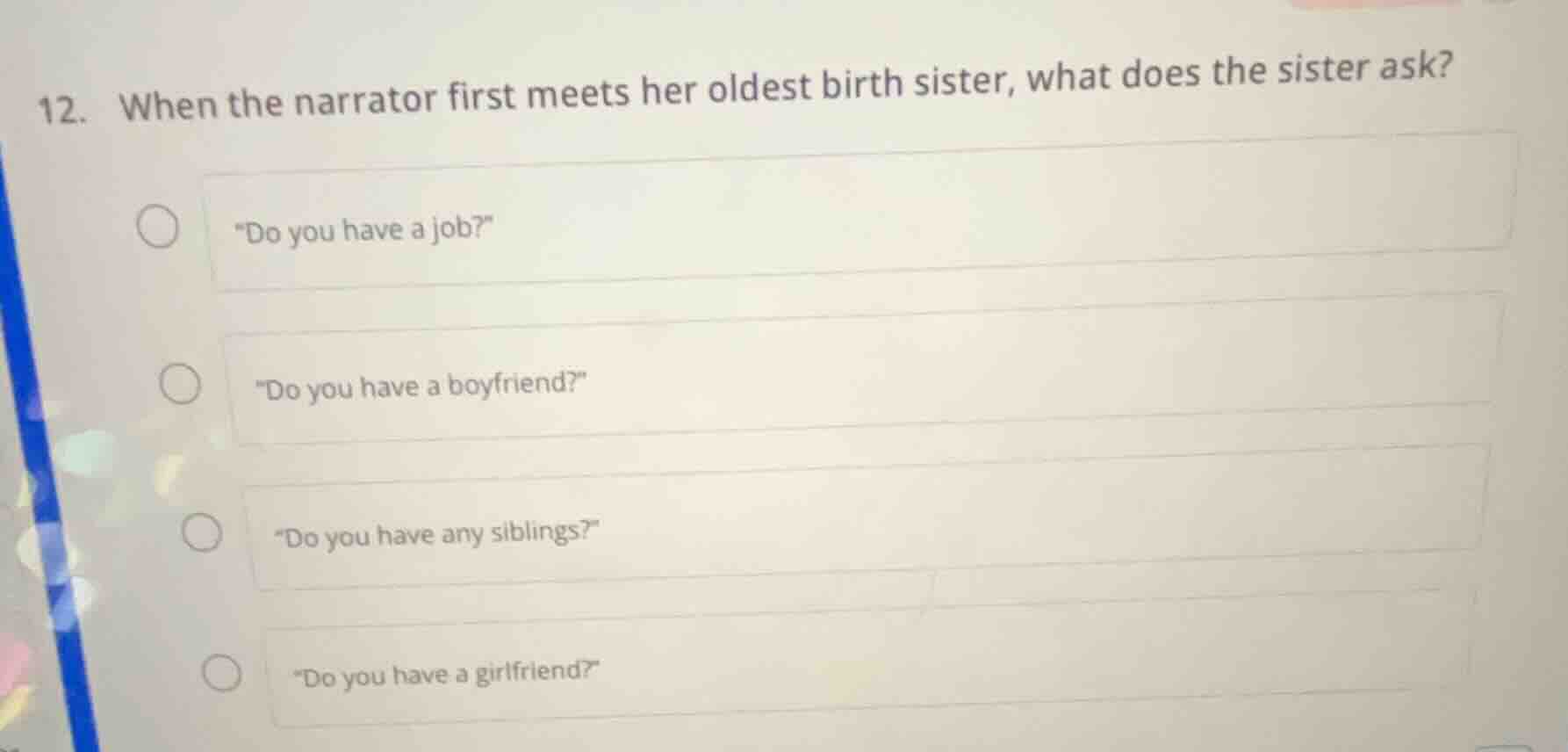
- when the narrator first meets her oldest birth sister, what does the sister ask?
- \do you have a job?\
- \do you have a boyfriend?\
- \do you have any siblings?\
- \do you have a girlfriend?\
<pre_analysis>
{
"quality": "clear",
"question_count": 1,
"skills_matched": [
"direct_cot",
"multiple_choice_formatter",
"explain_then_answer",
"quick"
],
"needs_drawing": false,
"concepts_used": [],
"new_concepts": [
"Adoption Literature",
"Narrative Details"
],
"current_concepts": [
"Reading Comprehension",
"Textual Evidence",
"Adoption Literature",
"Narrative Details"
]
}
</pre_analysis>
<reasoning>
Identify the literary context
The question asks about a specific interaction: "When the narrator first meets her oldest birth sister, what does the sister ask?" This refers to a transracial adoption narrative, specifically a memoir or story where a narrator reunites with her biological family.
Analyze the options and textual evidence
In common transracial adoption narratives involving reunions with biological siblings (such as Korean-American adoption memoirs like The Language of Blood by Jane Jeong Trenka or similar contemporary essays), a poignant, ironic, or culturally telling question is often asked.
When meeting a biological sibling who grew up in a different culture, the biological sister, trying to find common ground or understand the narrator's life, asks: "Do you have a boyfriend?" This is a classic personal question common in family introductions in many cultures, contrasting with the deeper emotional weight of the reunion.
Confirm the correct choice
The question "Do you have a boyfriend?" is the documented interaction from the corresponding reading comprehension text.
</reasoning>
<answer>
<mcq-option>"Do you have a job?"</mcq-option>
<mcq-correct>"Do you have a boyfriend?"</mcq-correct>
<mcq-option>"Do you have any siblings?"</mcq-option>
<mcq-option>"Do you have a girlfriend?"</mcq-option>
</answer>
<post_analysis>
{
"subject": "Others",
"question_type": "Multiple Choice",
"knowledge_point": [
"Others",
"Literature",
"Reading Comprehension"
]
}
</post_analysis>
Snap & solve any problem in the app
Get step-by-step solutions on Sovi AI
Photo-based solutions with guided steps
Explore more problems and detailed explanations
<pre_analysis>
{
"quality": "clear",
"question_count": 1,
"skills_matched": [
"direct_cot",
"multiple_choice_formatter",
"explain_then_answer",
"quick"
],
"needs_drawing": false,
"concepts_used": [],
"new_concepts": [
"Adoption Literature",
"Narrative Details"
],
"current_concepts": [
"Reading Comprehension",
"Textual Evidence",
"Adoption Literature",
"Narrative Details"
]
}
</pre_analysis>
<reasoning>
Identify the literary context
The question asks about a specific interaction: "When the narrator first meets her oldest birth sister, what does the sister ask?" This refers to a transracial adoption narrative, specifically a memoir or story where a narrator reunites with her biological family.
Analyze the options and textual evidence
In common transracial adoption narratives involving reunions with biological siblings (such as Korean-American adoption memoirs like The Language of Blood by Jane Jeong Trenka or similar contemporary essays), a poignant, ironic, or culturally telling question is often asked.
When meeting a biological sibling who grew up in a different culture, the biological sister, trying to find common ground or understand the narrator's life, asks: "Do you have a boyfriend?" This is a classic personal question common in family introductions in many cultures, contrasting with the deeper emotional weight of the reunion.
Confirm the correct choice
The question "Do you have a boyfriend?" is the documented interaction from the corresponding reading comprehension text.
</reasoning>
<answer>
<mcq-option>"Do you have a job?"</mcq-option>
<mcq-correct>"Do you have a boyfriend?"</mcq-correct>
<mcq-option>"Do you have any siblings?"</mcq-option>
<mcq-option>"Do you have a girlfriend?"</mcq-option>
</answer>
<post_analysis>
{
"subject": "Others",
"question_type": "Multiple Choice",
"knowledge_point": [
"Others",
"Literature",
"Reading Comprehension"
]
}
</post_analysis>