QUESTION IMAGE
Question
- write the name of main source of water.
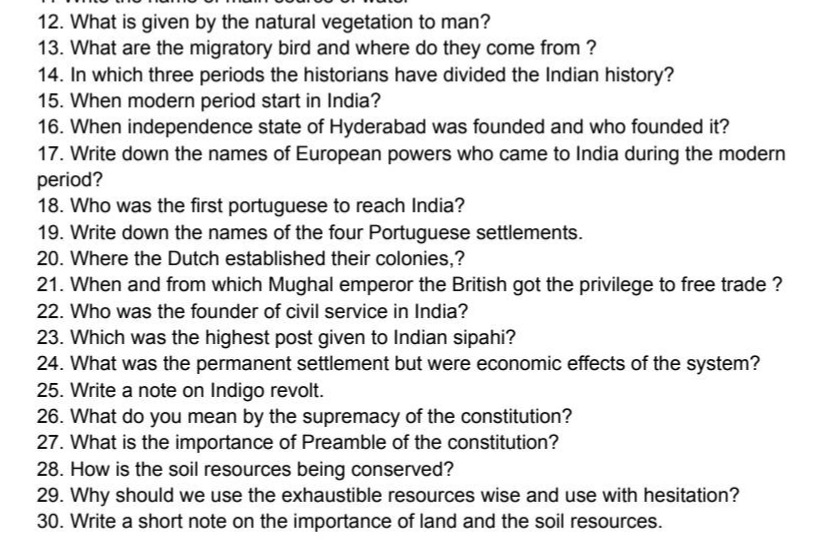
- what is given by the natural vegetation to man?
- what are the migratory bird and where do they come from ?
- in which three periods the historians have divided the indian history?
- when modern period start in india?
- when independence state of hyderabad was founded and who founded it?
- write down the names of european powers who came to india during the modern period?
- who was the first portuguese to reach india?
- write down the names of the four portuguese settlements.
- where the dutch established their colonies,?
- when and from which mughal emperor the british got the privilege to free trade ?
- who was the founder of civil service in india?
- which was the highest post given to indian sipahi?
- what was the permanent settlement but were economic effects of the system?
- write a note on indigo revolt.
- what do you mean by the supremacy of the constitution?
- what is the importance of preamble of the constitution?
- how is the soil resources being conserved?
- why should we use the exhaustible resources wise and use with hesitation?
- write a short note on the importance of land and the soil resources.
🆕 New Concept Discovered: Historical Periodisation and Resource Management
Understanding how history is divided and how natural resources are conserved.
Step 1: Geography and Ecology Questions (Q11–Q13)
- 11. Main source of water: Rainwater is the primary natural source of all fresh water on Earth, which replenishes surface bodies like rivers, lakes, and underground aquifers.
- 12. Benefits of natural vegetation: Natural vegetation provides humans with timber, firewood, oxygen, medicinal plants, fruits, nuts, and raw materials for industries (like paper and rubber). It also helps prevent soil erosion and maintains the water cycle.
- 13. Migratory birds: Migratory birds are birds that fly long distances from one region to another at specific times of the year to escape harsh weather, find food, or breed. They typically come to India from cold northern regions like Siberia, Central Asia, and Europe during the winter season (e.g., Siberian Cranes).
Step 2: Indian History Periodisation (Q14–Q15)
- 14. Three periods of Indian history: Historians have generally divided Indian history into:
- Ancient Period
- Medieval Period
- Modern Period
- 15. Start of the Modern Period in India: In India, the modern period is generally considered to have started in the 18th century, following the decline of the Mughal Empire and the gradual rise of British colonial power.
Step 3: Colonial Expansion and European Powers (Q16–Q20)
- 16. Independence state of Hyderabad: The independent state of Hyderabad was founded in 1724 by Mir Qamar-ud-din Khan (also known as Nizam-ul-Mulk Asaf Jah I).
- 17. European powers in India: The major European powers that came to India during the modern period were:
- The Portuguese
- The Dutch
- The British (English)
- The French
- The Danes (Danish)
- 18. First Portuguese to reach India: Vasco da Gama was the first Portuguese explorer to reach India, landing at Calicut (Kozhikode) in 1498.
- 19. Four Portuguese settlements: Four major Portuguese settlements in India were:
- Goa
- Daman
- Diu
- Cochin (Kochi)
- 20. Dutch colonies: The Dutch established their trading factories and colonies in places like Masulipatnam, Pulicat, Surat, Chinsurah, and Cochin.
Step 4: British Administration and Economic Policies (Q21–Q25)
- 21. British free trade privilege: The British East India Company obtained the privilege of duty-free trade (Farman) in 1717 from the Mughal Emperor Farrukhsiyar.
- 22. Founder of Civil Service in India: Lord Cornwallis is considered the founder of the Civil Service in India.
- 23. Highest post for Indian Sipahi: Under British rule, the highest rank an Indian soldier (sipahi/sepoy) could achieve was that of a Subedar.
- 24. Permanent Settlement and its economic effects:
- What it was: Introduced by Lord Cornwallis in 1793 in Bengal, it fixed the land revenue permanently for landlords (Zamindars).
- Economic effects: It led to the exploitation of peasants who were forced to pay high rents, caused many Zamindars to lose their lands if they failed to pay on time, and drained the rural economy while securing a fixed income for the British.
- 25. Note on the Indigo Revolt: The Indigo Revolt (1859) was a peasant uprising in Bengal where farmers refused to grow indigo. British planters forced them to grow indigo under highly exploitative contracts instead of food crops. Led by figures…

Snap & solve any problem in the app
Get step-by-step solutions on Sovi AI
Photo-based solutions with guided steps
Explore more problems and detailed explanations
All questions from 11 to 30 have been answered systematically above, covering key topics in Geography, History, Civics, and Resource Management.