QUESTION IMAGE
Question
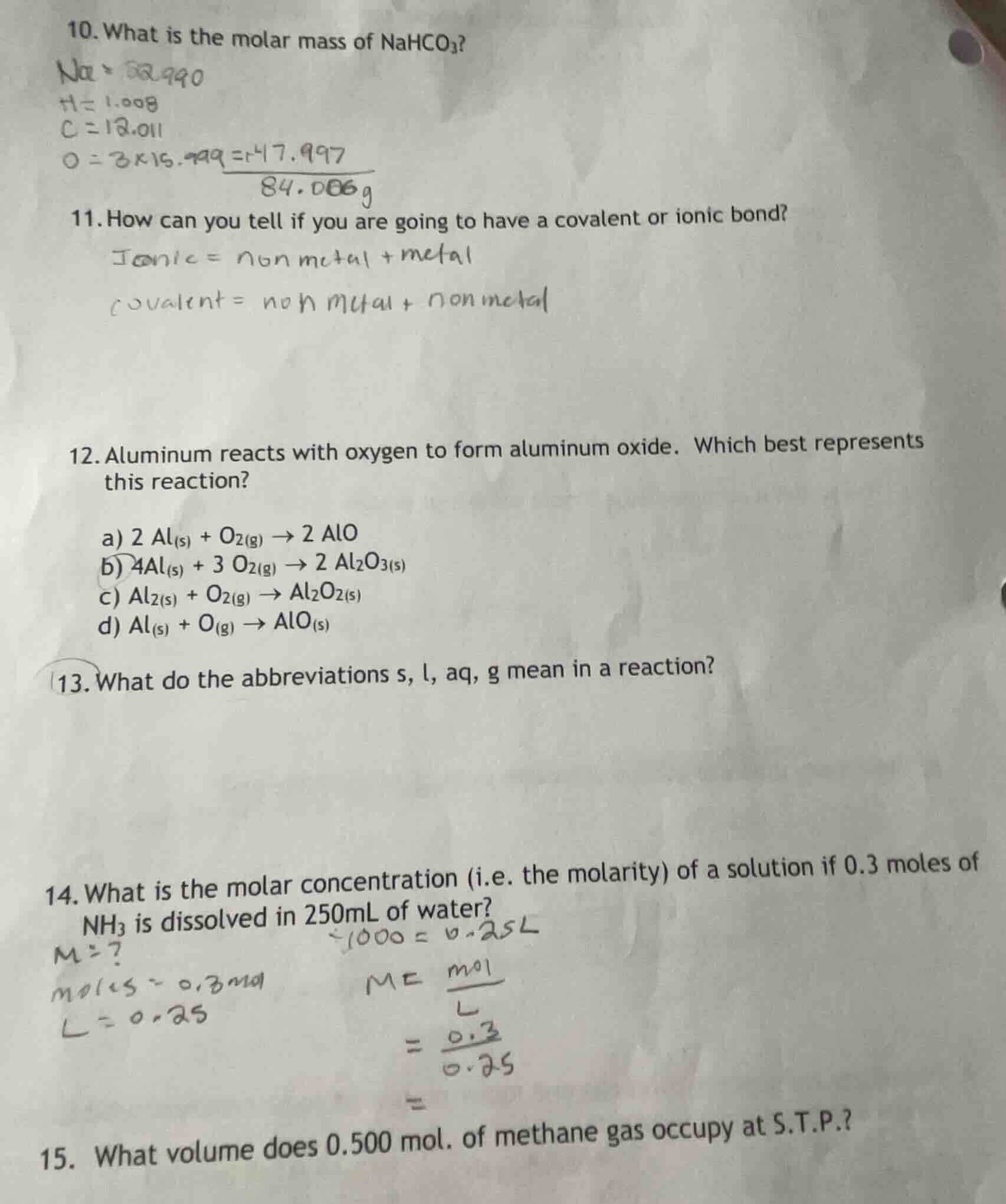
- what is the molar mass of \\(\text{nahco}_3\\)?
- how can you tell if you are going to have a covalent or ionic bond?
- aluminum reacts with oxygen to form aluminum oxide. which best represents this reaction?
a) \\(2\text{al}_{(\text{s})} + \text{o}_{2(\text{g})} \
ightarrow 2\text{alo}\\)
b) \\(4\text{al}_{(\text{s})} + 3\text{o}_{2(\text{g})} \
ightarrow 2\text{al}_2\text{o}_{3(\text{s})}\\)
c) \\(\text{al}_{2(\text{s})} + \text{o}_{2(\text{g})} \
ightarrow \text{al}_2\text{o}_{2(\text{s})}\\)
d) \\(\text{al}_{(\text{s})} + \text{o}_{(\text{g})} \
ightarrow \text{alo}_{(\text{s})}\\)
- what do the abbreviations s, l, aq, g mean in a reaction?
- what is the molar concentration (i.e. the molarity) of a solution if 0.3 moles of \\(\text{nh}_3\\) is dissolved in 250ml of water?
- what volume does 0.500 mol. of methane gas occupy at s.t.p.?
Calculate molar mass of sodium bicarbonate
We sum the atomic masses of all atoms in the chemical formula \( \text{NaHCO}_3 \).
Using standard atomic masses:
- \( \text{Na} = 22.990 \text{ g/mol} \)
- \( \text{H} = 1.008 \text{ g/mol} \)
- \( \text{C} = 12.011 \text{ g/mol} \)
- \( \text{O} = 3 \times 15.999 = 47.997 \text{ g/mol} \)
Summing these values:
Distinguish ionic and covalent bonds
We identify the types of elements involved in the bonding:
- Ionic Compounds are formed when a metal transfers electrons to a non-metal.
- Covalent bonds are formed when two non-metals share electrons.
Identify the balanced reaction for aluminum oxide
Aluminum (\(\text{Al}\)) reacts with oxygen gas (\(\text{O}_2\)) to form aluminum oxide (\(\text{Al}_2\text{O}_3\)).
Using Chemical Equation Balancing, we balance the atoms on both sides:
This matches option (b).
Define state abbreviations in reactions
These abbreviations represent the physical states of the substances:
- \(\text{s}\): solid
- \(\text{l}\): liquid
- \(\text{aq}\): aqueous (dissolved in water)
- \(\text{g}\): gas
Calculate molar concentration of ammonia
Molarity (\(M\)) is defined as moles of solute per liter of solution:
Convert volume to liters:
Calculate concentration:
Calculate gas volume at STP
At Standard Temperature and Pressure (STP), 1 mole of any ideal gas occupies a molar volume of \(22.4 \text{ L}\).
Using this relationship:

Snap & solve any problem in the app
Get step-by-step solutions on Sovi AI
Photo-based solutions with guided steps
Explore more problems and detailed explanations
Question 10
The molar mass of \( \text{NaHCO}_3 \) is \( 84.006 \text{ g/mol} \).
Question 11
- Ionic bond: Formed between a metal and a non-metal (via electron transfer).
- Covalent bond: Formed between two non-metals (via electron sharing).
Question 12
- a) 2 Al(s) + O2(g) -> 2 AlO
- b) 4Al(s) + 3 O2(g) -> 2 Al2O3(s) (Correct answer)
- c) Al2(s) + O2(g) -> Al2O2(s)
- d) Al(s) + O(g) -> AlO(s)
Question 13
- s: solid
- l: liquid
- aq: aqueous (dissolved in water)
- g: gas
Question 14
The molar concentration of the solution is \( 1.2 \text{ M} \) (or \( 1.2 \text{ mol/L} \)).
Question 15
The volume occupied by the gas at STP is \( 11.2 \text{ L} \).