Sovi.AI - AI Math Tutor

Scan to solve math questions

QUESTION IMAGE

you are providing care to a 30-year-old patient who presents with an ac…

Question

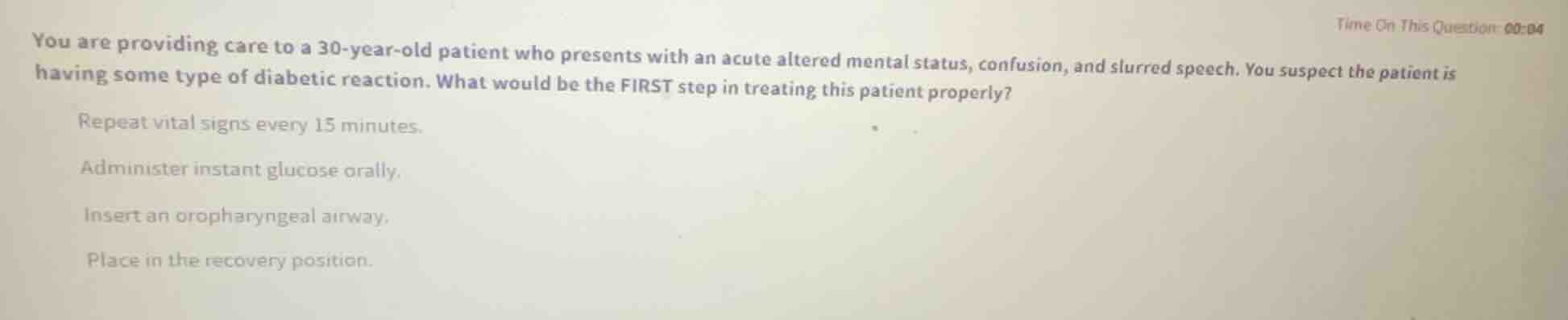
you are providing care to a 30-year-old patient who presents with an acute altered mental status, confusion, and slurred speech. you suspect the patient is having some type of diabetic reaction. what would be the first step in treating this patient properly?

repeat vital signs every 15 minutes.
administer instant glucose orally.
insert an oropharyngeal airway.
place in the recovery position.

Explanation:

Response

<pre_analysis>
{
"quality": "clear",
"question_count": 1,
"skills_matched": [
"direct_cot",
"multiple_choice_formatter",
"explain_then_answer",
"tutor",
"mastery_adaptive_brevity"
],
"needs_drawing": false,
"concepts_used": [
"Diabetic Emergencies Onset",
"Patient Positioning"
],
"new_concepts": [
"Altered Mental Status Management",
"Oral Glucose Contraindications"
],
"current_concepts": [
"Diabetic Emergencies Onset",
"Patient Positioning",
"Altered Mental Status Management",
"Oral Glucose Contraindications"
]
}
</pre_analysis>

<reasoning>

Assess patient airway and safety

Using the Diabetic Emergencies Onset and Patient Positioning knowledge points

  • The patient presents with acute altered mental status, confusion, and slurred speech.
  • These clinical signs indicate that the patient's airway reflexes may be compromised, making oral administration of glucose highly dangerous due to the risk of aspiration.
  • Placing the patient in the recovery position (lateral recumbent position) is the immediate priority to protect the airway, prevent aspiration, and manage secretions.

Evaluate alternative interventions

  • Administering oral glucose is contraindicated because the patient cannot safely swallow or follow commands.
  • Inserting an oropharyngeal airway is indicated only for unresponsive patients without a gag reflex, which is not established here.
  • Repeating vital signs every 15 minutes is a monitoring step, not an immediate airway-protective treatment.

</reasoning>

<answer>
<mcq-option>Repeat vital signs every 15 minutes.</mcq-option>
<mcq-option>Administer instant glucose orally.</mcq-option>
<mcq-option>Insert an oropharyngeal airway.</mcq-option>
<mcq-correct>Place in the recovery position.</mcq-correct>
</answer>

<post_analysis>
{
"subject": "Natural Science",
"question_type": "Multiple Choice",
"knowledge_point": [
"Natural Science",
"Medicine",
"Emergency Medical Services"
]
}
</post_analysis>

Answer:

<pre_analysis>
{
"quality": "clear",
"question_count": 1,
"skills_matched": [
"direct_cot",
"multiple_choice_formatter",
"explain_then_answer",
"tutor",
"mastery_adaptive_brevity"
],
"needs_drawing": false,
"concepts_used": [
"Diabetic Emergencies Onset",
"Patient Positioning"
],
"new_concepts": [
"Altered Mental Status Management",
"Oral Glucose Contraindications"
],
"current_concepts": [
"Diabetic Emergencies Onset",
"Patient Positioning",
"Altered Mental Status Management",
"Oral Glucose Contraindications"
]
}
</pre_analysis>

<reasoning>

Assess patient airway and safety

Using the Diabetic Emergencies Onset and Patient Positioning knowledge points

  • The patient presents with acute altered mental status, confusion, and slurred speech.
  • These clinical signs indicate that the patient's airway reflexes may be compromised, making oral administration of glucose highly dangerous due to the risk of aspiration.
  • Placing the patient in the recovery position (lateral recumbent position) is the immediate priority to protect the airway, prevent aspiration, and manage secretions.

Evaluate alternative interventions

  • Administering oral glucose is contraindicated because the patient cannot safely swallow or follow commands.
  • Inserting an oropharyngeal airway is indicated only for unresponsive patients without a gag reflex, which is not established here.
  • Repeating vital signs every 15 minutes is a monitoring step, not an immediate airway-protective treatment.

</reasoning>

<answer>
<mcq-option>Repeat vital signs every 15 minutes.</mcq-option>
<mcq-option>Administer instant glucose orally.</mcq-option>
<mcq-option>Insert an oropharyngeal airway.</mcq-option>
<mcq-correct>Place in the recovery position.</mcq-correct>
</answer>

<post_analysis>
{
"subject": "Natural Science",
"question_type": "Multiple Choice",
"knowledge_point": [
"Natural Science",
"Medicine",
"Emergency Medical Services"
]
}
</post_analysis>