QUESTION IMAGE
Question
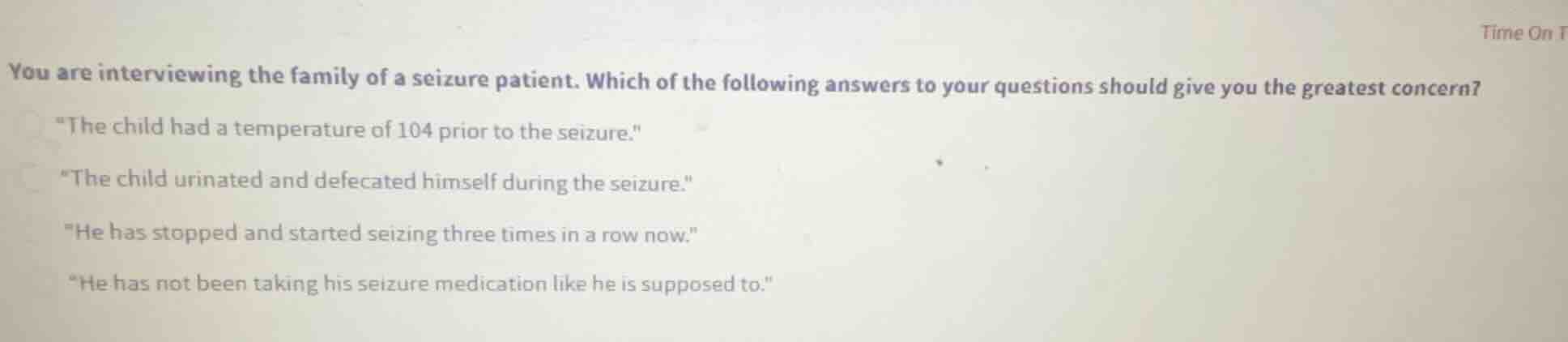
you are interviewing the family of a seizure patient. which of the following answers to your questions should give you the greatest concern?
\the child had a temperature of 104 prior to the seizure.\
\the child urinated and defecated himself during the seizure.\
\he has stopped and started seizing three times in a row now.\
\he has not been taking his seizure medication like he is supposed to.\
<pre_analysis>
{
"quality": "clear",
"question_count": 1,
"skills_matched": [
"direct_cot",
"multiple_choice_formatter",
"explain_then_answer",
"tutor",
"mastery_adaptive_brevity"
],
"needs_drawing": false,
"concepts_used": [
"Status Epilepticus",
"Pathophysiology of Seizures"
],
"new_concepts": [],
"current_concepts": [
"Status Epilepticus",
"Pathophysiology of Seizures",
"Seizure Risk Factors"
]
}
</pre_analysis>
<reasoning>
Analyze clinical significance of each statement
Using the Pathophysiology of Seizures knowledge point:
- A temperature of \(104^\circ\text{F}\) indicates a high fever, which is a common trigger for febrile seizures in pediatric patients. While concerning, it is a known, self-limiting etiology.
- Loss of bowel and bladder control (urination and defecation) is a typical autonomic manifestation during a generalized tonic-clonic seizure and does not inherently indicate an immediate life-threatening change in baseline seizure patterns.
- Non-compliance with seizure medications is a very common cause of breakthrough seizures, which requires medical management but is not an immediate, acute emergency on its own.
Identify the life-threatening emergency
Using the Status Epilepticus knowledge point
- The statement "He has stopped and started seizing three times in a row now" indicates consecutive seizures without a return to consciousness between episodes.
- This clinical presentation defines status epilepticus, a critical medical emergency that can lead to permanent brain damage, hyperthermia, and respiratory failure.
</reasoning>
<answer>
<mcq-option>"The child had a temperature of 104 prior to the seizure."</mcq-option>
<mcq-option>"The child urinated and defecated himself during the seizure."</mcq-option>
<mcq-correct>"He has stopped and started seizing three times in a row now."</mcq-correct>
<mcq-option>"He has not been taking his seizure medication like he is supposed to."</mcq-option>
</answer>
<post_analysis>
{
"subject": "Natural Science",
"question_type": "Multiple Choice",
"knowledge_point": [
"Natural Science",
"Medicine",
"Status Epilepticus"
]
}
</post_analysis>
Snap & solve any problem in the app
Get step-by-step solutions on Sovi AI
Photo-based solutions with guided steps
Explore more problems and detailed explanations
<pre_analysis>
{
"quality": "clear",
"question_count": 1,
"skills_matched": [
"direct_cot",
"multiple_choice_formatter",
"explain_then_answer",
"tutor",
"mastery_adaptive_brevity"
],
"needs_drawing": false,
"concepts_used": [
"Status Epilepticus",
"Pathophysiology of Seizures"
],
"new_concepts": [],
"current_concepts": [
"Status Epilepticus",
"Pathophysiology of Seizures",
"Seizure Risk Factors"
]
}
</pre_analysis>
<reasoning>
Analyze clinical significance of each statement
Using the Pathophysiology of Seizures knowledge point:
- A temperature of \(104^\circ\text{F}\) indicates a high fever, which is a common trigger for febrile seizures in pediatric patients. While concerning, it is a known, self-limiting etiology.
- Loss of bowel and bladder control (urination and defecation) is a typical autonomic manifestation during a generalized tonic-clonic seizure and does not inherently indicate an immediate life-threatening change in baseline seizure patterns.
- Non-compliance with seizure medications is a very common cause of breakthrough seizures, which requires medical management but is not an immediate, acute emergency on its own.
Identify the life-threatening emergency
Using the Status Epilepticus knowledge point
- The statement "He has stopped and started seizing three times in a row now" indicates consecutive seizures without a return to consciousness between episodes.
- This clinical presentation defines status epilepticus, a critical medical emergency that can lead to permanent brain damage, hyperthermia, and respiratory failure.
</reasoning>
<answer>
<mcq-option>"The child had a temperature of 104 prior to the seizure."</mcq-option>
<mcq-option>"The child urinated and defecated himself during the seizure."</mcq-option>
<mcq-correct>"He has stopped and started seizing three times in a row now."</mcq-correct>
<mcq-option>"He has not been taking his seizure medication like he is supposed to."</mcq-option>
</answer>
<post_analysis>
{
"subject": "Natural Science",
"question_type": "Multiple Choice",
"knowledge_point": [
"Natural Science",
"Medicine",
"Status Epilepticus"
]
}
</post_analysis>