QUESTION IMAGE
Question
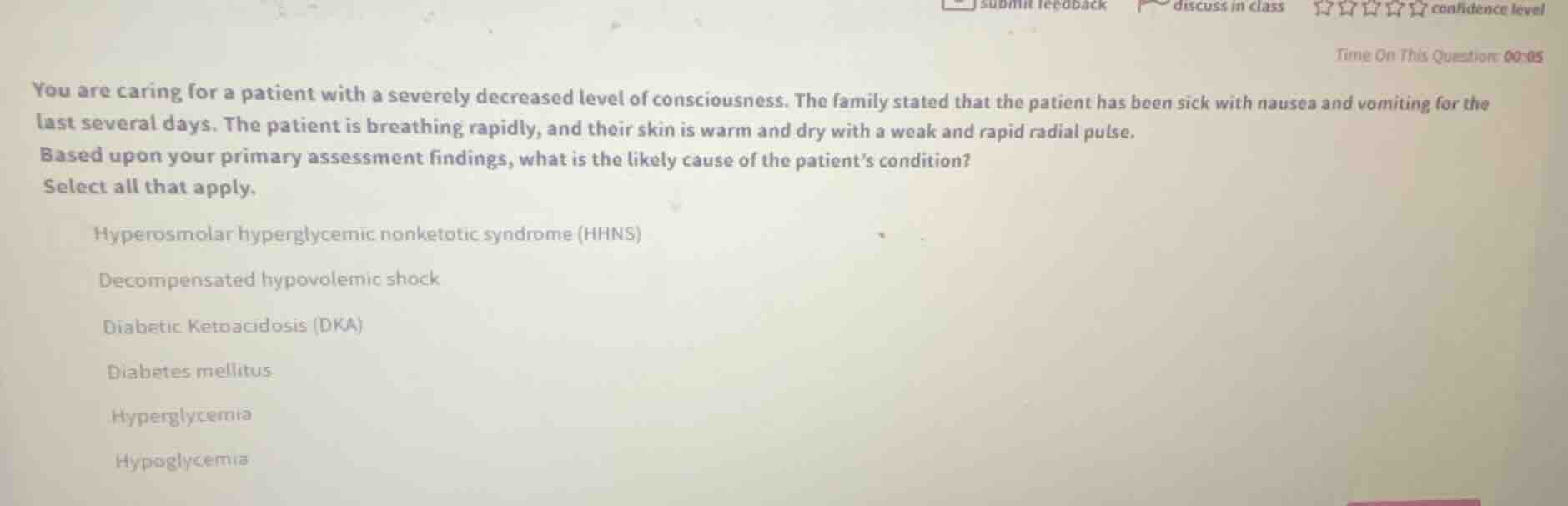
you are caring for a patient with a severely decreased level of consciousness. the family stated that the patient has been sick with nausea and vomiting for the last several days. the patient is breathing rapidly, and their skin is warm and dry with a weak and rapid radial pulse.
based upon your primary assessment findings, what is the likely cause of the patients condition?
select all that apply.
hyperosmolar hyperglycemic nonketotic syndrome (hhns)
decompensated hypovolemic shock
diabetic ketoacidosis (dka)
diabetes mellitus
hyperglycemia
hypoglycemia
<pre_analysis>
{
"quality": "clear",
"question_count": 1,
"skills_matched": [
"direct_cot",
"multiple_choice_formatter",
"explain_then_answer",
"tutor",
"mastery_adaptive_brevity"
],
"needs_drawing": false,
"concepts_used": [
"Diabetic Ketoacidosis Pathophysiology",
"Decompensated Shock",
"Hyperglycemia Symptoms"
],
"new_concepts": [
"Hyperosmolar Hyperglycemic Nonketotic Syndrome"
],
"current_concepts": [
"Diabetic Ketoacidosis Pathophysiology",
"Decompensated Shock",
"Hyperglycemia Symptoms",
"Hyperosmolar Hyperglycemic Nonketotic Syndrome"
]
}
</pre_analysis>
<reasoning>
Analyze patient presentation and history
Using the Hyperglycemia Symptoms knowledge point, we evaluate the clinical findings:
- Severely decreased level of consciousness.
- History of nausea and vomiting for several days (leads to profound dehydration).
- Rapid breathing (suggestive of Kussmaul respirations to compensate for metabolic acidosis, or respiratory compensation for shock).
- Skin is warm and dry (classic sign of dehydration from hyperglycemia/diuresis, rather than the cool, clammy skin of typical hypovolemic shock).
- Weak and rapid radial pulse (indicates circulatory compromise/shock).
Evaluate Diabetic Ketoacidosis (DKA)
Using the Diabetic Ketoacidosis Pathophysiology knowledge point:
- DKA typically presents with hyperglycemia, dehydration (warm, dry skin), nausea/vomiting, altered mental status, and rapid, deep respirations (Kussmaul breathing) to blow off carbon dioxide and compensate for metabolic acidosis.
- The patient's presentation matches DKA perfectly.
Evaluate Decompensated Shock
Using the Decompensated Shock knowledge point:
- The patient has a severely decreased level of consciousness and a weak, rapid radial pulse, indicating that compensatory mechanisms are failing to maintain adequate cerebral perfusion.
- Severe dehydration from vomiting and osmotic diuresis has led to decompensated hypovolemic shock.
Evaluate HHNS, Diabetes, and Hyperglycemia
- Hyperosmolar hyperglycemic nonketotic syndrome (HHNS): Characterized by extreme hyperglycemia, profound dehydration (warm, dry skin), and altered mental status without significant ketoacidosis (though rapid breathing can still occur due to severe shock/hypoperfusion). This is a highly likely cause.
- Diabetes mellitus: The underlying chronic disease process responsible for both DKA and HHNS.
- Hyperglycemia: The physiological state of high blood glucose that drives both DKA and HHNS, causing osmotic diuresis, dehydration, and subsequent shock.
- Hypoglycemia: Incorrect, as hypoglycemia typically presents with cool, clammy, diaphoretic skin and rapid onset, rather than warm, dry skin after days of illness.
</reasoning>
<answer>
<mcq-correct>Hyperosmolar hyperglycemic nonketotic syndrome (HHNS)</mcq-correct>
<mcq-correct>Decompensated hypovolemic shock</mcq-correct>
<mcq-correct>Diabetic Ketoacidosis (DKA)</mcq-correct>
<mcq-correct>Diabetes mellitus</mcq-correct>
<mcq-correct>Hyperglycemia</mcq-correct>
<mcq-option>Hypoglycemia</mcq-option>
</answer>
<post_analysis>
{
"subject": "Natural Science",
"question_type": "Multiple Choice",
"knowledge_point": [
"Natural Science",
"Medicine",
"Endocrine Emergencies"
]
}
</post_analysis>
Snap & solve any problem in the app
Get step-by-step solutions on Sovi AI
Photo-based solutions with guided steps
Explore more problems and detailed explanations
<pre_analysis>
{
"quality": "clear",
"question_count": 1,
"skills_matched": [
"direct_cot",
"multiple_choice_formatter",
"explain_then_answer",
"tutor",
"mastery_adaptive_brevity"
],
"needs_drawing": false,
"concepts_used": [
"Diabetic Ketoacidosis Pathophysiology",
"Decompensated Shock",
"Hyperglycemia Symptoms"
],
"new_concepts": [
"Hyperosmolar Hyperglycemic Nonketotic Syndrome"
],
"current_concepts": [
"Diabetic Ketoacidosis Pathophysiology",
"Decompensated Shock",
"Hyperglycemia Symptoms",
"Hyperosmolar Hyperglycemic Nonketotic Syndrome"
]
}
</pre_analysis>
<reasoning>
Analyze patient presentation and history
Using the Hyperglycemia Symptoms knowledge point, we evaluate the clinical findings:
- Severely decreased level of consciousness.
- History of nausea and vomiting for several days (leads to profound dehydration).
- Rapid breathing (suggestive of Kussmaul respirations to compensate for metabolic acidosis, or respiratory compensation for shock).
- Skin is warm and dry (classic sign of dehydration from hyperglycemia/diuresis, rather than the cool, clammy skin of typical hypovolemic shock).
- Weak and rapid radial pulse (indicates circulatory compromise/shock).
Evaluate Diabetic Ketoacidosis (DKA)
Using the Diabetic Ketoacidosis Pathophysiology knowledge point:
- DKA typically presents with hyperglycemia, dehydration (warm, dry skin), nausea/vomiting, altered mental status, and rapid, deep respirations (Kussmaul breathing) to blow off carbon dioxide and compensate for metabolic acidosis.
- The patient's presentation matches DKA perfectly.
Evaluate Decompensated Shock
Using the Decompensated Shock knowledge point:
- The patient has a severely decreased level of consciousness and a weak, rapid radial pulse, indicating that compensatory mechanisms are failing to maintain adequate cerebral perfusion.
- Severe dehydration from vomiting and osmotic diuresis has led to decompensated hypovolemic shock.
Evaluate HHNS, Diabetes, and Hyperglycemia
- Hyperosmolar hyperglycemic nonketotic syndrome (HHNS): Characterized by extreme hyperglycemia, profound dehydration (warm, dry skin), and altered mental status without significant ketoacidosis (though rapid breathing can still occur due to severe shock/hypoperfusion). This is a highly likely cause.
- Diabetes mellitus: The underlying chronic disease process responsible for both DKA and HHNS.
- Hyperglycemia: The physiological state of high blood glucose that drives both DKA and HHNS, causing osmotic diuresis, dehydration, and subsequent shock.
- Hypoglycemia: Incorrect, as hypoglycemia typically presents with cool, clammy, diaphoretic skin and rapid onset, rather than warm, dry skin after days of illness.
</reasoning>
<answer>
<mcq-correct>Hyperosmolar hyperglycemic nonketotic syndrome (HHNS)</mcq-correct>
<mcq-correct>Decompensated hypovolemic shock</mcq-correct>
<mcq-correct>Diabetic Ketoacidosis (DKA)</mcq-correct>
<mcq-correct>Diabetes mellitus</mcq-correct>
<mcq-correct>Hyperglycemia</mcq-correct>
<mcq-option>Hypoglycemia</mcq-option>
</answer>
<post_analysis>
{
"subject": "Natural Science",
"question_type": "Multiple Choice",
"knowledge_point": [
"Natural Science",
"Medicine",
"Endocrine Emergencies"
]
}
</post_analysis>