QUESTION IMAGE
Question
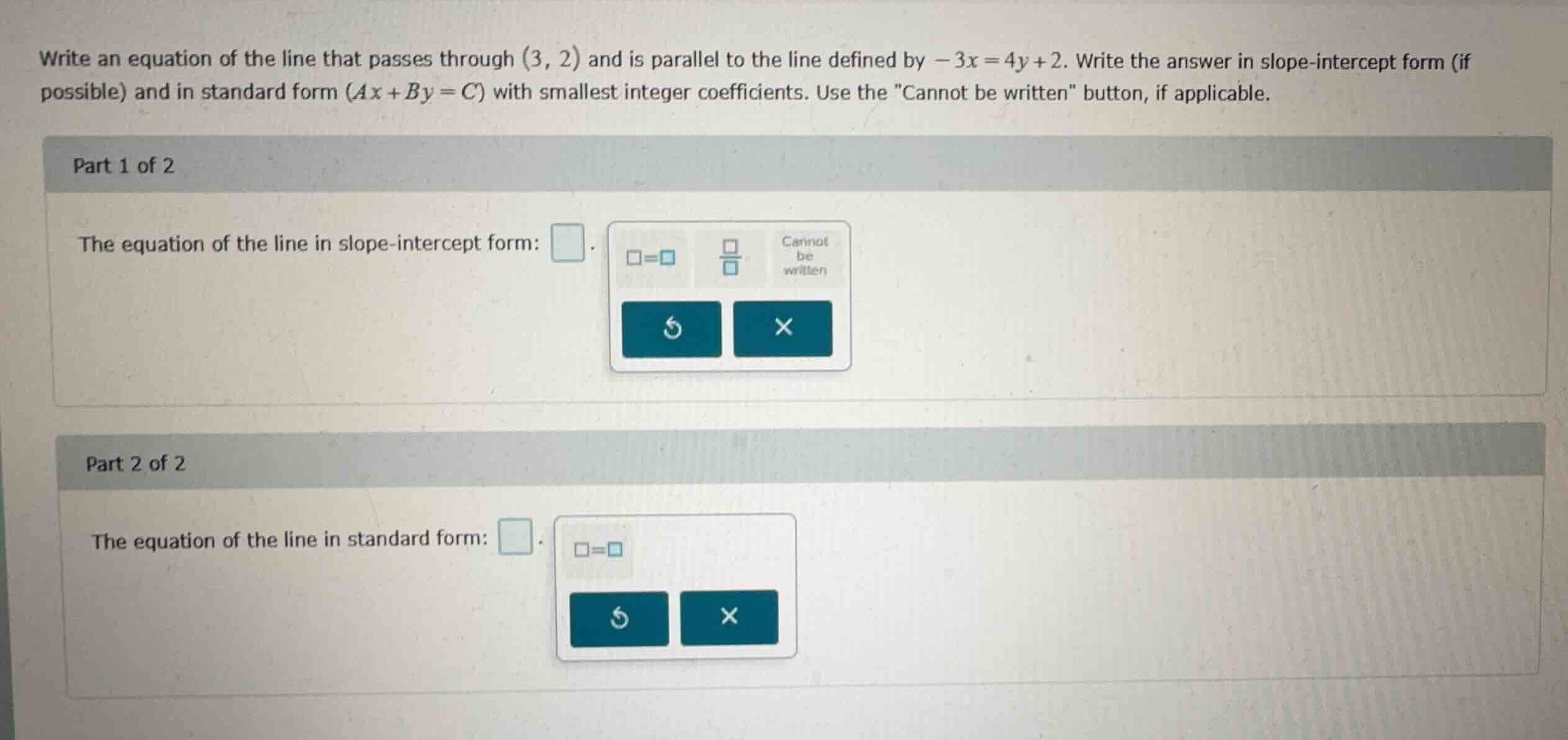
write an equation of the line that passes through \\((3, 2)\\) and is parallel to the line defined by \\(-3x = 4y + 2\\). write the answer in slope-intercept form (if possible) and in standard form (\\(ax + by = c\\)) with smallest integer coefficients. use the \cannot be written\ button, if applicable.
part 1 of 2
the equation of the line in slope-intercept form:
part 2 of 2
the equation of the line in standard form:
Step 1: Find the slope of the given line.
$$-3x = 4y + 2 \implies 4y = -3x - 2 \implies y = -\frac{3}{4}x - \frac{1}{2}$$
Step 2: Determine the parallel line's slope.
$$m = -\frac{3}{4}$$
Step 3: Use point-slope form with point \((3, 2)\).
$$y - 2 = -\frac{3}{4}(x - 3)$$
Step 4: Convert to slope-intercept form.
$$y = -\frac{3}{4}x + \frac{9}{4} + 2 \implies y = -\frac{3}{4}x + \frac{17}{4}$$
Step 5: Convert to standard form.
$$4y = -3x + 17 \implies 3x + 4y = 17$$

Snap & solve any problem in the app
Get step-by-step solutions on Sovi AI
Photo-based solutions with guided steps
Explore more problems and detailed explanations
Part 1: \(y = -\frac{3}{4}x + \frac{17}{4}\)
Part 2: \(3x + 4y = 17\)