QUESTION IMAGE
Question
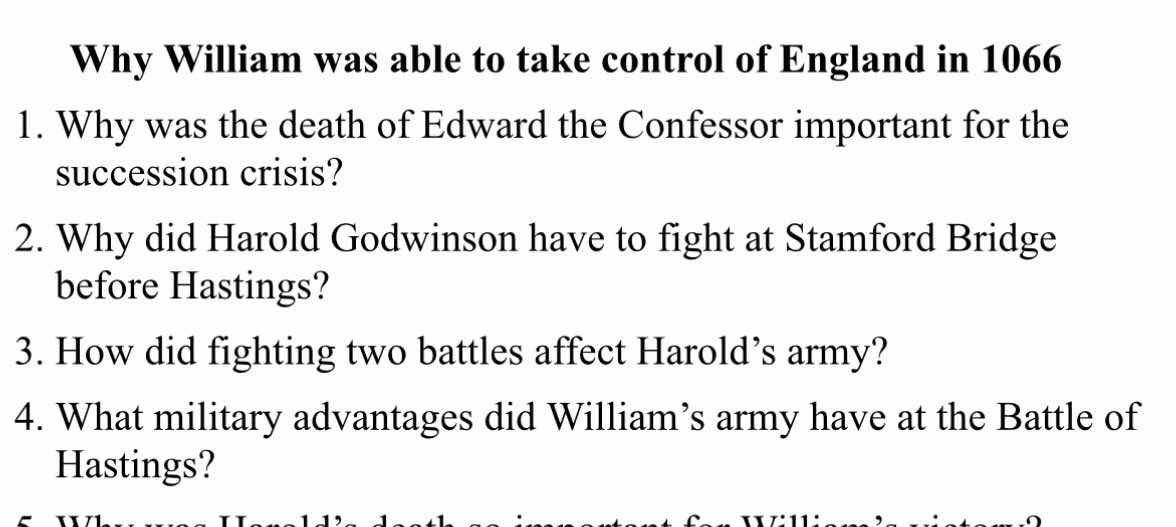
why william was able to take control of england in 1066
- why was the death of edward the confessor important for the succession crisis?
- why did harold godwinson have to fight at stamford bridge before hastings?
- how did fighting two battles affect harolds army?
- what military advantages did williams army have at the battle of hastings?
- why was harolds death so important for williams victory?
Analyze the succession crisis of 1066
The death of Edward the Confessor in January 1066 triggered a major succession crisis because he died without leaving a direct heir. This power vacuum allowed multiple claimants—including Harold Godwinson, William of Normandy, and Harald Hardrada—to assert their rights to the English throne, setting the stage for invasion and conflict.
Examine the Battle of Stamford Bridge
Harold Godwinson had to march north to fight at Stamford Bridge because England faced a dual-front invasion. Harald Hardrada, the King of Norway, allied with Harold's exiled brother Tostig and invaded Yorkshire, forcing Godwinson to rapidly defend the northern territory before dealing with the Norman threat in the south.
Assess the impact of consecutive battles
Fighting two major battles in quick succession severely weakened Harold's army. His forces had to march hundreds of miles north to Stamford Bridge, fight a grueling battle, and then immediately march all the way back south to face William, leaving his soldiers exhausted, depleted, and lacking key archers and housecarls.
Identify William's military advantages
William's army possessed several distinct tactical advantages at the Battle of Hastings. Unlike Harold's primarily infantry-based army, William utilized a highly trained cavalry (knights) and a large contingent of skilled archers, allowing him to execute flexible tactics like feigned retreats to break the Anglo-Saxon shield wall.
Evaluate the significance of Harold's death
Harold Godwinson's death during the Battle of Hastings was the decisive turning point for William's victory. It completely shattered the morale of the Anglo-Saxon army, causing their shield wall to collapse and leading to a chaotic retreat, which secured the battlefield and the crown for William.

Snap & solve any problem in the app
Get step-by-step solutions on Sovi AI
Photo-based solutions with guided steps
Explore more problems and detailed explanations
Question 1
The death of Edward the Confessor was important because he died without a direct heir, creating a power vacuum that led to competing claims for the English throne by Harold Godwinson, William of Normandy, and Harald Hardrada.
Question 2
Harold Godwinson had to fight at Stamford Bridge to defeat a rival invasion in the north led by Harald Hardrada of Norway and Tostig Godwinson, before he could turn south to face William of Normandy.
Question 3
Fighting two battles exhausted Harold's troops, caused significant casualties among his elite housecarls, and forced his army to complete two grueling, rapid marches across the length of England.
Question 4
William's army had a highly trained cavalry (knights), a strong force of archers, and a more diverse, professional force compared to Harold's predominantly infantry-based shield wall.
Question 5
Harold's death destroyed Anglo-Saxon morale, causing their defensive shield wall to break and throwing their forces into a disorganized retreat, which finalized William's victory on the battlefield.