QUESTION IMAGE
Question
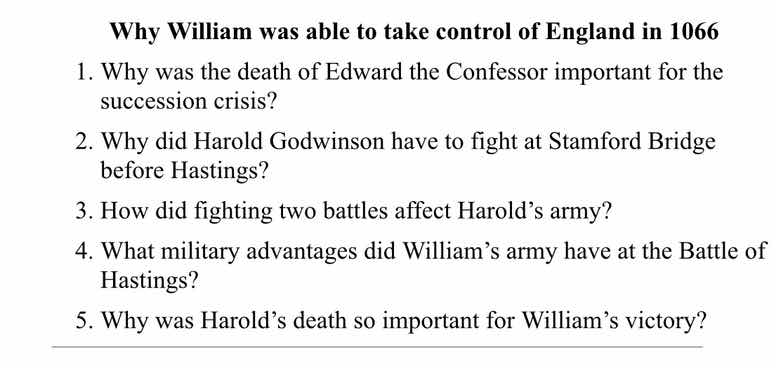
why william was able to take control of england in 1066
- why was the death of edward the confessor important for the succession crisis?
- why did harold godwinson have to fight at stamford bridge before hastings?
- how did fighting two battles affect harolds army?
- what military advantages did williams army have at the battle of hastings?
- why was harolds death so important for williams victory?
Death of Edward the Confessor
Edward died without a direct heir, triggering a Succession Crisis. This power vacuum allowed multiple claimants, including Harold Godwinson, William of Normandy, and Harald Hardrada, to contest the English throne.
Battle of Stamford Bridge
Harold Godwinson had to defend England against a northern invasion led by Harald Hardrada. This battle occurred just weeks before William landed in the south, forcing Harold to march his army hundreds of miles north to fight.
Impact of two battles
Fighting at Stamford Bridge left Harold's army exhausted, depleted, and forced to march rapidly back south. Many experienced housecarls were killed, leaving his force weakened and reliant on less-trained local militia (the fyrd) at the Battle of Hastings.
William's military advantages
William's army possessed highly trained cavalry and skilled archers, whereas Harold's army fought primarily on foot using a static shield wall. William also utilized superior tactical flexibility, including feigned retreats to break the Saxon shield wall.
Importance of Harold's death
Harold's death shattered Anglo-Saxon morale and broke their chain of command. Without their king and leader, the remaining English forces panicked, broke formation, and fled, securing William's decisive victory.

Snap & solve any problem in the app
Get step-by-step solutions on Sovi AI
Photo-based solutions with guided steps
Explore more problems and detailed explanations
Question 1
The death of Edward the Confessor was critical because he died without leaving a clear, direct heir. This created a power vacuum that triggered a major succession crisis, prompting rival claims to the English throne from Harold Godwinson, William of Normandy, and Harald Hardrada.
Question 2
Harold Godwinson had to fight at Stamford Bridge to repel a massive Viking invasion led by Harald Hardrada in the north. This forced Harold to split his attention and march his army away from the southern coast, where William of Normandy was preparing to invade.
Question 3
Fighting two battles in quick succession severely weakened Harold's army. His soldiers were physically exhausted from marching hundreds of miles north and then immediately back south, and he lost many of his elite, professional soldiers (housecarls) before facing William.
Question 4
William's army had several key military advantages, including a highly trained cavalry force and a large contingent of archers. In contrast, Harold's army lacked cavalry and relied on a static infantry shield wall, which William dismantled using tactical maneuvers like feigned retreats.
Question 5
Harold's death was decisive because it destroyed the morale and organization of the Anglo-Saxon army. Without their king and commander to lead them, the shield wall collapsed, and the remaining soldiers panicked and fled, leaving the path open for William to claim the crown.