QUESTION IMAGE
Question
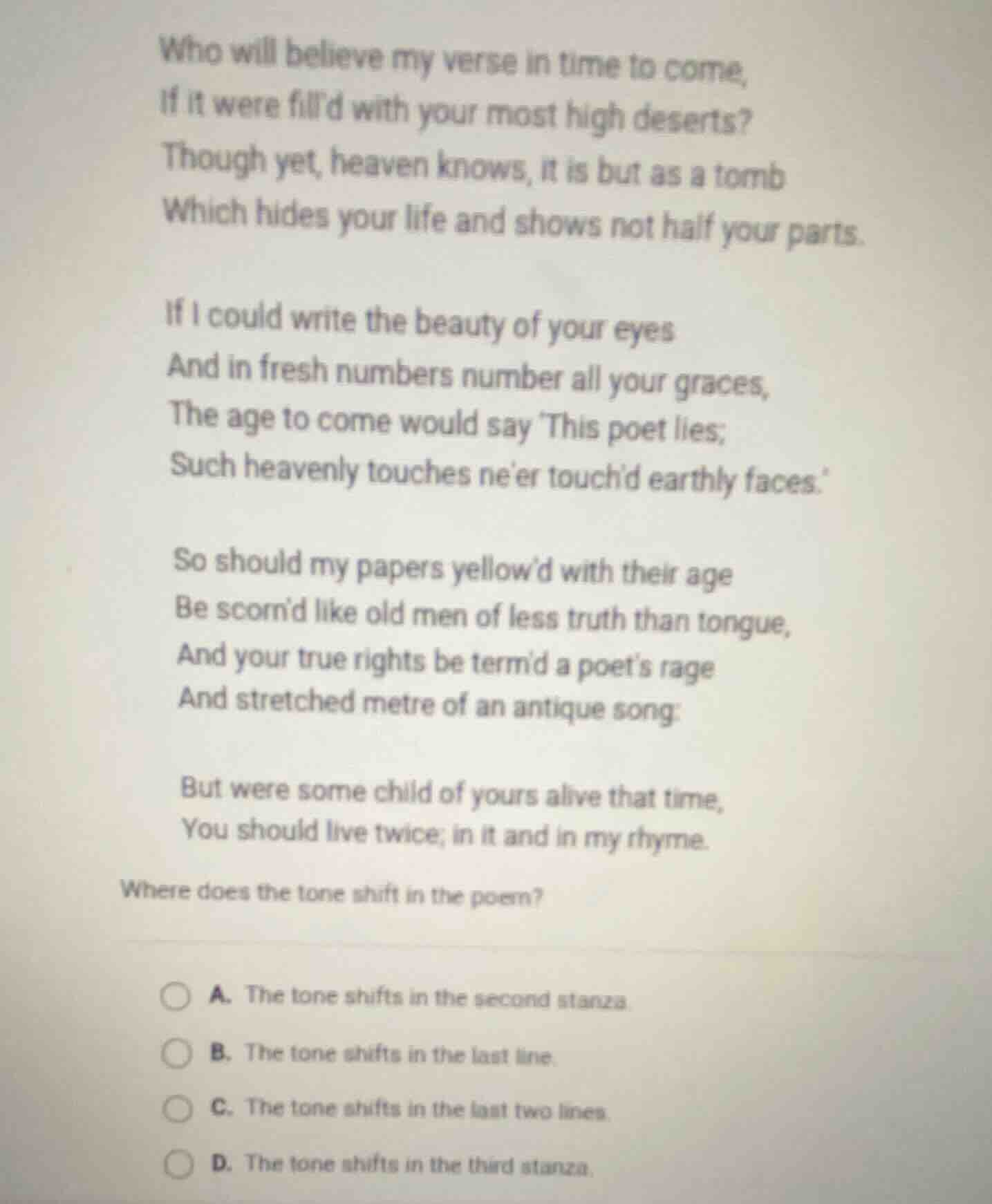
who will believe my verse in time to come,
if it were filld with your most high deserts?
though yet, heaven knows, it is but as a tomb
which hides your life and shows not half your parts.
if i could write the beauty of your eyes
and in fresh numbers number all your graces,
the age to come would say this poet lies;
such heavenly touches neer touchd earthly faces.
so should my papers yellowd with their age
be scornd like old men of less truth than tongue,
and your true rights be termd a poets rage
and stretched metre of an antique song:
but were some child of yours alive that time,
you should live twice; in it and in my rhyme.
where does the tone shift in the poem?
a. the tone shifts in the second stanza.
b. the tone shifts in the last line.
c. the tone shifts in the last two lines.
d. the tone shifts in the third stanza.
Identify the poem's structure
The text is Shakespeare's Sonnet 17. It consists of three quatrains (four-line stanzas) and a concluding rhyming couplet (two lines).
Analyze the thematic progression
The first three stanzas (lines 1–12) express doubt, melancholy, and the limitations of the poet's verse to capture the subject's true beauty. The poet fears future generations will think the descriptions are exaggerated lies.
Locate the shift in tone
Using Poetry Analysis, we look for the "volta" or turn. The final two lines (the couplet) begin with the coordinating conjunction "But," signaling a dramatic shift from despair to hope: "But were some child of yours alive that time, / You should live twice; in it and in my rhyme."
Match with textual evidence
Using Textual Evidence, the tone shifts from pessimistic doubt about the power of poetry to a hopeful resolution of immortality through biological legacy combined with art. This shift occurs precisely at the start of the final two lines (the concluding couplet).

Snap & solve any problem in the app
Get step-by-step solutions on Sovi AI
Photo-based solutions with guided steps
Explore more problems and detailed explanations
- A. The tone shifts in the second stanza.
- B. The tone shifts in the last line.
- C. The tone shifts in the last two lines. (Correct answer)
- D. The tone shifts in the third stanza.