QUESTION IMAGE
Question
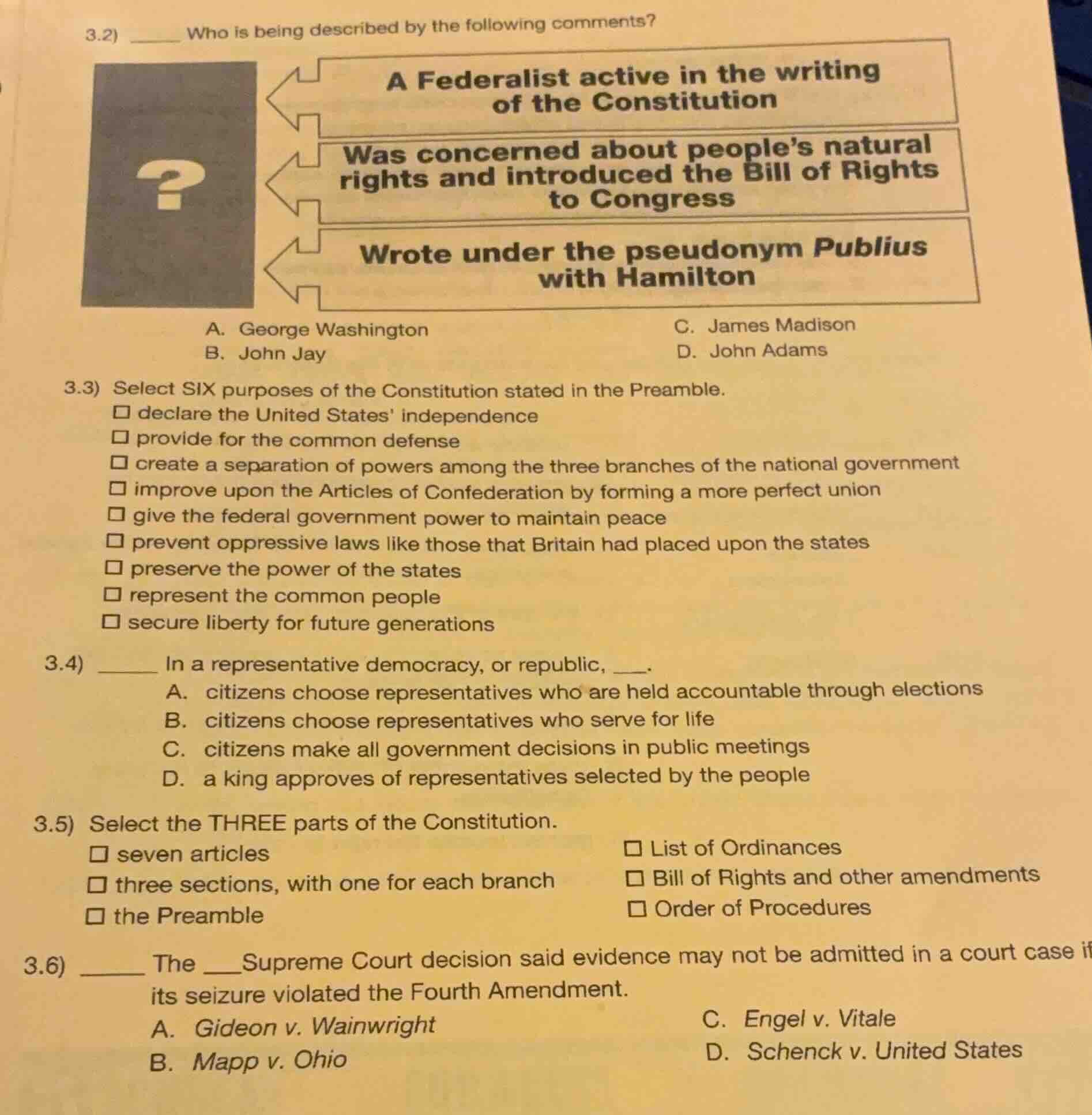
3.2) __ who is being described by the following comments? image with a question mark and three descriptions: a federalist active in the writing of the constitution; was concerned about peoples natural rights and introduced the bill of rights to congress; wrote under the pseudonym publius with hamilton a. george washington c. james madison b. john jay d. john adams 3.3) select six purposes of the constitution stated in the preamble. □ declare the united states independence □ provide for the common defense □ create a separation of powers among the three branches of the national government □ improve upon the articles of confederation by forming a more perfect union □ give the federal government power to maintain peace □ prevent oppressive laws like those that britain had placed upon the states □ preserve the power of the states □ represent the common people □ secure liberty for future generations 3.4) in a representative democracy, or republic, _. a. citizens choose representatives who are held accountable through elections b. citizens choose representatives who serve for life c. citizens make all government decisions in public meetings d. a king approves of representatives selected by the people 3.5) select the three parts of the constitution. □ seven articles □ list of ordinances □ three sections, with one for each branch □ bill of rights and other amendments □ the preamble □ order of procedures 3.6) __ the supreme court decision said evidence may not be admitted in a court case if its seizure violated the fourth amendment. a. gideon v. wainwright c. engel v. vitale b. mapp v. ohio d. schenck v. united states
3.2
- George Washington was not a writer of the Federalist Papers or the Bill of Rights sponsor. John Jay co-wrote Federalist Papers but did not lead the Bill of Rights push. John Adams was a Federalist but not part of the Federalist Papers core writers or Bill of Rights introduction. James Madison was a key Constitution writer, co-wrote Federalist Papers as Publius with Hamilton, and introduced the Bill of Rights.
3.3
- The Preamble states: "We the People of the United States, in Order to form a more perfect Union, establish Justice, insure domestic Tranquility, provide for the common defence, promote the general Welfare, and secure the Blessings of Liberty to ourselves and our Posterity, do ordain and establish this Constitution for the United States of America." The correct options align with these phrases. Independence was declared in the Declaration of Independence, separation of powers is in the main articles, not the Preamble, and the other incorrect options are not stated in the Preamble.
3.4
- A representative democracy/republic is defined by citizens electing representatives who are accountable via elections. Life-term representatives are not a feature of this system, direct citizen decision-making is direct democracy, and a king approving representatives is a monarchy/hybrid system, not a republic.
3.5
- The U.S. Constitution has three core parts: the Preamble (opening statement), seven articles (establishing government structure), and the Bill of Rights plus subsequent amendments (changes and protections). The other options are not official parts of the Constitution.
3.6
- Gideon v. Wainwright established right to counsel for indigent defendants. Engel v. Vitale banned school-sponsored prayer. Schenck v. United States set the "clear and present danger" test for free speech. Mapp v. Ohio established the exclusionary rule, stating evidence from illegal searches (violating 4th Amendment) is inadmissible in state courts.

Snap & solve any problem in the app
Get step-by-step solutions on Sovi AI
Photo-based solutions with guided steps
Explore more problems and detailed explanations
3.2) C. James Madison
3.3)
- □ provide for the common defense
- □ improve upon the Articles of Confederation by forming a more perfect union
- □ give the federal government power to maintain peace
- □ prevent oppressive laws like those that Britain had placed upon the states
- □ represent the common people
- □ secure liberty for future generations
3.4) A. citizens choose representatives who are held accountable through elections
3.5)
- □ seven articles
- □ the Preamble
- □ Bill of Rights and other amendments
3.6) B. Mapp v. Ohio