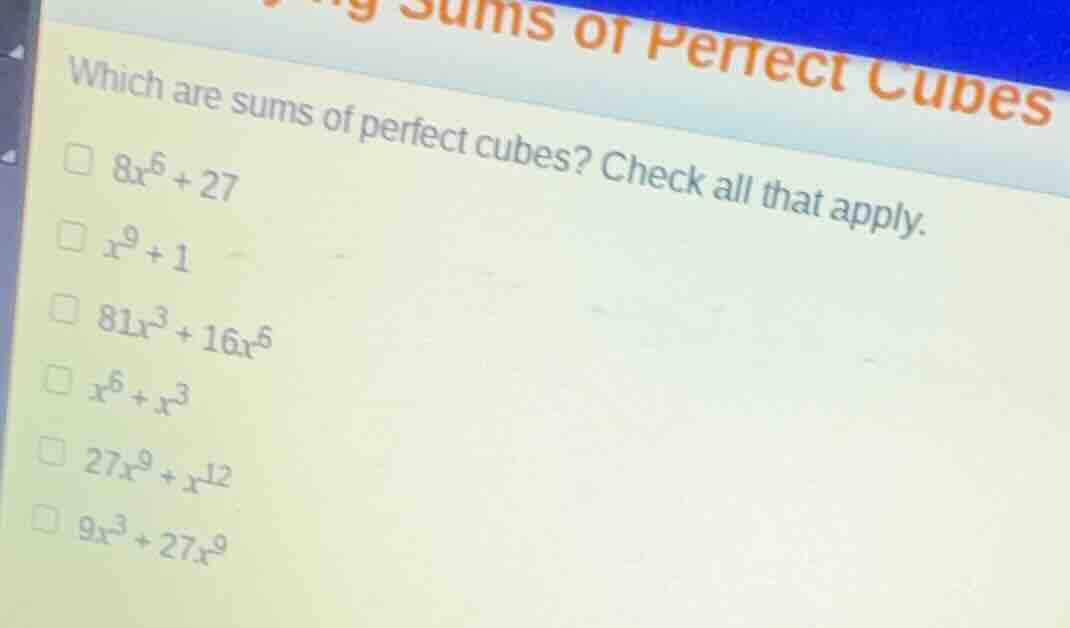
QUESTION IMAGE
Question
which are sums of perfect cubes? check all that apply.
\\(8x^6 + 27\\)
\\(x^9 + 1\\)
\\(81x^3 + 16x^6\\)
\\(x^6 + x^3\\)
\\(27x^9 + x^{12}\\)
\\(9x^3 + 27x^9\\)
<pre_analysis>
{
"quality": "clear",
"question_count": 1,
"skills_matched": [
"step_cot",
"multiple_choice_formatter",
"explain_then_answer",
"tutor"
],
"needs_drawing": false,
"concepts_used": [
"Sum of Cubes",
"Perfect Cubes"
],
"new_concepts": [],
"current_concepts": [
"Sum of Cubes",
"Perfect Cubes"
]
}
</pre_analysis>
<reasoning>
Define the conditions for a sum of perfect cubes
An algebraic expression is a sum of perfect cubes if it can be written in the form \(A^3 + B^3\), where both \(A\) and \(B\) are monomials with integer coefficients and integer exponents. For a monomial \(c x^n\) to be a perfect cube, its coefficient \(c\) must be a perfect integer cube (e.g., \(1, 8, 27, 64, \dots\)) and the exponent \(n\) of the variable must be a multiple of 3.
Analyze each option
Using the Perfect Cubes and Sum of Cubes knowledge points:
- Option 1: \(8x^6 + 27\)
- \(8x^6 = (2x^2)^3\) (since \(2^3 = 8\) and \((x^2)^3 = x^6\))
- \(27 = 3^3\)
- Both terms are perfect cubes, so this is a sum of perfect cubes.
- Option 2: \(x^9 + 1\)
- \(x^9 = (x^3)^3\)
- \(1 = 1^3\)
- Both terms are perfect cubes, so this is a sum of perfect cubes.
- Option 3: \(81x^3 + 16x^6\)
- \(81\) is not a perfect cube (\(4^3 = 64\), \(5^3 = 125\)).
- \(16\) is not a perfect cube.
- This is not a sum of perfect cubes.
- Option 4: \(x^6 + x^3\)
- \(x^6 = (x^2)^3\)
- \(x^3 = (x)^3\)
- Both terms are perfect cubes, so this is a sum of perfect cubes.
- Option 5: \(27x^9 + x^{12}\)
- \(27x^9 = (3x^3)^3\)
- \(x^{12} = (x^4)^3\)
- Both terms are perfect cubes, so this is a sum of perfect cubes.
- Option 6: \(9x^3 + 27x^9\)
- \(9\) is not a perfect cube.
- This is not a sum of perfect cubes.
</reasoning>
<answer>
<mcq-correct>(A) \(8x^6 + 27\)</mcq-correct>
<mcq-correct>(B) \(x^9 + 1\)</mcq-correct>
<mcq-option>(C) \(81x^3 + 16x^6\)</mcq-option>
<mcq-correct>(D) \(x^6 + x^3\)</mcq-correct>
<mcq-correct>(E) \(27x^9 + x^{12}\)</mcq-correct>
<mcq-option>(F) \(9x^3 + 27x^9\)</mcq-option>
</answer>
<post_analysis>
{
"subject": "Mathematics",
"question_type": "Multiple Choice",
"knowledge_point": [
"Mathematics",
"Algebra",
"Sum of Cubes"
]
}
</post_analysis>
Snap & solve any problem in the app
Get step-by-step solutions on Sovi AI
Photo-based solutions with guided steps
Explore more problems and detailed explanations
<pre_analysis>
{
"quality": "clear",
"question_count": 1,
"skills_matched": [
"step_cot",
"multiple_choice_formatter",
"explain_then_answer",
"tutor"
],
"needs_drawing": false,
"concepts_used": [
"Sum of Cubes",
"Perfect Cubes"
],
"new_concepts": [],
"current_concepts": [
"Sum of Cubes",
"Perfect Cubes"
]
}
</pre_analysis>
<reasoning>
Define the conditions for a sum of perfect cubes
An algebraic expression is a sum of perfect cubes if it can be written in the form \(A^3 + B^3\), where both \(A\) and \(B\) are monomials with integer coefficients and integer exponents. For a monomial \(c x^n\) to be a perfect cube, its coefficient \(c\) must be a perfect integer cube (e.g., \(1, 8, 27, 64, \dots\)) and the exponent \(n\) of the variable must be a multiple of 3.
Analyze each option
Using the Perfect Cubes and Sum of Cubes knowledge points:
- Option 1: \(8x^6 + 27\)
- \(8x^6 = (2x^2)^3\) (since \(2^3 = 8\) and \((x^2)^3 = x^6\))
- \(27 = 3^3\)
- Both terms are perfect cubes, so this is a sum of perfect cubes.
- Option 2: \(x^9 + 1\)
- \(x^9 = (x^3)^3\)
- \(1 = 1^3\)
- Both terms are perfect cubes, so this is a sum of perfect cubes.
- Option 3: \(81x^3 + 16x^6\)
- \(81\) is not a perfect cube (\(4^3 = 64\), \(5^3 = 125\)).
- \(16\) is not a perfect cube.
- This is not a sum of perfect cubes.
- Option 4: \(x^6 + x^3\)
- \(x^6 = (x^2)^3\)
- \(x^3 = (x)^3\)
- Both terms are perfect cubes, so this is a sum of perfect cubes.
- Option 5: \(27x^9 + x^{12}\)
- \(27x^9 = (3x^3)^3\)
- \(x^{12} = (x^4)^3\)
- Both terms are perfect cubes, so this is a sum of perfect cubes.
- Option 6: \(9x^3 + 27x^9\)
- \(9\) is not a perfect cube.
- This is not a sum of perfect cubes.
</reasoning>
<answer>
<mcq-correct>(A) \(8x^6 + 27\)</mcq-correct>
<mcq-correct>(B) \(x^9 + 1\)</mcq-correct>
<mcq-option>(C) \(81x^3 + 16x^6\)</mcq-option>
<mcq-correct>(D) \(x^6 + x^3\)</mcq-correct>
<mcq-correct>(E) \(27x^9 + x^{12}\)</mcq-correct>
<mcq-option>(F) \(9x^3 + 27x^9\)</mcq-option>
</answer>
<post_analysis>
{
"subject": "Mathematics",
"question_type": "Multiple Choice",
"knowledge_point": [
"Mathematics",
"Algebra",
"Sum of Cubes"
]
}
</post_analysis>