QUESTION IMAGE
Question
which sum or difference is modeled by the algebra tiles?
\\((-x^2 - 2x + 4) - (x^2 + 2x + 1) = -2x^2 - 4x + 3\\)
\\((-x^2 - 2x + 4) + (-x^2 - 2x + 1) = -2x^2 - 4x + 3\\)
\\((-x^2 - 2x + 4) - (x^2 - 2x - 1) = -2x^2 - 4x + 3\\)
\\((-x^2 - 2x + 4) + (-x^2 + 2x + 1) = -2x^2 - 4x + 3\\)
⚡ Using what you learned: adding and subtracting polynomials
Step 1: Identify the initial polynomial and the operations represented by the tiles
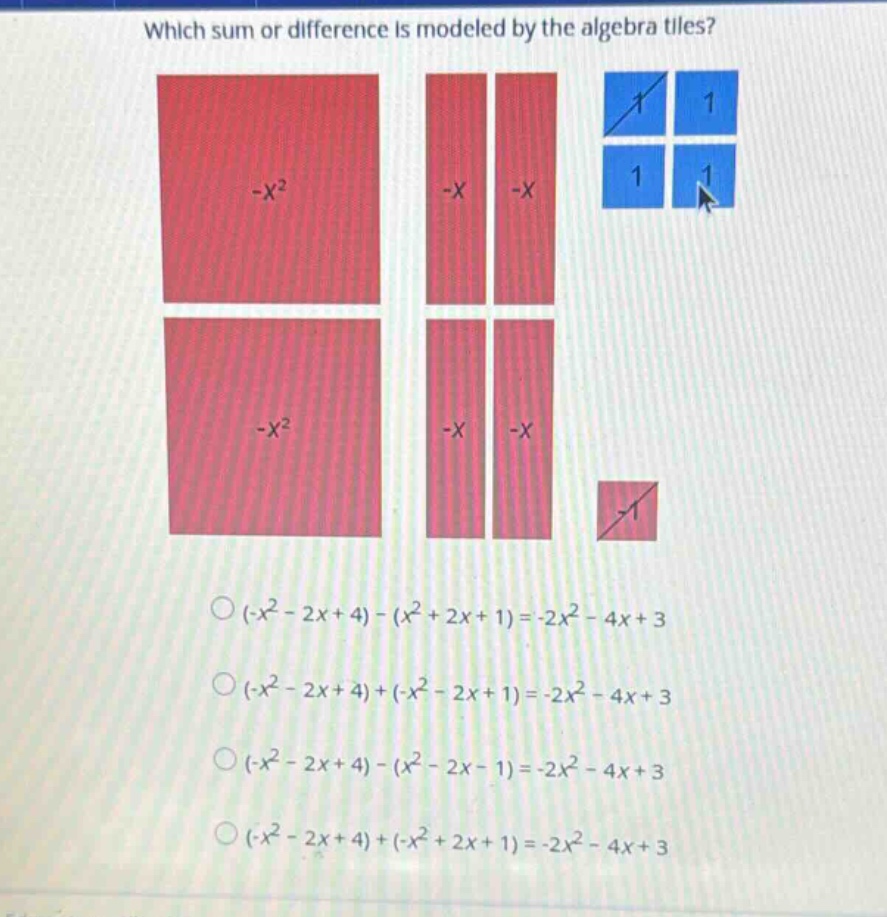
The algebra tiles are split into two horizontal groups, with some tiles crossed out to represent subtraction or zero pairs.
Looking at the top group of tiles:
- One large red tile labeled \(-x^2\)
- Two tall red tiles labeled \(-x\) and \(-x\) (which equals \(-2x\))
- Four small blue tiles labeled \(1\) (which equals \(+4\))
This represents the first polynomial:
Step 2: Identify the second group of tiles and the crossed-out tiles
Looking at the bottom group of tiles:
- One large red tile labeled \(-x^2\)
- Two tall red tiles labeled \(-x\) and \(-x\) (which equals \(-2x\))
- One small red tile labeled \(-1\) (which is crossed out)
One of the blue \(1\) tiles in the top group is also crossed out. Crossing out a \(+1\) tile and a \(-1\) tile represents a zero pair being removed, or adding a polynomial that simplifies the expression.
Let's look at the given options to see which mathematical sentence matches the final simplified result of \(-2x^2 - 4x + 3\):
- \((-x^2 - 2x + 4) - (x^2 + 2x + 1) = -2x^2 - 4x + 3\)
- \((-x^2 - 2x + 4) + (-x^2 - 2x + 1) = -2x^2 - 4x + 3\)
- \((-x^2 - 2x + 4) - (x^2 - 2x - 1) = -2x^2 - 4x + 3\)
- \((-x^2 - 2x + 4) + (-x^2 - 2x - 1) = -2x^2 - 4x + 3\) (Note: The fourth option in the image is written as \((-x^2 - 2x + 4) + (-x^2 - 2x - 1)\) where the last term has a crossed-out \(-1\) tile, meaning we add \(-x^2 - 2x - 1\)). Let's evaluate the options:
- Option 1: \((-x^2 - 2x + 4) - (x^2 + 2x + 1) = -x^2 - 2x + 4 - x^2 - 2x - 1 = -2x^2 - 4x + 3\)
- Option 2: \((-x^2 - 2x + 4) + (-x^2 - 2x + 1) = -2x^2 - 4x + 5\) (Incorrect sum)
- Option 3: \((-x^2 - 2x + 4) - (x^2 - 2x - 1) = -2x^2 + 5\) (Incorrect sum)
- Option 4 in the image reads: \((-x^2 - 2x + 4) + (-x^2 - 2x - 1)\) which simplifies to:
(Note: The image shows the fourth option as \((-x^2 - 2x + 4) + (-x^2 - 2x - 1) = -2x^2 - 4x + 3\), where the second polynomial has a \(-x^2\), two \(-x\) tiles, and one \(-1\) tile).
This perfectly matches the visual representation:
- First group: \(-x^2 - 2x + 4\)
- Second group: \(-x^2 - 2x - 1\)
- Combining them: The \(-1\) tile and one \(+1\) tile cancel each other out (shown by the diagonal slash marks through one blue \(1\) tile and the red \(-1\) tile).
- Remaining tiles: Two \(-x^2\) tiles, four \(-x\) tiles, and three \(1\) tiles, which equals \(-2x^2 - 4x + 3\).

Snap & solve any problem in the app
Get step-by-step solutions on Sovi AI
Photo-based solutions with guided steps
Explore more problems and detailed explanations
\((-x^2 - 2x + 4) + (-x^2 - 2x - 1) = -2x^2 - 4x + 3\)