QUESTION IMAGE
Question
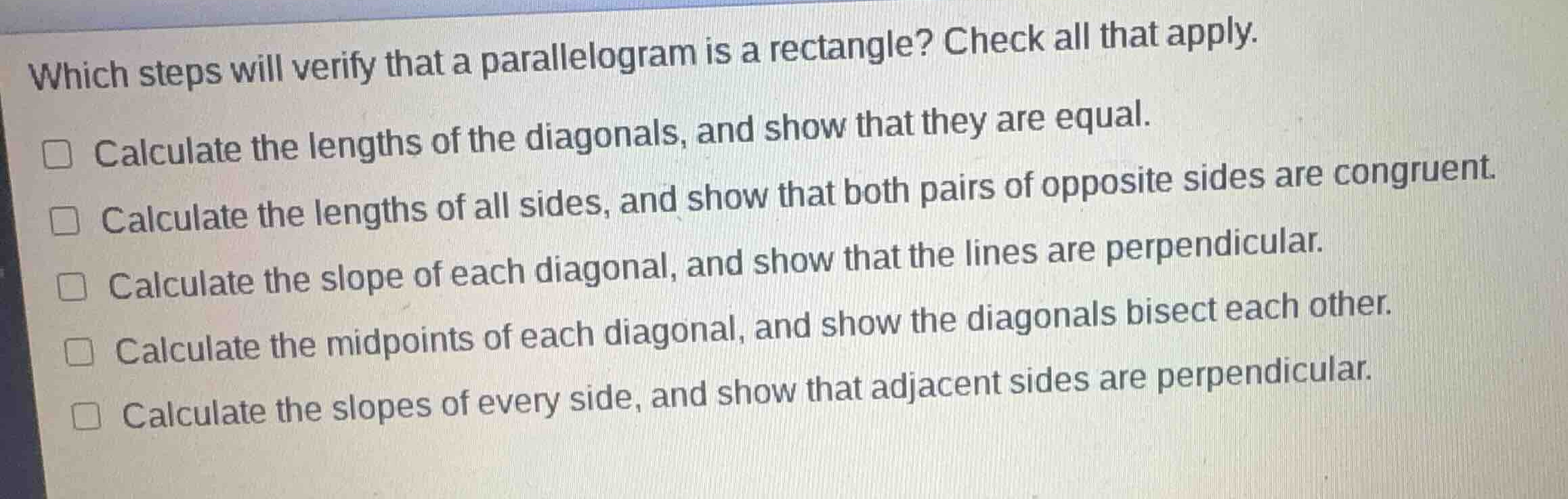
which steps will verify that a parallelogram is a rectangle? check all that apply.
calculate the lengths of the diagonals, and show that they are equal.
calculate the lengths of all sides, and show that both pairs of opposite sides are congruent.
calculate the slope of each diagonal, and show that the lines are perpendicular.
calculate the midpoints of each diagonal, and show the diagonals bisect each other.
calculate the slopes of every side, and show that adjacent sides are perpendicular.
<pre_analysis>
{
"quality": "clear",
"question_count": 1,
"skills_matched": [
"direct_cot",
"multiple_choice_formatter",
"explain_then_answer",
"tutor",
"mastery_adaptive_brevity"
],
"needs_drawing": false,
"concepts_used": [
"Proving a Parallelogram is a Rectangle",
"Properties of Rectangles"
],
"new_concepts": [],
"current_concepts": [
"Proving a Parallelogram is a Rectangle",
"Properties of Rectangles",
"Properties of Parallelograms"
]
}
</pre_analysis>
<reasoning>
Analyze the definition of a rectangle
Using the Properties of Rectangles knowledge point
A rectangle is defined as a parallelogram with four right angles. To prove a given quadrilateral that is already known to be a parallelogram is a rectangle, we must show it possesses a property unique to rectangles among general parallelograms.
Evaluate diagonal length condition
Using the Proving a Parallelogram is a Rectangle knowledge point
A key theorem states that a parallelogram is a rectangle if and only if its diagonals are congruent (equal in length). Therefore, calculating the lengths of the diagonals and showing they are equal is a valid verification step.
Evaluate opposite side length condition
Using the Properties of Parallelograms knowledge point
In any parallelogram, opposite sides are always congruent. Showing that both pairs of opposite sides are congruent only confirms the figure is a parallelogram, which is already given. It does not prove it is a rectangle.
Evaluate diagonal slope and midpoint conditions
Using the Proving a Parallelogram is a Rectangle knowledge point
Perpendicular diagonals are a property of rhombuses, not rectangles. Showing diagonals bisect each other is true for all parallelograms and does not distinguish a rectangle. Thus, these two options are incorrect.
Evaluate adjacent side slope condition
Using the Proving a Parallelogram is a Rectangle knowledge point
If adjacent sides of a parallelogram are perpendicular, they meet at a \(90^\circ\) angle. Since opposite angles in a parallelogram are equal and consecutive angles are supplementary, having one right angle guarantees all four angles are \(90^\circ\). Thus, showing adjacent sides are perpendicular verifies it is a rectangle.
</reasoning>
<answer>
<mcq-correct>Calculate the lengths of the diagonals, and show that they are equal.</mcq-correct>
<mcq-option>Calculate the lengths of all sides, and show that both pairs of opposite sides are congruent.</mcq-option>
<mcq-option>Calculate the slope of each diagonal, and show that the lines are perpendicular.</mcq-option>
<mcq-option>Calculate the midpoints of each diagonal, and show the diagonals bisect each other.</mcq-option>
<mcq-correct>Calculate the slopes of every side, and show that adjacent sides are perpendicular.</mcq-correct>
</answer>
<post_analysis>
{
"subject": "Mathematics",
"question_type": "Multiple Choice",
"knowledge_point": [
"Mathematics",
"Geometry",
"Proving a Parallelogram is a Rectangle"
]
}
</post_analysis>
Snap & solve any problem in the app
Get step-by-step solutions on Sovi AI
Photo-based solutions with guided steps
Explore more problems and detailed explanations
<pre_analysis>
{
"quality": "clear",
"question_count": 1,
"skills_matched": [
"direct_cot",
"multiple_choice_formatter",
"explain_then_answer",
"tutor",
"mastery_adaptive_brevity"
],
"needs_drawing": false,
"concepts_used": [
"Proving a Parallelogram is a Rectangle",
"Properties of Rectangles"
],
"new_concepts": [],
"current_concepts": [
"Proving a Parallelogram is a Rectangle",
"Properties of Rectangles",
"Properties of Parallelograms"
]
}
</pre_analysis>
<reasoning>
Analyze the definition of a rectangle
Using the Properties of Rectangles knowledge point
A rectangle is defined as a parallelogram with four right angles. To prove a given quadrilateral that is already known to be a parallelogram is a rectangle, we must show it possesses a property unique to rectangles among general parallelograms.
Evaluate diagonal length condition
Using the Proving a Parallelogram is a Rectangle knowledge point
A key theorem states that a parallelogram is a rectangle if and only if its diagonals are congruent (equal in length). Therefore, calculating the lengths of the diagonals and showing they are equal is a valid verification step.
Evaluate opposite side length condition
Using the Properties of Parallelograms knowledge point
In any parallelogram, opposite sides are always congruent. Showing that both pairs of opposite sides are congruent only confirms the figure is a parallelogram, which is already given. It does not prove it is a rectangle.
Evaluate diagonal slope and midpoint conditions
Using the Proving a Parallelogram is a Rectangle knowledge point
Perpendicular diagonals are a property of rhombuses, not rectangles. Showing diagonals bisect each other is true for all parallelograms and does not distinguish a rectangle. Thus, these two options are incorrect.
Evaluate adjacent side slope condition
Using the Proving a Parallelogram is a Rectangle knowledge point
If adjacent sides of a parallelogram are perpendicular, they meet at a \(90^\circ\) angle. Since opposite angles in a parallelogram are equal and consecutive angles are supplementary, having one right angle guarantees all four angles are \(90^\circ\). Thus, showing adjacent sides are perpendicular verifies it is a rectangle.
</reasoning>
<answer>
<mcq-correct>Calculate the lengths of the diagonals, and show that they are equal.</mcq-correct>
<mcq-option>Calculate the lengths of all sides, and show that both pairs of opposite sides are congruent.</mcq-option>
<mcq-option>Calculate the slope of each diagonal, and show that the lines are perpendicular.</mcq-option>
<mcq-option>Calculate the midpoints of each diagonal, and show the diagonals bisect each other.</mcq-option>
<mcq-correct>Calculate the slopes of every side, and show that adjacent sides are perpendicular.</mcq-correct>
</answer>
<post_analysis>
{
"subject": "Mathematics",
"question_type": "Multiple Choice",
"knowledge_point": [
"Mathematics",
"Geometry",
"Proving a Parallelogram is a Rectangle"
]
}
</post_analysis>