Sovi.AI - AI Math Tutor

Scan to solve math questions

QUESTION IMAGE

which sequence describes the result of increasing the number of gas par…

Question

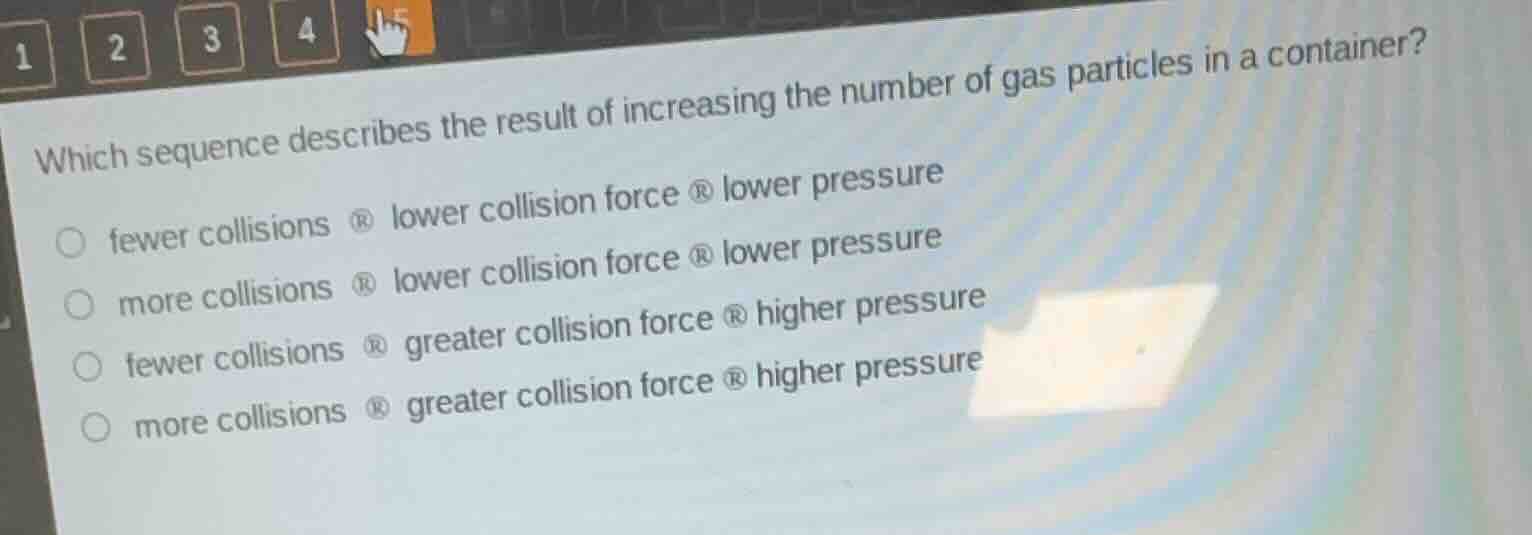
which sequence describes the result of increasing the number of gas particles in a container?

fewer collisions \\(\
ightarrow\\) lower collision force \\(\
ightarrow\\) lower pressure
more collisions \\(\
ightarrow\\) lower collision force \\(\
ightarrow\\) lower pressure
fewer collisions \\(\
ightarrow\\) greater collision force \\(\
ightarrow\\) higher pressure
more collisions \\(\
ightarrow\\) greater collision force \\(\
ightarrow\\) higher pressure

Explanation:

Response

<pre_analysis>
{
"quality": "clear",
"question_count": 1,
"skills_matched": [
"direct_cot",
"multiple_choice_formatter",
"explain_then_answer",
"quick"
],
"needs_drawing": false,
"concepts_used": [
"Gas Behavior"
],
"new_concepts": [
"Kinetic Molecular Theory",
"Gas Pressure Mechanism"
],
"current_concepts": [
"Gas Behavior",
"Kinetic Molecular Theory",
"Gas Pressure Mechanism"
]
}
</pre_analysis>

<reasoning>

Analyze the effect of increasing gas particles

Adding more gas particles to a fixed container increases the density of the gas, leading to a higher frequency of collisions between the particles and the container walls.

Analyze the resulting force and pressure

A higher frequency of collisions results in a greater cumulative collision force exerted on the container walls per unit area, which directly translates to higher pressure.
</reasoning>

<answer>
<mcq-option>fewer collisions → lower collision force → lower pressure</mcq-option>
<mcq-option>more collisions → lower collision force → lower pressure</mcq-option>
<mcq-option>fewer collisions → greater collision force → higher pressure</mcq-option>
<mcq-correct>more collisions → greater collision force → higher pressure</mcq-correct>
</answer>

<post_analysis>
{
"subject": "Natural Science",
"question_type": "Multiple Choice",
"knowledge_point": [
"Natural Science",
"Physics",
"Gas Behavior"
]
}
</post_analysis>

Answer:

<pre_analysis>
{
"quality": "clear",
"question_count": 1,
"skills_matched": [
"direct_cot",
"multiple_choice_formatter",
"explain_then_answer",
"quick"
],
"needs_drawing": false,
"concepts_used": [
"Gas Behavior"
],
"new_concepts": [
"Kinetic Molecular Theory",
"Gas Pressure Mechanism"
],
"current_concepts": [
"Gas Behavior",
"Kinetic Molecular Theory",
"Gas Pressure Mechanism"
]
}
</pre_analysis>

<reasoning>

Analyze the effect of increasing gas particles

Adding more gas particles to a fixed container increases the density of the gas, leading to a higher frequency of collisions between the particles and the container walls.

Analyze the resulting force and pressure

A higher frequency of collisions results in a greater cumulative collision force exerted on the container walls per unit area, which directly translates to higher pressure.
</reasoning>

<answer>
<mcq-option>fewer collisions → lower collision force → lower pressure</mcq-option>
<mcq-option>more collisions → lower collision force → lower pressure</mcq-option>
<mcq-option>fewer collisions → greater collision force → higher pressure</mcq-option>
<mcq-correct>more collisions → greater collision force → higher pressure</mcq-correct>
</answer>

<post_analysis>
{
"subject": "Natural Science",
"question_type": "Multiple Choice",
"knowledge_point": [
"Natural Science",
"Physics",
"Gas Behavior"
]
}
</post_analysis>