QUESTION IMAGE
Question
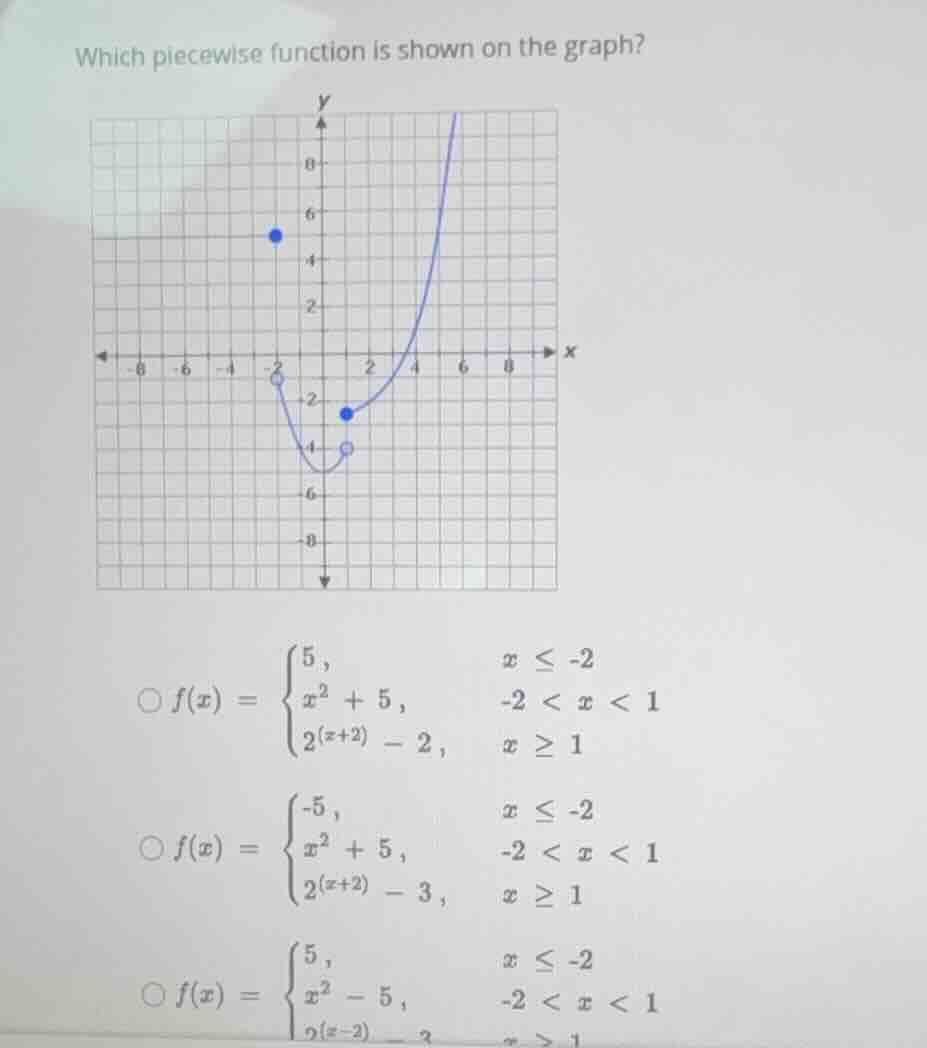
which piecewise function is shown on the graph?
\\( f(x) = \
\\)
\\( f(x) = \
\\)
\\( f(x) = \
\\)
Analyze the constant piece for \(x \le -2\)
The graph shows a single solid point at \((-2, 5)\) and no other points to the left, representing the constant function:
Analyze the quadratic piece for \(-2 < x < 1\)
The graph shows a parabola opening upwards with a vertex at \((0, -5)\) and open circles at \((-2, -1)\) and \((1, -4)\).
The equation of this parabola is:
Analyze the exponential piece for \(x \ge 1\)
The graph shows a curve starting with a solid point at \((1, -3)\) and passing through \((2, -2)\), \((3, 0)\), \((4, 4)\).
This matches the exponential function:
For example, at \(x = 1\):
At \(x = 2\):
At \(x = 3\):
Let's check the third option's formula:
This perfectly matches the third option shown in the image.

Snap & solve any problem in the app
Get step-by-step solutions on Sovi AI
Photo-based solutions with guided steps
Explore more problems and detailed explanations
- (A) \(f(x) =
\)
- (B) \(f(x) =
\)
- **(C) \(f(x) =
\) (Correct answer)**