QUESTION IMAGE
Question
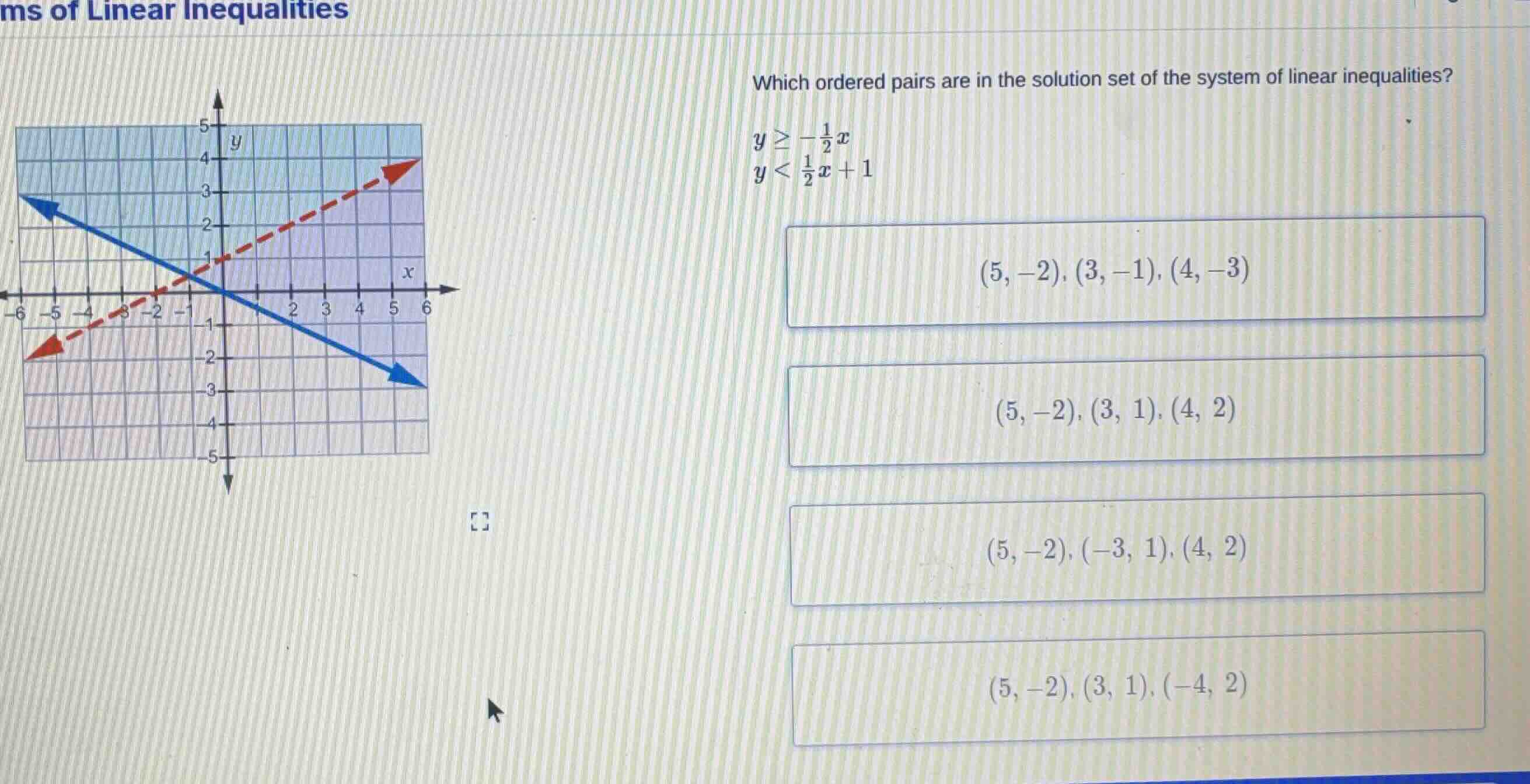
which ordered pairs are in the solution set of the system of linear inequalities?
\\\
\\
- \\((5, -2), (3, -1), (4, -3)\\)
- \\((5, -2), (3, 1), (4, 2)\\)
- \\((5, -2), (-3, 1), (4, 2)\\)
- \\((5, -2), (3, 1), (-4, 2)\\)
🆕 New Concept Discovered: Solving Systems of Linear Inequalities
Finding points that satisfy multiple inequality conditions at once
Step 1: Understand the system of inequalities
To find which ordered pairs are in the solution set, each point \( (x, y) \) must satisfy both inequalities in the system:
- \( y \geq -\frac{1}{2}x \)
- \( y < \frac{1}{2}x + 1 \)
Alternatively, we can look at the graph. The solution set is the overlapping shaded region (the purple region where both the blue and red shaded areas meet).
- The boundary line \( y = -\frac{1}{2}x \) is solid, so points on this line can be included if they satisfy the second inequality.
- The boundary line \( y = \frac{1}{2}x + 1 \) is dashed, so points on this line are not included in the solution set.
---
Step 2: Test the common point \((5, -2)\)
All four options contain the point \( (5, -2) \). Let's verify it algebraically to be sure:
- Inequality 1:
- Inequality 2:
Since both are true, \( (5, -2) \) is a valid solution.
---
Step 3: Test points from the options
Let's test the remaining points in the options to find the correct set.
Testing point \((3, 1)\):
- Inequality 1:
- Inequality 2:
Since both are true, \( (3, 1) \) is a solution. This eliminates the first option (which has \( (3, -1) \)) and the third option (which has \( (-3, 1) \)).
---
Step 4: Test the remaining candidates \((4, 2)\) and \((-4, 2)\)
We now compare the second option containing \( (4, 2) \) and the fourth option containing \( (-4, 2) \).
Testing point \((4, 2)\):
- Inequality 1:
- Inequality 2:
Since both are true, \( (4, 2) \) is a solution.
Testing point \((-4, 2)\) for comparison:
- Inequality 1:
- Inequality 2:
Since \( (-4, 2) \) fails the second inequality, it is not a solution.
---

Snap & solve any problem in the app
Get step-by-step solutions on Sovi AI
Photo-based solutions with guided steps
Explore more problems and detailed explanations