QUESTION IMAGE
Question
which ordered pair makes both inequalities true?
$y > -3x + 3$
$y \geq 2x - 2$
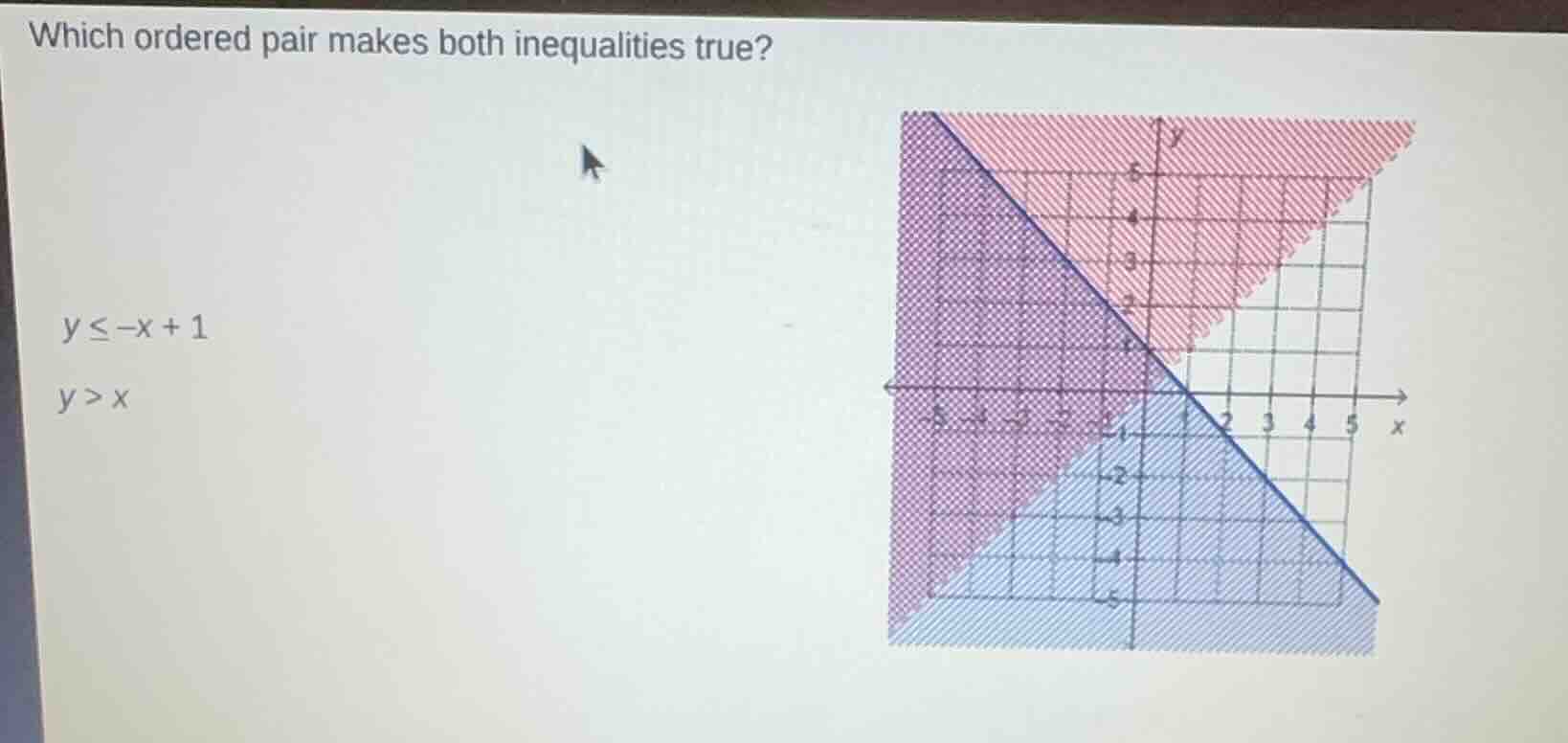
graph with x-axis from -5 to 5, y-axis from -6 to 5, showing two shaded regions and two lines: one with slope -3 and y-intercept 3 (dashed), one with slope 2 and y-intercept -2 (solid)
options:
- $(1,0)$
- $(-1,1)$
- $(2,2)$
- $(0,3)$
Step1: Test (1,0) in inequalities
First inequality: \(0 > -3(1) + 3\) → \(0 > 0\)? No.
Second inequality: \(0 \geq 2(1) - 2\) → \(0 \geq 0\)? Yes. But fails first, so reject.
Step2: Test (-1,1) in inequalities
First inequality: \(1 > -3(-1) + 3\) → \(1 > 6\)? No.
Second inequality: \(1 \geq 2(-1) - 2\) → \(1 \geq -4\)? Yes. Fails first, reject.
Step3: Test (2,2) in inequalities
First inequality: \(2 > -3(2) + 3\) → \(2 > -3\)? Yes.
Second inequality: \(2 \geq 2(2) - 2\) → \(2 \geq 2\)? Yes. Both hold? Wait, wait, let's check again. Wait, first inequality: \(y > -3x + 3\), x=2, y=2: \(2 > -6 + 3 = -3\), yes. Second: \(y \geq 2x - 2\), 2 ≥ 4 - 2 = 2, yes. Wait, but wait the graph? Wait, maybe I made a mistake. Wait, let's check (0,3).
Step4: Test (0,3) in inequalities
First inequality: \(3 > -3(0) + 3\) → \(3 > 3\)? No. Wait, no, wait: \(y > -3x + 3\), x=0, y=3: 3 > 0 + 3 → 3 > 3? No. Wait, that's not right. Wait, maybe I messed up (2,2). Wait, first inequality: \(y > -3x + 3\), x=2: -3*2 +3 = -6 +3 = -3. So y=2 > -3: yes. Second: \(y \geq 2x - 2\), x=2: 4 -2 =2. So y=2 ≥2: yes. So (2,2) works? Wait, but let's check the graph. The overlapping region (purple) should be where both are true. Let's see the lines: \(y = -3x + 3\) has y-intercept 3, slope -3. \(y = 2x - 2\) has y-intercept -2, slope 2. The intersection point: solve -3x +3 = 2x -2 → 5x=5 → x=1, y=0. So the overlapping region is above \(y = -3x + 3\) (dashed line) and above or on \(y = 2x - 2\) (solid line). Let's check each point:
(1,0): on \(y=2x -2\) (since 0=2*1 -2), but \(y > -3x +3\) → 0 > 0? No, so (1,0) is on the solid line but not above the dashed line.
(-1,1): x=-1, y=1. \(y > -3*(-1)+3 = 6\)? 1 >6? No.
(2,2): x=2, y=2. \(y > -3*2 +3 = -3\): yes. \(y \geq 2*2 -2 =2\): yes. So (2,2) is in the blue and red overlap? Wait, the red is \(y > -3x +3\), blue is \(y \geq 2x -2\). The overlap is purple. Let's see x=2, y=2: is it in purple? Let's check the graph. The line \(y=-3x +3\) at x=2 is y=-3, so above that (y=2 > -3) is red. The line \(y=2x -2\) at x=2 is y=2, so on or above (y=2 ≥2) is blue. So the overlap at x=2, y=2 is in both, so (2,2) works. Wait, but earlier (0,3): \(y > -3*0 +3\) → 3 >3? No, so (0,3) is on the line \(y=-3x +3\), but the inequality is strict (>), so (0,3) doesn't satisfy \(y > -3x +3\). So (2,2) is the correct one. Wait, but let's recheck:
For (2,2):
- \(y > -3x + 3\): \(2 > -3(2) + 3\) → \(2 > -6 + 3\) → \(2 > -3\): True.
- \(y \geq 2x - 2\): \(2 \geq 2(2) - 2\) → \(2 \geq 4 - 2\) → \(2 \geq 2\): True.
So (2,2) satisfies both.
Snap & solve any problem in the app
Get step-by-step solutions on Sovi AI
Photo-based solutions with guided steps
Explore more problems and detailed explanations
(2,2)