QUESTION IMAGE
Question
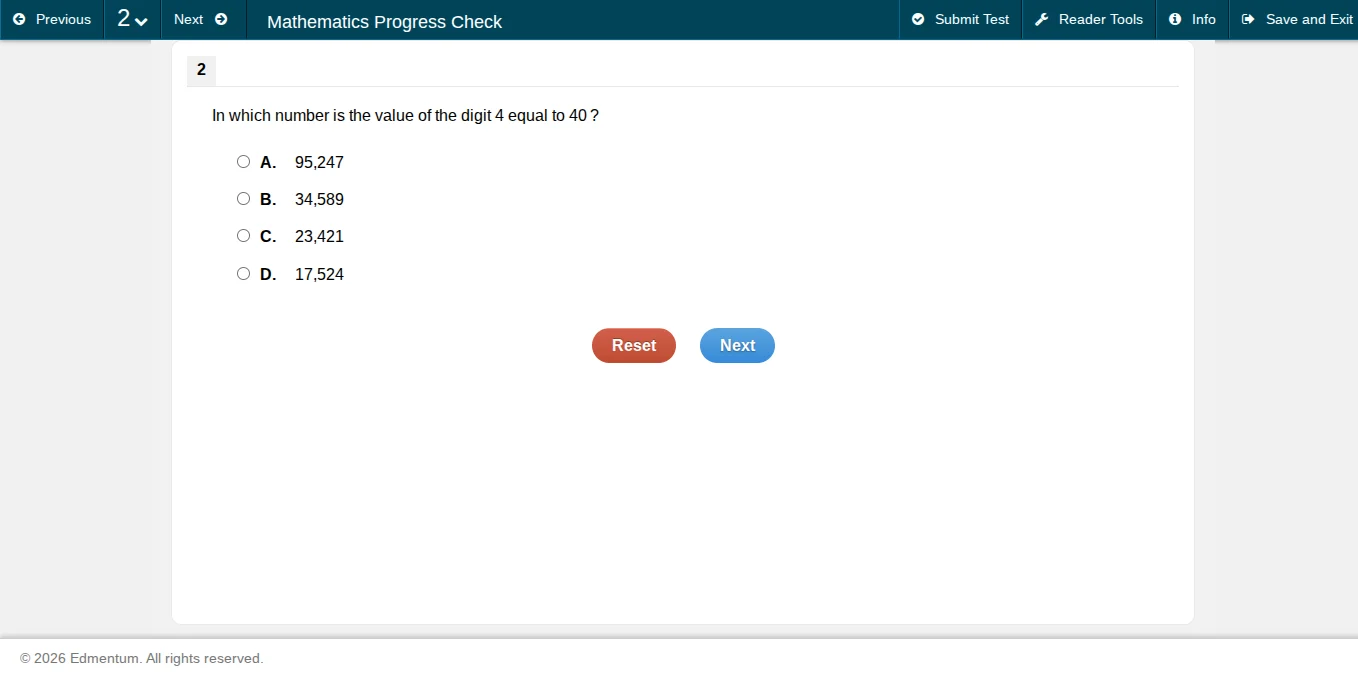
in which number is the value of the digit 4 equal to 40?
a. 95,247
b. 34,589
c. 23,421
d. 17,524
Step1: Recall place values (tens place: \(10\))
We need the digit 4 to have a value of 40. Since \(4\times10 = 40\), the digit 4 must be in the tens place (second digit from the right).
Step2: Analyze each option
- Option A: 95,247
The digit 4 is in the tens place? Let's check positions (from right: 7 (ones), 4 (tens), 2 (hundreds), 5 (thousands), 9 (ten - thousands)). Wait, no: positions (right - to - left: 1 (ones), 2 (tens), 3 (hundreds), 4 (thousands), 5 (ten - thousands)). So in 95,247: digits are 9 (ten - thousands), 5 (thousands), 2 (hundreds), 4 (tens), 7 (ones). Wait, no: 95,247 is 9 (ten - thousands), 5 (thousands), 2 (hundreds), 4 (tens), 7 (ones)? Wait, no, 95,247: \(9\times10000 + 5\times1000+2\times100 + 4\times10+7\times1\). So 4 is in tens place: \(4\times10 = 40\)? Wait, no, let's re - check other options.
- Option B: 34,589
Digits: 3 (ten - thousands), 4 (thousands), 5 (hundreds), 8 (tens), 9 (ones). So 4 is in thousands place: \(4\times1000 = 4000
eq40\).
- Option C: 23,421
Digits: 2 (ten - thousands), 3 (thousands), 4 (hundreds), 2 (tens), 1 (ones). So 4 is in hundreds place: \(4\times100 = 400
eq40\).
- Option D: 17,524
Digits: 1 (ten - thousands), 7 (thousands), 5 (hundreds), 2 (tens), 4 (ones). So 4 is in ones place: \(4\times1 = 4
eq40\).
Wait, I made a mistake earlier. Let's re - do the place values correctly.
For a number \(abcde\) (where \(a\) is ten - thousands, \(b\) is thousands, \(c\) is hundreds, \(d\) is tens, \(e\) is ones):
- Option A: 95,247 → \(a = 9\) (ten - thousands), \(b = 5\) (thousands), \(c = 2\) (hundreds), \(d = 4\) (tens), \(e = 7\) (ones). So \(d = 4\) (tens place), so value of 4 is \(4\times10=40\). Wait, but let's check again. Wait, no, 95,247: \(9\times10000 + 5\times1000+2\times100 + 4\times10+7\times1=90000 + 5000+200 + 40+7\). So the 4 is in tens place, value \(4\times10 = 40\). Wait, but let's check the other options again.
Wait, no, the correct way:
We need the digit 4 to have a value of 40, which means \(4\times10=40\), so the digit 4 must be in the tens place (the second digit from the right, i.e., the digit in the tens place, which is the 2nd position from the right).
Let's list the numbers with their digit positions (right - most is position 1 (ones), position 2 (tens), position 3 (hundreds), position 4 (thousands), position 5 (ten - thousands)):
- 95,247: digits (from right: position 1: 7, position 2: 4, position 3: 2, position 4: 5, position 5: 9). So position 2 (tens) has digit 4. So \(4\times10 = 40\).
- 34,589: from right: position 1: 9, position 2: 8, position 3: 5, position 4: 4, position 5: 3. So position 4 (thousands) has digit 4: \(4\times1000 = 4000\).
- 23,421: from right: position 1: 1, position 2: 2, position 3: 4, position 4: 3, position 5: 2. So position 3 (hundreds) has digit 4: \(4\times100 = 400\).
- 17,524: from right: position 1: 4, position 2: 2, position 3: 5, position 4: 7, position 5: 1. So position 1 (ones) has digit 4: \(4\times1 = 4\).
So the number where the digit 4 has a value of 40 is 95,247? Wait, but let's check again. Wait, maybe I messed up the numbering. Let's write each number in expanded form:
- \(95247=9\times10000 + 5\times1000+2\times100 + 4\times10+7\times1\). So the 4 is multiplied by 10, so its value is 40.
- \(34589 = 3\times10000+4\times1000 + 5\times100+8\times10 + 9\times1\). 4 is multiplied by 1000, value 4000.
- \(23421=2\times10000 + 3\times1000+4\times100+2\times10 + 1\times1\). 4 is multiplied by 100, value 400.
- \(17524=1\times10000 + 7\times1000+5\times100+2…

Snap & solve any problem in the app
Get step-by-step solutions on Sovi AI
Photo-based solutions with guided steps
Explore more problems and detailed explanations
A. 95,247