QUESTION IMAGE
Question
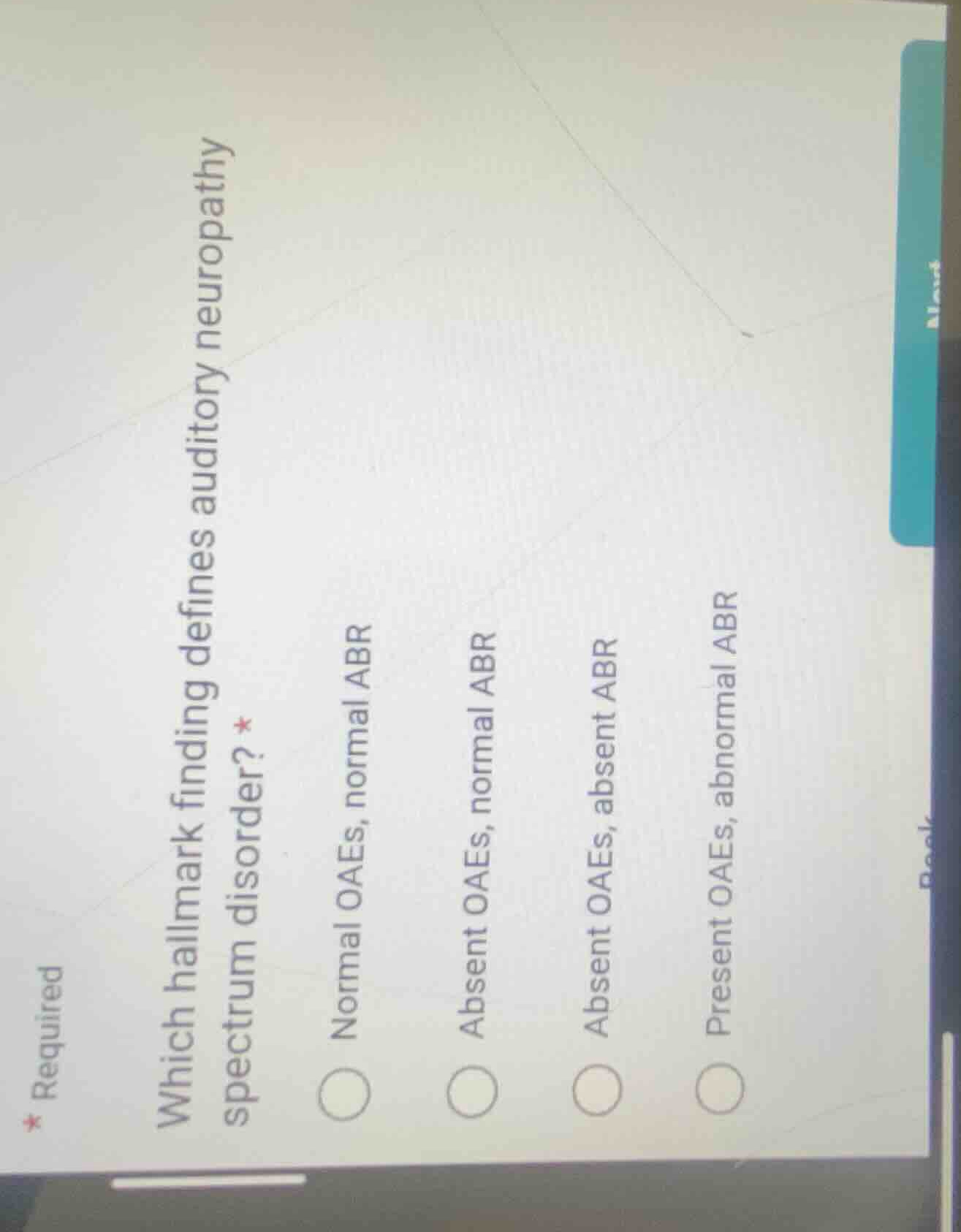
which hallmark finding defines auditory neuropathy spectrum disorder? *
normal oaes, normal abr
absent oaes, normal abr
absent oaes, absent abr
present oaes, abnormal abr
<pre_analysis>
{
"quality": "clear",
"question_count": 1,
"skills_matched": [
"direct_cot",
"multiple_choice_formatter",
"explain_then_answer",
"tutor"
],
"needs_drawing": false,
"concepts_used": [
"Auditory Brainstem Response",
"Otoacoustic Emissions"
],
"new_concepts": [
"Auditory Neuropathy Spectrum Disorder"
],
"current_concepts": [
"Auditory Brainstem Response",
"Otoacoustic Emissions",
"Auditory Neuropathy Spectrum Disorder"
]
}
</pre_analysis>
<reasoning>
Define auditory neuropathy spectrum disorder
Auditory Neuropathy Spectrum Disorder (ANSD) is a clinical condition characterized by normal outer hair cell function in the cochlea but disrupted transmission of auditory signals along the auditory nerve to the brainstem.
Analyze outer hair cell function
Using the Otoacoustic Emissions knowledge point, we know that OAEs measure the pre-neural, biomechanical activity of the outer hair cells within the cochlea. Because outer hair cell function is typically spared or normal in patients with ANSD, otoacoustic emissions are expected to be present (normal).
Analyze auditory nerve and brainstem transmission
Using the Auditory Brainstem Response knowledge point, we know that the ABR measures the synchronous neural activity along the auditory nerve and through the brainstem pathways. Because neural synchrony is disrupted or absent in ANSD, the ABR waveform is characteristically abnormal, severely degraded, or completely absent.
Compare clinical findings to options
Combining these two hallmark findings, the diagnostic profile of ANSD is characterized by:
- Present (normal) OAEs, indicating intact outer hair cell function.
- Absent or severely abnormal ABR, indicating disrupted neural synchrony.
This matches the option: "Present OAEs, abnormal ABR".
</reasoning>
<answer>
<mcq-option>Normal OAEs, normal ABR</mcq-option>
<mcq-option>Absent OAEs, normal ABR</mcq-option>
<mcq-option>Absent OAEs, absent ABR</mcq-option>
<mcq-correct>Present OAEs, abnormal ABR</mcq-correct>
</answer>
<post_analysis>
{
"subject": "Natural Science",
"question_type": "Multiple Choice",
"knowledge_point": [
"Natural Science",
"Medicine",
"Audiology"
]
}
</post_analysis>
Snap & solve any problem in the app
Get step-by-step solutions on Sovi AI
Photo-based solutions with guided steps
Explore more problems and detailed explanations
<pre_analysis>
{
"quality": "clear",
"question_count": 1,
"skills_matched": [
"direct_cot",
"multiple_choice_formatter",
"explain_then_answer",
"tutor"
],
"needs_drawing": false,
"concepts_used": [
"Auditory Brainstem Response",
"Otoacoustic Emissions"
],
"new_concepts": [
"Auditory Neuropathy Spectrum Disorder"
],
"current_concepts": [
"Auditory Brainstem Response",
"Otoacoustic Emissions",
"Auditory Neuropathy Spectrum Disorder"
]
}
</pre_analysis>
<reasoning>
Define auditory neuropathy spectrum disorder
Auditory Neuropathy Spectrum Disorder (ANSD) is a clinical condition characterized by normal outer hair cell function in the cochlea but disrupted transmission of auditory signals along the auditory nerve to the brainstem.
Analyze outer hair cell function
Using the Otoacoustic Emissions knowledge point, we know that OAEs measure the pre-neural, biomechanical activity of the outer hair cells within the cochlea. Because outer hair cell function is typically spared or normal in patients with ANSD, otoacoustic emissions are expected to be present (normal).
Analyze auditory nerve and brainstem transmission
Using the Auditory Brainstem Response knowledge point, we know that the ABR measures the synchronous neural activity along the auditory nerve and through the brainstem pathways. Because neural synchrony is disrupted or absent in ANSD, the ABR waveform is characteristically abnormal, severely degraded, or completely absent.
Compare clinical findings to options
Combining these two hallmark findings, the diagnostic profile of ANSD is characterized by:
- Present (normal) OAEs, indicating intact outer hair cell function.
- Absent or severely abnormal ABR, indicating disrupted neural synchrony.
This matches the option: "Present OAEs, abnormal ABR".
</reasoning>
<answer>
<mcq-option>Normal OAEs, normal ABR</mcq-option>
<mcq-option>Absent OAEs, normal ABR</mcq-option>
<mcq-option>Absent OAEs, absent ABR</mcq-option>
<mcq-correct>Present OAEs, abnormal ABR</mcq-correct>
</answer>
<post_analysis>
{
"subject": "Natural Science",
"question_type": "Multiple Choice",
"knowledge_point": [
"Natural Science",
"Medicine",
"Audiology"
]
}
</post_analysis>