QUESTION IMAGE
Question
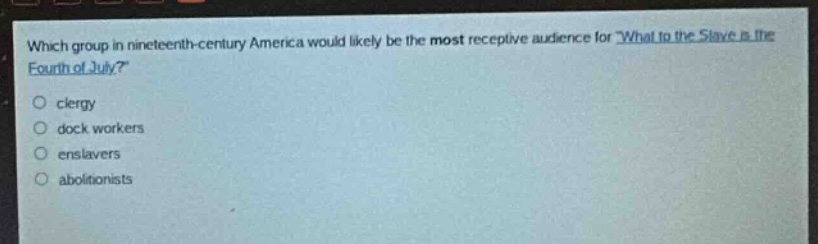
which group in nineteenth-century america would likely be the most receptive audience for \what to the slave is the fourth of july?\
clergy
dock workers
enslavers
abolitionists
🆕 New Concept Discovered: Rhetorical Analysis and Historical Context
Understanding how an author's message connects to specific historical audiences.
Step 1: Identify the core message of the text
"What to the Slave is the Fourth of July?" is a famous speech delivered by Frederick Douglass in 1852. In this speech, Douglass argues that while the Fourth of July represents freedom and independence for white Americans, it serves as a painful reminder of the ongoing injustice, cruelty, and lack of freedom experienced by enslaved African Americans.
Step 2: Analyze the potential audiences
We need to determine which group would be most supportive of and receptive to this anti-slavery, pro-liberty message:
- Clergy: Many religious leaders in the 19th century were divided on the issue of slavery, and some even used religious texts to justify it.
- Dock workers: This working-class group was generally focused on labor and economic competition, and was not organized around the cause of ending slavery.
- Enslavers: This group actively profited from and defended the institution of slavery, making them highly hostile to Douglass's message.
- Abolitionists: This group was actively dedicated to ending slavery and securing civil rights for African Americans. They would strongly agree with Douglass's critique of American hypocrisy regarding freedom.

Snap & solve any problem in the app
Get step-by-step solutions on Sovi AI
Photo-based solutions with guided steps
Explore more problems and detailed explanations
abolitionists