QUESTION IMAGE
Question
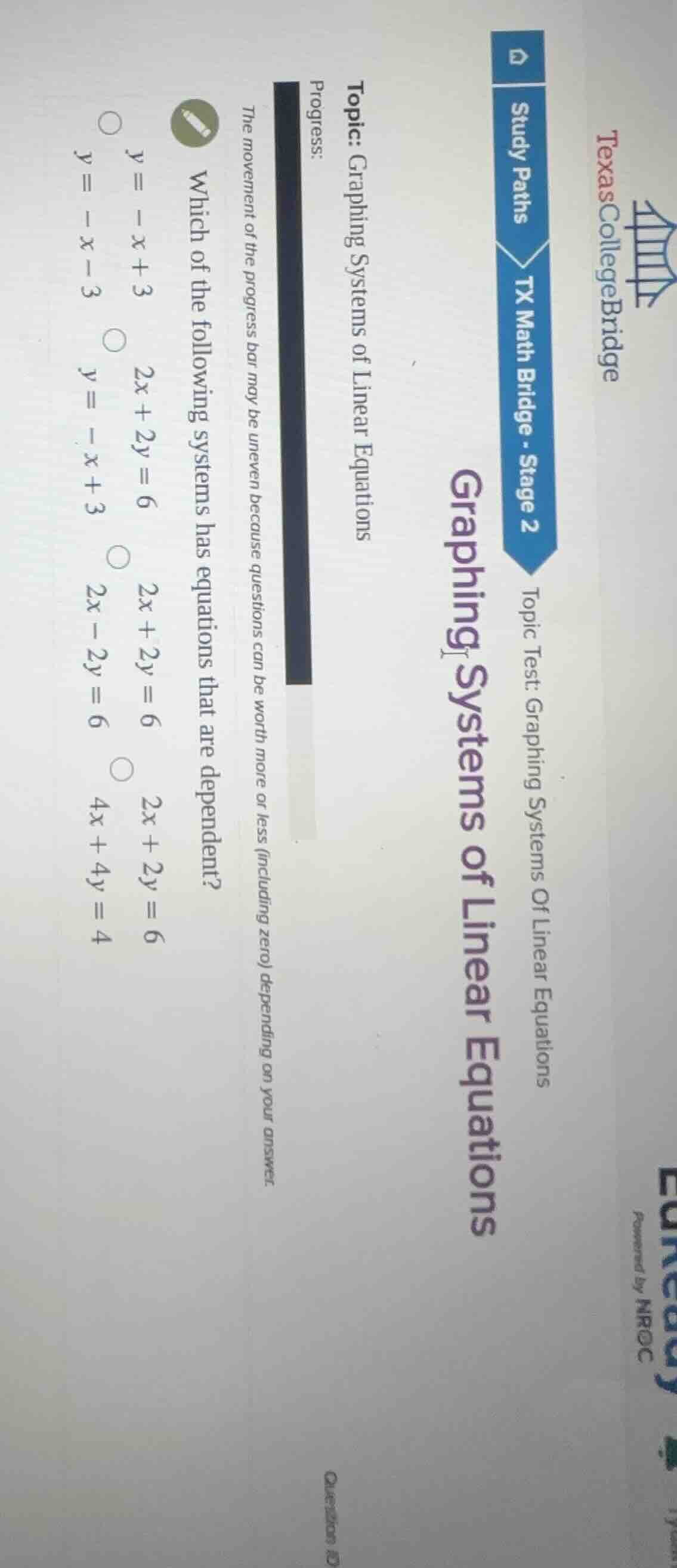
which of the following systems has equations that are dependent? \\( \
$$\begin{array}{l} y = -x + 3 \\\\ 2x + 2y = 6 \\end{array}$$
\\) \\( \
$$\begin{array}{l} y = -x + 3 \\\\ y = -x - 3 \\end{array}$$
\\) \\( \
$$\begin{array}{l} 2x + 2y = 6 \\\\ 2x - 2y = 6 \\end{array}$$
\\) \\( \
$$\begin{array}{l} 2x + 2y = 6 \\\\ 4x + 4y = 4 \\end{array}$$
\\)
Step1: Recall dependent system definition
A dependent system of linear equations has infinitely many solutions, meaning the equations are equivalent (one is a multiple of the other or can be transformed into each other).
Step2: Analyze each option
- Option 1: \( y = -x + 3 \) and \( y = -x - 3 \). These are parallel lines (same slope, different y - intercepts), so they are inconsistent (no solution), not dependent.
- Option 2: First equation \( 2x + 2y = 6 \), divide by 2: \( x + y = 3 \), solve for \( y \): \( y=-x + 3 \). The second equation is \( y=-x + 3 \). So the two equations are the same (equivalent), so this system is dependent.
- Option 3: \( 2x + 2y = 6 \) and \( 2x - 2y = 6 \). These are not equivalent (different signs on \( y \) term), so they are independent (intersect at one point).
- Option 4: \( 2x + 2y = 6 \) (divide by 2: \( x + y = 3 \)) and \( 4x + 4y = 4 \) (divide by 4: \( x + y = 1 \)). These are parallel lines (same slope, different y - intercepts), inconsistent (no solution), not dependent.

Snap & solve any problem in the app
Get step-by-step solutions on Sovi AI
Photo-based solutions with guided steps
Explore more problems and detailed explanations
\( 2x + 2y = 6 \) and \( y = -x + 3 \) (the second option in the list)