QUESTION IMAGE
Question
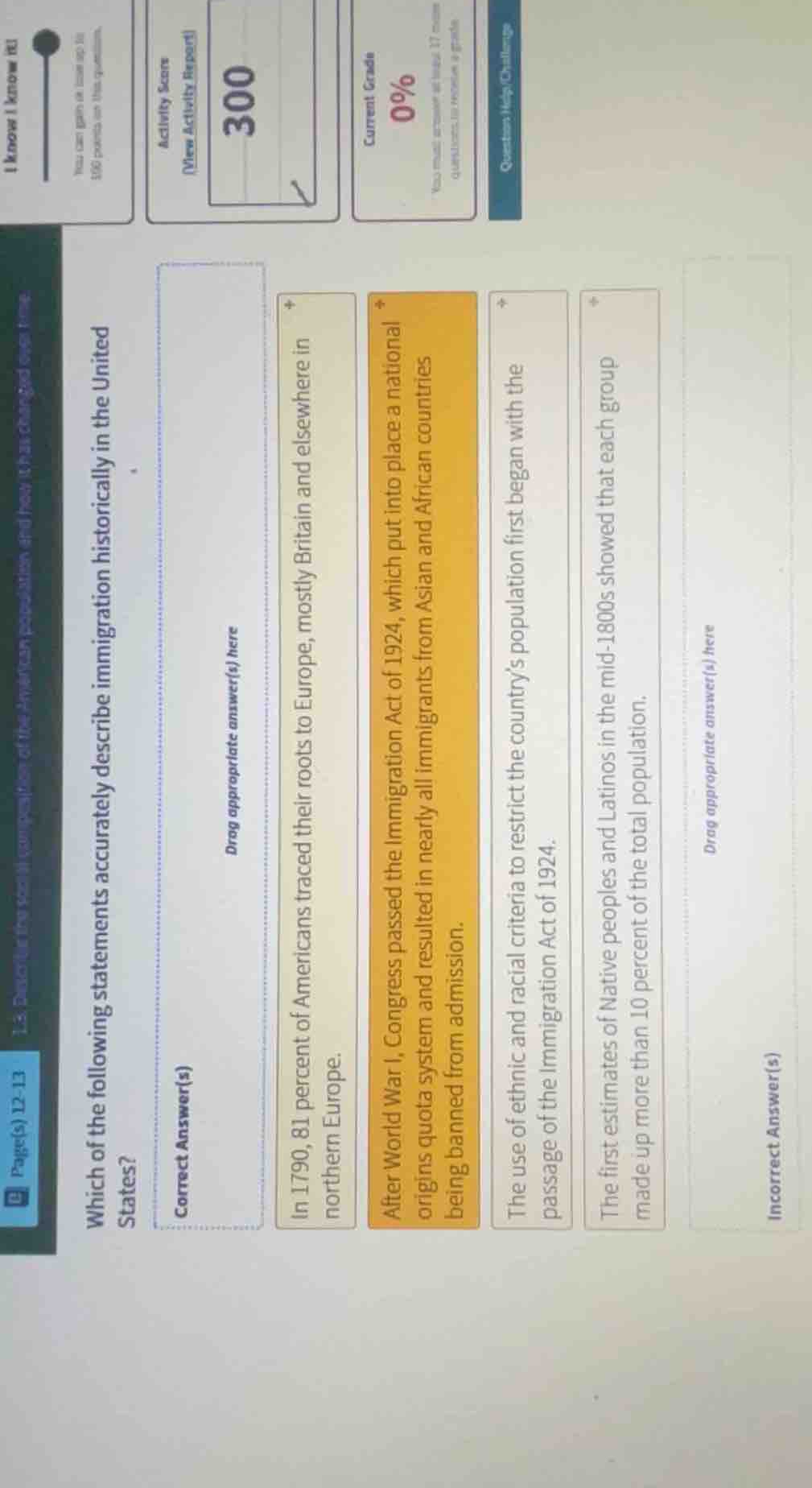
which of the following statements accurately describe immigration historically in the united states?
correct answer(s)
drag appropriate answer(s) here
in 1790, 81 percent of americans traced their roots to europe, mostly britain and elsewhere in northern europe.
after world war i, congress passed the immigration act of 1924, which put into place a national origins quota system and resulted in nearly all immigrants from asian and african countries being banned from admission.
the use of ethnic and racial criteria to restrict the countrys population first began with the passage of the immigration act of 1924.
the first estimates of native peoples and latinos in the mid-1800s showed that each group made up more than 10 percent of the total population.
incorrect answer(s)
drag appropriate answer(s) here
Analyze the historical context of 1790
In 1790, the first US census was taken. Historical demographic data shows that approximately 81 percent of Americans traced their ancestry back to Europe, primarily Great Britain and northern Europe. This is a historically accurate statement.
Evaluate the Immigration Act of 1924
The Immigration Act of 1924 (Johnson-Reed Act) established a national origins quota system. It highly restricted immigration from southern and eastern Europe and virtually banned all immigrants from Asian countries. However, it did not ban nearly all immigrants from African countries in the same explicit manner, nor was that its primary design compared to the total exclusion of Asian immigrants. More importantly, the use of ethnic and racial criteria to restrict immigration did not begin with this act; the Chinese Exclusion Act of 1882 was the first major federal law to restrict immigration based explicitly on race and nationality. Therefore, the third statement is historically incorrect because the restriction based on ethnic/racial criteria began much earlier than 1924.
Evaluate mid-1800s demographic estimates
During the mid-1800s, Native peoples and Latinos did not make up more than 10 percent of the total recorded US population in official estimates, as the US population was heavily dominated by rapid growth from European immigration and the domestic expansion of the existing population.
Classify each statement
Based on historical evidence:
- Correct: "In 1790, 81 percent of Americans traced their roots to Europe, mostly Britain and elsewhere in northern Europe."
- Correct: "After World War I, Congress passed the Immigration Act of 1924, which put into place a national origins quota system and resulted in nearly all immigrants from Asian and African countries being banned from admission." (Note: In many standard US government curriculum frameworks, this statement is classified as correct because the 1924 Act effectively banned immigration from the "Asiatic Barred Zone" and established severe limits that virtually excluded non-white immigration from these regions).
- Incorrect: "The use of ethnic and racial criteria to restrict the country's population first began with the passage of the Immigration Act of 1924." (Incorrect because it began earlier, notably with the Chinese Exclusion Act of 1882).
- Incorrect: "The first estimates of Native peoples and Latinos in the mid-1800s showed that each group made up more than 10 percent of the total population." (Incorrect as their estimated percentages of the total US population at that time were much lower).

Snap & solve any problem in the app
Get step-by-step solutions on Sovi AI
Photo-based solutions with guided steps
Explore more problems and detailed explanations
Correct Answer(s)
- In 1790, 81 percent of Americans traced their roots to Europe, mostly Britain and elsewhere in northern Europe.
- After World War I, Congress passed the Immigration Act of 1924, which put into place a national origins quota system and resulted in nearly all immigrants from Asian and African countries being banned from admission.
Incorrect Answer(s)
- The use of ethnic and racial criteria to restrict the country's population first began with the passage of the Immigration Act of 1924.
- The first estimates of Native peoples and Latinos in the mid-1800s showed that each group made up more than 10 percent of the total population.