QUESTION IMAGE
Question
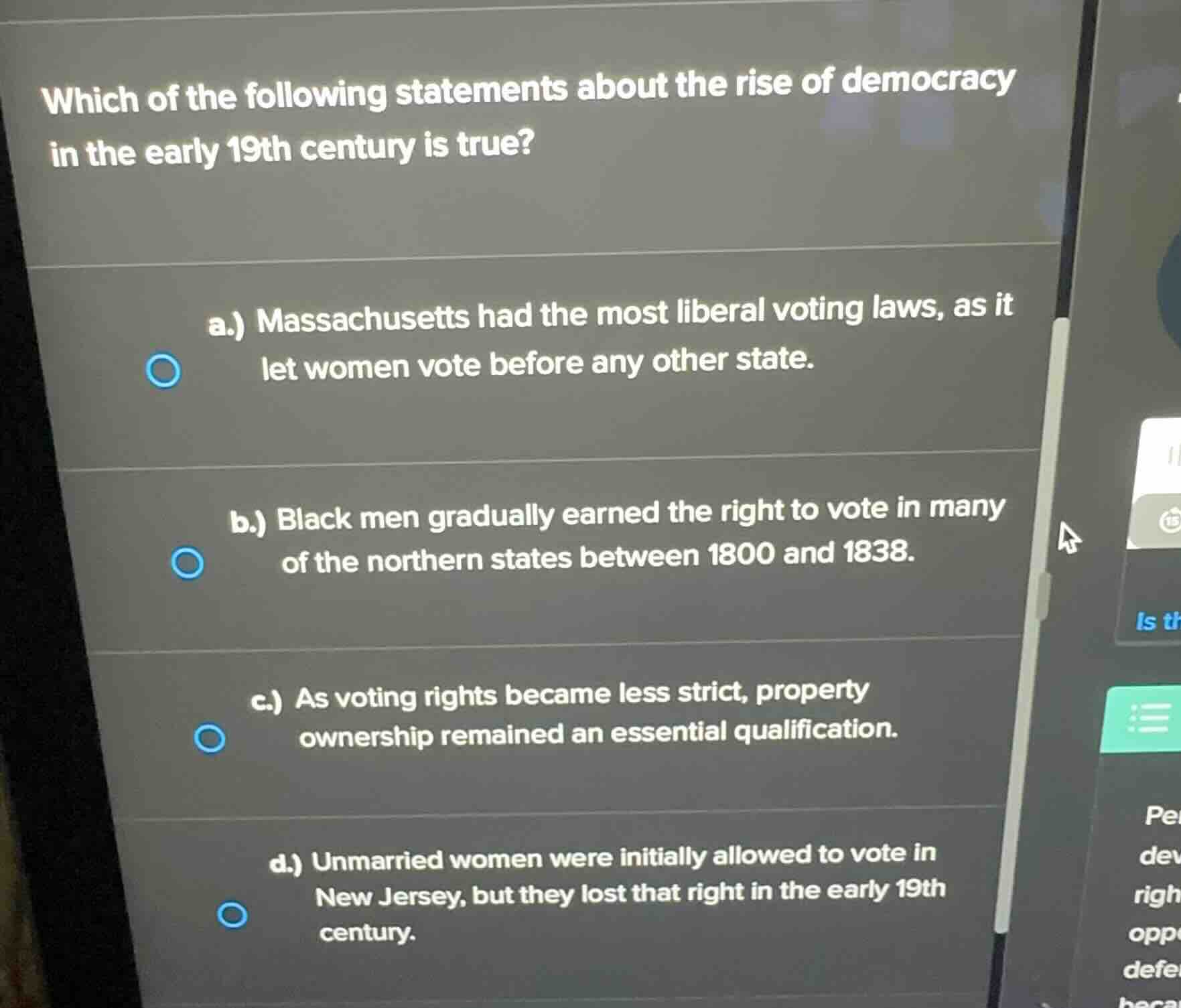
which of the following statements about the rise of democracy in the early 19th century is true?
a.) massachusetts had the most liberal voting laws, as it let women vote before any other state.
b.) black men gradually earned the right to vote in many of the northern states between 1800 and 1838.
c.) as voting rights became less strict, property ownership remained an essential qualification.
d.) unmarried women were initially allowed to vote in new jersey, but they lost that right in the early 19th century.
Analyze the historical context of early 19th-century American democracy
During the early 19th century, the United States experienced a significant expansion of the franchise for white men, a period often associated with Jacksonian Democracy. This expansion came through the gradual elimination of property qualifications for voting. However, this democratization was highly exclusionary, as it often coincided with the restriction of voting rights for women and free Black Americans.
Evaluate option A
Massachusetts did not allow women to vote in the early 19th century. The first state to allow women to vote on equal terms with men was Wyoming in 1869 (as a territory). Therefore, option A is historically incorrect.
Evaluate option B
In the early 19th century, the trend for free Black men in the North was actually the loss of voting rights rather than gaining them. As property qualifications were removed for white men, several northern states (such as New York in 1821 and Pennsylvania in 1838) explicitly disenfranchised or placed higher property restrictions specifically on Black voters. Therefore, option B is historically incorrect.
Evaluate option C
The defining feature of the rise of democracy in this era was the removal of property qualifications for white men. Property ownership did not remain an essential qualification; instead, it was widely replaced by taxpayer requirements or universal white male suffrage. Therefore, option C is historically incorrect.
Evaluate option D
New Jersey's original 1776 state constitution allowed all inhabitants who met certain property requirements to vote, which included unmarried women (widows and single women who owned property) and free Black people. However, in 1807, the New Jersey legislature passed a law that restricted the franchise exclusively to free white male citizens, stripping unmarried women of their voting rights. This matches the statement in option D.

Snap & solve any problem in the app
Get step-by-step solutions on Sovi AI
Photo-based solutions with guided steps
Explore more problems and detailed explanations
- a.) Massachusetts had the most liberal voting laws, as it let women vote before any other state.
- b.) Black men gradually earned the right to vote in many of the northern states between 1800 and 1838.
- c.) As voting rights became less strict, property ownership remained an essential qualification.
- d.) Unmarried women were initially allowed to vote in New Jersey, but they lost that right in the early 19th century. (Correct answer)